In an interview with The New York Times earlier this week, US President Donald Trump spoke about China’s claims on the island of Taiwan, calling it “a source of pride” for Chinese President Xi Jinping.
Commenting on the possibility of a Chinese attack on Taiwan, Trump said, “He considers it to be a part of China, and that’s up to him what he’s going to be doing. But I’ve expressed to him that I would be very unhappy if he did that, and I don’t think he’ll do that. I hope he doesn’t do that.”

Chinese claims on Taiwan have been made aggressively in recent years, accompanied by actions such as the massive military drills around Taiwan in late December 2025. Chinese media named Taiwan-US ties — including the US government’s latest approval of $11 billion for weapons sales — as a key reason for sending the message.
China conducted similar drills in 2022, after then Speaker of the US House of Representatives, Nancy Pelosi, visited Taiwan, which was seen as interference in its internal affairs. Such concerns go back decades.
Origins of the US-Taiwan relationship
The US-Taiwan ties have been driven by Cold War machinations, Taiwan’s material significance to the US, and its strategic interests.
The modern-day states of China and Taiwan were established in 1949, after the end of a civil war between the Communists and the Nationalist Party. The Communists won in mainland China, while the Nationalists fled to Taiwan to establish a separate government, even as both governments laid historical claims to both territories.
Today, Taiwan identifies itself as a sovereign state, while China views it as a breakaway province, fated to reunite with the “motherland”. The United States’ view is rather complex.
Story continues below this ad
During the Cold War, the US described Taiwan (officially called the Republic of China) as the legitimate government of China. However, under former US President Richard Nixon, an attempt was made to normalise ties with the Communist-led People’s Republic of China.
He viewed his 1972 visit to Beijing as a means of cultivating new leverage against the Soviet Union, after the Sino-Soviet split in the 1960s drove a rift between the former communist allies. However, it sent shockwaves across the world because Taiwan, which the US had until now supported as a bulwark of democracy against a Communist China, was now at stake.
The groundwork for this visit had been laid for years. In July 1971, then US Secretary of State Henry Kissinger undertook a secret diplomatic mission (dubbed “Polo I”) to China, where the foreign ministry assured him that “Premier Zhou Enlai would be prepared to explore all subjects.” Pakistan’s President Yahya Khan, and the communist Romania and Poland, helped facilitate conversations with Chinese officials.
According to official transcripts, Kissinger told Zhou that “For us this is an historic occasion. Because this is the first time that American and Chinese leaders are talking to each other on a basis where each country recognizes each other as equals.” He added, “As for the political future of Taiwan, we are not advocating a “Two Chinas” solution or a “One China, One Taiwan” solution.” Zhou asked, “What is the attitude of your government toward the so-called Taiwan Independence Movement?” “The Taiwanese? We would not support this,” said Kissinger.
Story continues below this ad
In his memoir, The White House Years (1979), Kissinger elaborated on the cold math of having to choose between Beijing and Taipei: “No government ever less deserved what was about to happen to it than Taiwan… But we were in a position where we had to decide which was more important: the 17 million people on Taiwan or the 800 million on the mainland.”
For China, too, the tide was turning. As it considered embarking on economic liberalisation, which would happen in 1979, there was reason to look West.
The three Communiques
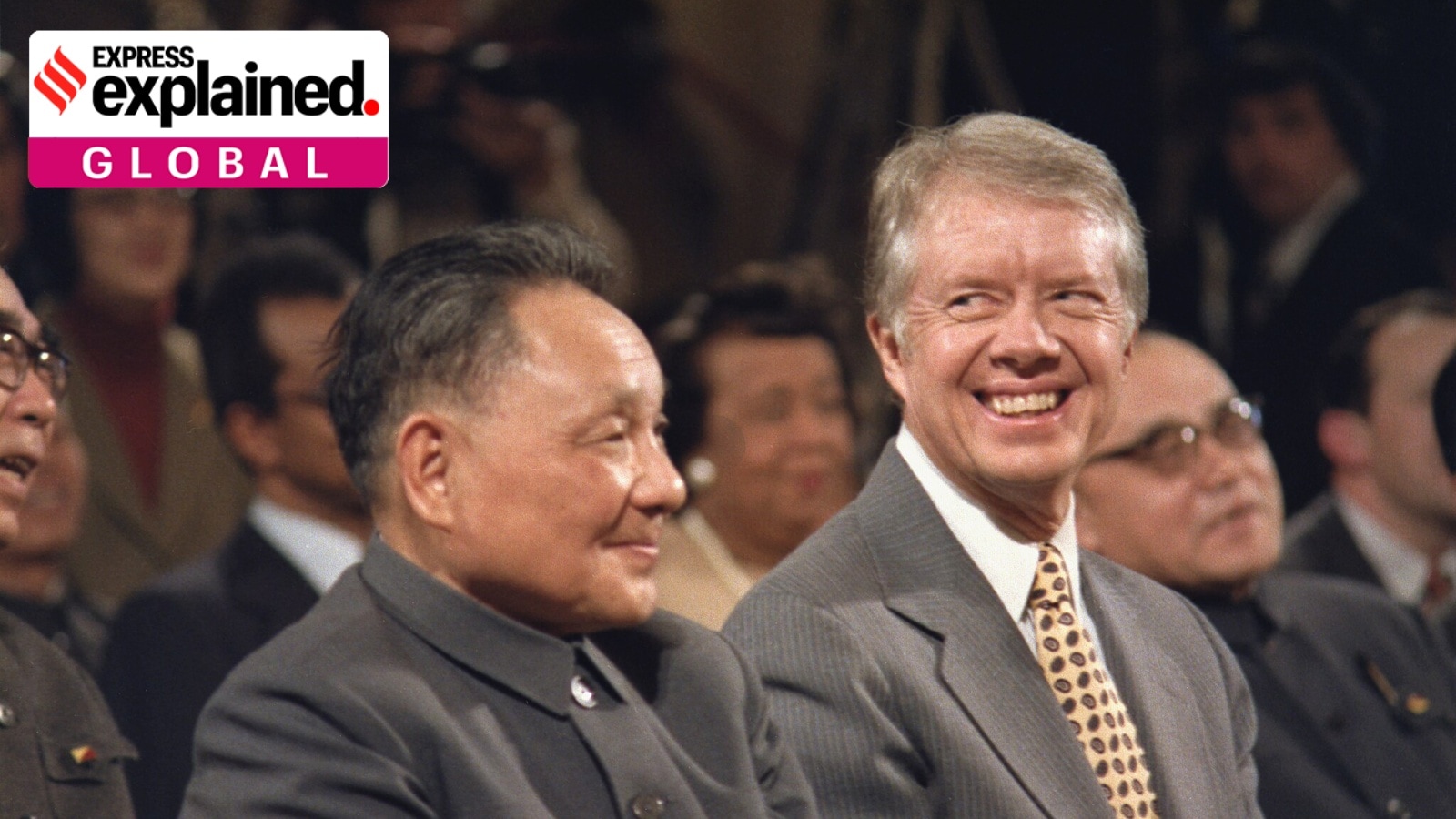
Following the Shanghai Communique of 1972, the US subscribed to a “One China Policy”, acknowledging China’s claims of Taiwan being a part of China. In 1979, under the Joint Communique signed by US President Jimmy Carter and Chinese Vice Premier Deng Xiaoping, the US formally recognised the PRC as the sole legal government of China, ending diplomatic relations with Taiwan.
Finally, in 1982, under the third communique, the US reiterated its commitment to the One China Policy and promised to gradually reduce arms sales to Taiwan, on the condition that the future of Taiwan would be decided by peaceful means. Simultaneously, then US President Ronald Reagan issued “Six Assurances” to Taiwan, largely stating that even though diplomatic ties had been severed, they would continue to support Taiwan.
Story continues below this ad
However, while China sees the three communiques as legally binding, the US views them simply as policy statements. A significant point of departure in their views can be observed in the usage of specific vocabulary. China pushes for the world to follow the ‘One China Principle’ while the US explicitly subscribes to the ‘One China Policy’.
Thus, for Beijing, there is only one China, with Taiwan as an inseparable part of it. In contrast, Washington follows a deliberately vague policy, which only acknowledges Beijing’s claim to Taiwan but does not explicitly agree to it. This also allowed the US to maintain what’s called “strategic ambiguity” on any future scenario, where it may be required to militarily help Taiwan defend itself.
Why Taiwan matters to the US
Taiwan is primarily of strategic, geopolitical and economic interest to the US.
Geopolitically, it lies on the Taiwan Strait — an important trade route for the US and its allies, such as South Korea, Japan, and Singapore. According to the US State Department, it accounts for roughly 20% of all maritime trade. Bloomberg Intelligence reported that nearly half of the world’s container fleet passes through it, including 88% of the largest containers, with the total value of goods at $2.45 trillion. If China invades Taiwan, it will be capable of creating blockades around the route.
Story continues below this ad
In addition, controlling Taiwan would increase the scope of China’s Exclusive Economic Zone, giving it control over the surrounding oceans and sea lanes of communication.
Strategically, Taiwan sits right in the middle of the first island chain, a strategic island arc of US allies (South Korea, Taiwan, Japan and the Philippines), significant for Washington to further its foreign policy and contain Beijing in the Western Pacific. Though conceptualised during the Cold War era to stop the westward expansion of communism, it has evolved into a strategy to counter China.
Economically, Taiwan accounts for 68% of the semiconductor market share. These chips are essential for manufacturing goods in industries ranging from defence to automobiles, and underpin the functioning of basic electronic goods, such as laptops and smartphones.
The think tank Council on Foreign Relations noted that, led by the Taiwan Semiconductor Manufacturing Company (TSMC), four of the largest foundries (by market share) are based in Taiwan. A disruption in the supply chain will see a spillover in dependent sectors, costing the world economy significantly.
Story continues below this ad
A recent estimate by Bloomberg economists suggests that a war in Taiwan could cost the world economy $10 trillion, or nearly 10% of the global GDP. To put it into perspective, this will be much more severe than the impact of the Covid-19 pandemic.
Under Xi Jinping, prospects of an attack have heightened. But with an unpredictable US foreign policy under Trump, there is a lack of clarity over how the country may respond, and how far it may go to defend an old ally.
The author is an intern with The Indian Express.