Last Updated:January 11, 2026, 15:54 IST
Accountability delayed is accountability denied — and in modern war, silence is never empty. It is strategic



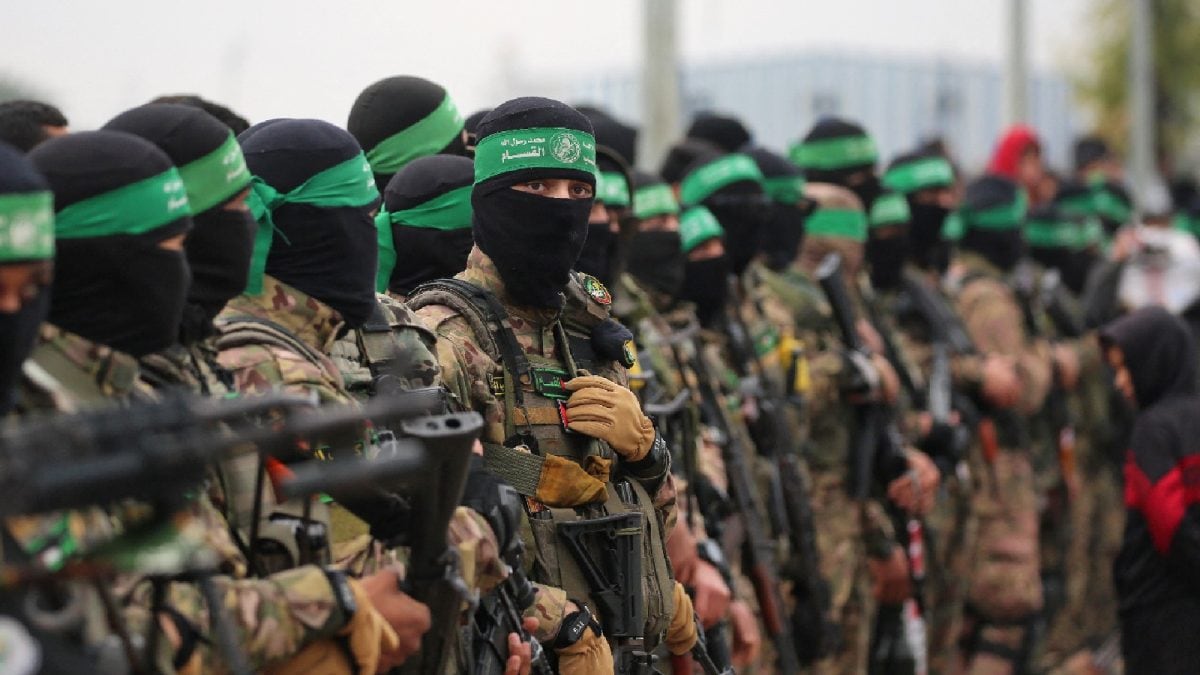
The allegations emerging from Hamas captivity must be understood as more than personal accounts of trauma. (Image: AFP)
When freed Israeli hostages began describing sexual assault during their captivity by Hamas, the disclosures landed not as isolated revelations but as disruptions. They arrived in a world already saturated with images of war in Gaza, humanitarian statistics, and hardened moral positions. Within hours, the testimonies were contested, reframed, or dismissed — not through investigation, but through narrative competition.
What followed was not simply debate over facts, but a struggle over meaning. In contemporary conflict, this struggle is decisive, because wars today are fought not only with weapons, but with testimony, silence, and selective belief.
The allegations emerging from Hamas captivity must therefore be understood as more than personal accounts of trauma. They are geopolitical events, because sexual violence, enforced silence, and denial sit at the intersection of warfare, legitimacy, and international norms. What is at stake is not only whether crimes occurred, but whether the international system still possesses the capacity and the will to apply universal standards when those standards collide with ideology, information warfare, and asymmetric power.
Sexual violence in war is not a moral abstraction. It is a legally codified strategy.
The United Nations Security Council, through Resolution 1820 and subsequent frameworks, formally recognised sexual violence as a tactic of war precisely because of its recurring, systematic use across conflicts. This recognition emerged from empirical evidence, not advocacy.
In Bosnia, the International Criminal Tribunal for the former Yugoslavia documented rape camps designed to terrorise populations and force displacement, leading to convictions for crimes against humanity. In Iraq, UN investigative teams concluded that ISIS institutionalised sexual slavery of Yazidi women, complete with bureaucratic records and threats of execution for disclosure. In Nigeria, UN and Human Rights Watch reports documented Boko Haram’s use of sexual violence to impose population control and deter resistance.
Across these conflicts, the pattern is stable: sexual violence is deployed not as excess cruelty, but as instrumental coercion. It fractures social trust, enforces silence, and leaves damage that outlasts military engagement. To place hostage testimonies within this framework is not to politicise them; it is to analyse them accurately.
The most common mechanism for undermining such testimony is delay. Why now? Why not earlier? The question is rhetorically effective precisely because it ignores the conditions of captivity. Trauma research and post-conflict documentation consistently show that survivors of sexual violence in captivity disclose months or years later, if at all.
In ISIS captivity cases, many survivors spoke publicly only after perpetrators lost territorial control. Fear of retaliation against remaining captives, family members, or oneself was cited repeatedly as the reason for silence.
Silence, in this sense, is not an evidentiary gap. It is a product of power.
From a geopolitical perspective, this matters because time advantages denial. Narrative ecosystems operate at the speed of outrage, while legal accountability operates at the speed of institutions. International tribunals require access, corroboration, political consensus, and years of procedural inertia. Social media, by contrast, requires minutes.
By the time testimony emerges, global moral positions are already entrenched. Silence buys deniability, and deniability buys legitimacy.
Hostage-taking must be understood within this informational asymmetry. Non-state armed groups no longer treat hostages primarily as bargaining assets; they treat them as instruments of cognitive warfare. Captivity generates uncertainty, emotional leverage, and narrative ambiguity that constrains state response.
Analysts at institutions such as the Washington Institute for Near East Policy have described this shift as a move from kinetic leverage to psychological and informational dominance. In this framework, testimony becomes destabilising. It reframes the conflict from politics to criminality, from resistance narratives to universal stigma. That is why silence is enforced, and why denial follows release with such immediacy.
Parallel to this dynamic runs the humanitarian narrative, which is both indispensable and vulnerable to instrumentalisation. Civilian suffering in Gaza is real and severe. War produces humanitarian catastrophe as a matter of course. Yet in contemporary conflicts, humanitarian data does not circulate in a neutral vacuum.
Famine determinations, casualty counts, and aid access assessments rely on methodologies that are complex, contested, and often revised. In Yemen, early famine declarations were later recalibrated amid disputes over sampling and access. In Syria, casualty figures varied widely depending on source and period. In Ethiopia’s Tigray conflict, humanitarian data became deeply politicised, delaying both aid delivery and accountability.
The consequence is not denial of suffering, but narrative displacement. Attention shifts from perpetrators to conditions, from acts to outcomes, from responsibility to tragedy. Humanitarian catastrophe and war crimes coexist in most conflicts; treating one as a shield against scrutiny of the other is not moral clarity, but strategic framing.
Perhaps the most destabilising effect of this narrative warfare is the erosion of universal moral standards. Feminist and human rights advocacy rests on a simple principle: survivors must be believed.
Yet in geopolitical conflicts, belief increasingly tracks ideology. Testimony that aligns with political sympathies is amplified; testimony that disrupts them is questioned, relativised, or dismissed as instrumental. This selective empathy does not protect civilians. It signals to armed groups that ideology can neutralise accountability.
International legal scholars and UN officials have repeatedly warned that selective application of norms weakens the entire system. Universalism collapses when it becomes conditional.
For global audiences — particularly in the Global South — this inconsistency is not theoretical. It fuels scepticism towards international institutions and accelerates the erosion of moral authority.
History offers no comfort here. In Rwanda, early warnings of mass violence were dismissed until genocide was undeniable. In Bosnia, systematic sexual violence was downplayed until tribunals forced recognition years later. In Iraq, ISIS crimes were fully documented only after territorial defeat made denial untenable. These failures were not born of ignorance, but of hesitation, political cost, narrative discomfort, and fear of destabilising existing alignments.
Non-state actors observe these outcomes closely. They learn that enforced silence buys time, that humanitarian framing diffuses blame, that denial delays justice, and that moral inconsistency weakens enforcement. The international system, meanwhile, remains slow, fragmented, and reactive. Investigations trail outrage. Accountability trails memory.
This is not a failure of data. It is a failure of resolve.
This analysis is not an argument for one government or against one people. It is an argument for coherence. Sexual violence cannot be relativised without consequence. Testimony cannot be dismissed as propaganda without training future abusers. And silence, when enforced, never signifies absence. It signifies power.
Wars today are fought not only over land and lives, but over meaning. If global audiences accept selective morality and narrative convenience, the cost will not be confined to this conflict. History is unforgiving on this point. Accountability delayed is accountability denied — and in modern war, silence is never empty. It is strategic.
(The author is a practising advocate. She writes articles on women’s rights, politics and law. Views expressed in the above piece are personal and solely those of the author. They do not necessarily reflect News18’s views)
First Published:
January 11, 2026, 15:54 IST
News opinion Opinion | From Hamas Captivity To Global Silence: How Hostage Testimony Exposes New Geopolitics Of WarDisclaimer: Comments reflect users’ views, not News18’s. Please keep discussions respectful and constructive. Abusive, defamatory, or illegal comments will be removed. News18 may disable any comment at its discretion. By posting, you agree to our Terms of Use and Privacy Policy.
Read More