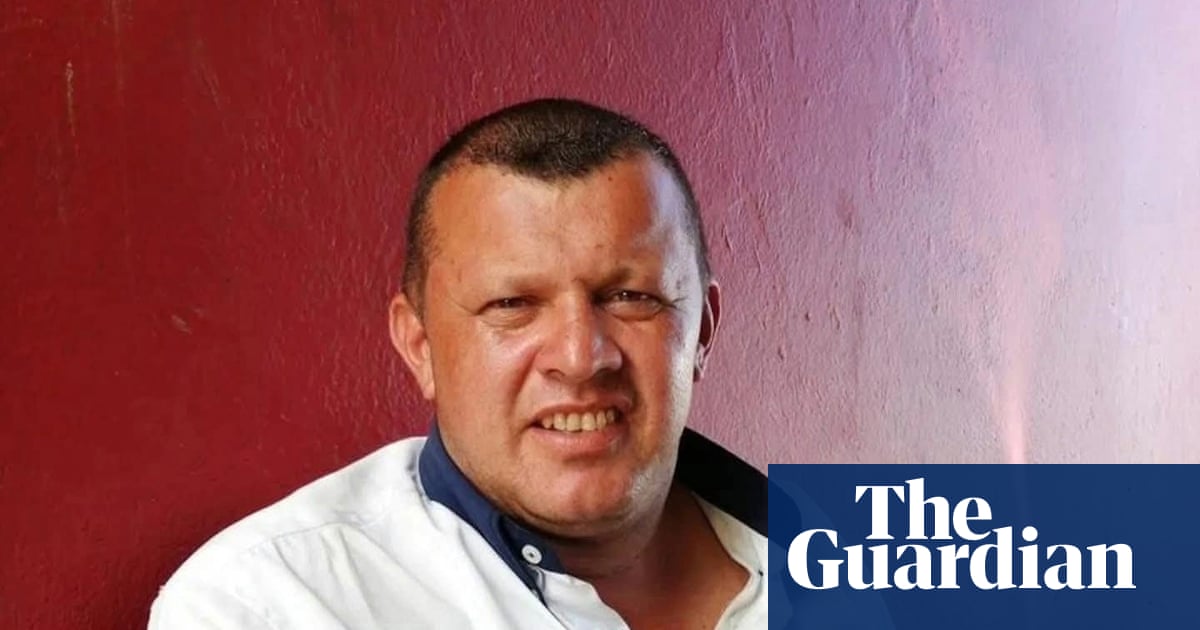
The family of a Costa Rican man who was deported from the United States in a vegetative state and died shortly after arriving back in his home country is still urgently seeking answers from the authorities about what happened to him while he was in detention.
Randall Gamboa Esquivel had left Costa Rica in good health and crossed the United States-Mexico border in December 2024, according to his family. However, Gamboa was detained by the US authorities for re-entering American soil unlawfully, as he had previously lived there undocumented between 2002 and 2013.
Gamboa was initially held at the Webb county detention center in Laredo and then transferred to the Port Isabel detention center in Los Fresnos, both in south Texas. Nearly 10 months later, in September 2025, the Trump administration flew the 52-year-old to the Costa Rican capital of San José on an air ambulance.
He never came round and five weeks later Gamboa was pronounced dead at a hospital in Pérez Zeledón, his home town, around three hours north of the capital.
The Guardian spoke with relatives, neighbors and old friends in Costa Rica who remain shocked and outraged about what happened. His younger sister, Greidy Mata, said she is still trying to make sense of how his health deteriorated so badly while in the custody of US Immigration and Custom Enforcement (ICE).
Greidy Mata Esquivel, sister of Randall Gamboa, visits the place where her brother is buried. Photograph: Emi Kondo/The Guardian
In an exclusive interview in Pérez Zeledón, Mata recounted that Gamboa had sounded and looked healthy when they talked via video calls while he was in detention, until 12 June, which marked their last conversation, after which he seemed to vanish. Mata waited for weeks to hear from him, but in fact Gamboa had fallen into a health crisis.
“My brother disappeared and we had to reach out to agencies, lawyers, consulates, anyone willing to help,” Mata said in Spanish, standing across the street from the hospital where Gamboa passed on 26 October.
“How is it possible that a man that left healthy, tall, chubby, robust, came back dirty, looked abandoned, with ulcers on his entire body, in a vegetative state?” she said.
Medical records related to Gamboa’s time in US custody and shared with the Guardian show that there was a transfer request for him from the Port Isabel detention facility to Valley Baptist medical center in Harlingen, 28 miles (45km) east, on 23 June.
According to a document included in the medical records and issued by Ice Health Service Corps (IHSC), a service within ICE that provides healthcare in immigration custody and assesses people slated for deportation, Gamboa was hospitalized with an “altered mental status”. The document also indicates he had been taking antipsychotic and antidepressant medications.
Relatives and friends denied Gamboa had a history of mental illness before he migrated to the US.
Tricia McLaughlin, assistant secretary at the US Department of Homeland Security (DHS), the parent company of ICE, said in an email response when asked about Gamboa’s detention and health that: “While in custody, medical professionals diagnosed him with unspecified psychosis and hospitalized him at Valley Baptist Hospital so he could get proper mental health and medical care.”
McLaughlin added that medical care for those in the custody of ICE includes “dental and mental health intake screening within 12 hours of arriving at each detention facility, a full health assessment within 14 days of entering ICE custody or arrival at a facility, and access to medical appointments and 24-hour emergency care”. She added: “This is the best health care that many aliens have received in their entire lives.”
Gamboa’s death certificate does not list a cause of death. An accompanying document with highlights in yellow says determining the cause could take months. Photograph: Emi Kondo/The Guardian
By 7 July, Gamboa had been diagnosed with at least 10 conditions, medical documents from the hospital show. Sepsis, a life-threatening reaction to an infection, is listed as his primary diagnosis, followed by rhabdomyolysis, a condition in which damaged muscle tissue breaks down rapidly.
Other conditions outlined in the records included protein malnutrition and toxic encephalopathy, caused by an infection or prolonged exposure to drugs, radiation or metals that ultimately alters brain function.
“I can’t sleep thinking what would’ve happened if we knew he was sick? Why did they keep this information from us? We found out where he was in August,” said Mata, making an effort to keep a calm composure despite crying on the recent December afternoon in Pérez Zeledón when she gave an interview.
“The information didn’t come from the Costa Rican consulate, nor ICE, it came from a lawyer whom we asked for help and who called us saying: ‘I found him in a bed, he follows you with his eyes, but can’t talk, he is in a vegetative state’,” she said.
Greidy Mata Esquivel, sister of Randall Gamboa, shares photos of his brother’s ear and the ulcer he had when he arrived in Costa Rica. Photograph: Emi Kondo/The Guardian
Costa Rica’s Ministry of Foreign Affairs declined an interview with the Guardian to discuss Gamboa’s case. It also didn’t answer a series of questions including whether any of their consular officers visited Gamboa during his hospitalization in Texas.
The director of Costa Rica’s migration agency, Omer Badilla, said his office was notified that Gamboa was being deported back to San José, but didn’t receive any details regarding his health.
According to a further document in Gamboa’s medical reports from the hospital, a doctor who visited Gamboa on August 2 wrote: “He doesn’t move or respond. He does blink at times … there is immobility and mutism present. The patient appears exhibiting the decerebrate posturing.”
“Decerebrate posturing” typically refers to a patient’s arms and legs being held stiffly straight, with head arched back and toes pointed down. The doctor also noted that Gamboa was “undergoing tube placement”.
A list of medications Randall Gamboa was taking in ICE detention. Photograph: Emi Kondo/The Guardian
The medication list included in the medical records showed that by 7 August, nearly a month before his deportation to Costa Rica, Gamboa had received IV injections and more than a dozen medications. He was assessed as catatonic.
“At times this all seems like a horror story or a lie,” said Mata, as she prepared to mark Christmas while in mourning for her brother.
She said that when Gamboa came home, there was at first a flicker of optimism. “It was nice seeing and touching him again because it gave us hope that he could recover,” she said, adding: “But the doctors never said that … and we realized then that the condition in which he arrived was irreversible.”