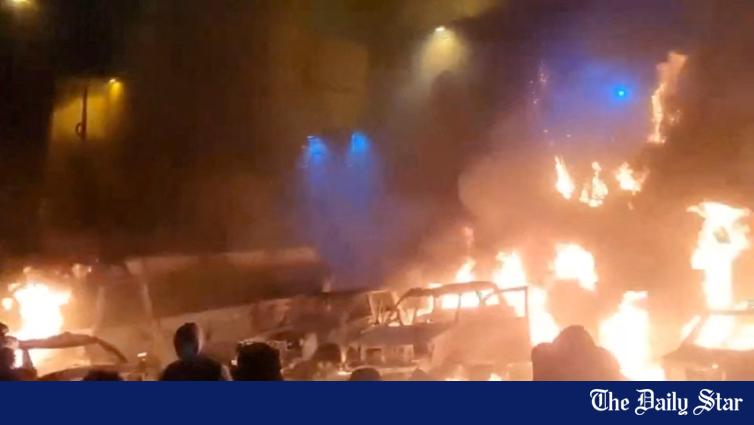
Iran’s newest wave of unrest began because of money. When shopkeepers in Tehran’s Grand Bazaar shut their doors on December 28, 2025, in protest of a collapsing rial and soaring prices, an economic strike rapidly turned into a national political challenge. The state’s answer has been blunt: lethal force, mass arrests, and a near-total internet blackout that Amnesty International says is being used to obscure grave abuses.
The obvious comparison is the 2022 “Woman, Life, Freedom” movement after the custodial death of Mahsa Amini, a 22-year old detained over alleged hijab violations, an episode condemned by human rights experts. That movement attacked Iran’s claim to moral guardianship. This one attacks something even more foundational: the regime’s promise that it can keep society afloat, and that sacrifice today will yield stability tomorrow.
The economic roots of the protest are neither mysterious nor temporary. Iran is trapped in a cycle of sanctions pressure, corruption, and opaque institutions that punish productivity while rewarding loyalty. Chronic inflation has become a form of daily dispossession. The International Monetary Fund projects consumer price inflation in 2026 in the low 40 percent range, a level that shreds wages and savings. Currency collapse is not a technical problem in Iran; it is a political event that tells citizens the state has lost control of the most basic guarantee of economic order.
Economics alone does not topple regimes. What turns economic pain into regime rejection is coalition. In Iran, protests have often been segmented: students, women, workers, and ethnic peripheries, each rising and then being isolated. A bazaar strike changes that geometry. The bazaar is a social institution as much as a market, and it signals when private frustration has become public refusal. When merchants join street politics, the regime cannot dismiss dissent as marginal. It reads as an economic vote of no confidence.
That is why the communications blackout matters. Internet shutdowns are not just censorship but a counterinsurgency tool designed to prevent coordination and hide the scale of violence. But they also advertise fear. Under a blackout, casualty and arrest figures vary and are hard to verify, yet the trend is clear. Overseas rights monitors point to dozens killed and thousands detained in Iran as protests expand. The movement has rapidly shifted from economic grievances to explicit denunciations of Supreme Leader Ali Khamenei and the Islamic republic itself, with some demonstrators invoking the exiled Reza Pahlavi, reflecting both deepening anger and a fractured opposition.
Geopolitically, Iran is not merely another state facing street anger; it is a strategic hub in an already unstable region. Tehran’s rulers have spent decades building influence through aligned armed actors and political partners across the Middle East, a posture the Council on Foreign Relations tracks from Lebanon to Yemen and Iraq. Supporters call this deterrence. Many Iranians see it as an expensive foreign policy that delivers prestige to the security elite while ordinary life becomes a permanent austerity exercise.
The regime’s strategic environment has also tightened. Syria is the clearest reminder that systems that look permanent can crumble quickly. The fall of Bashar al Assad in December 2024 disrupted an arena where Iran had long sought strategic depth. Then came a direct military shock: in June 2025, the US struck three Iranian nuclear sites, described in a Congressional Research Service brief as intended to destroy or severely degrade Iran’s nuclear programme. Whatever one thinks of the legality or wisdom of those strikes, the political message landed: escalation did not protect the economy, and restraint did not prevent humiliation.
External responses may shape the trajectory, but not always as intended. President Donald Trump has warned that the US is “locked and loaded” if Iranian authorities kill peaceful protesters. Such statements may aim to deter bloodshed. They also risk reinforcing Tehran’s narrative that dissent is a foreign plot, a frame that can harden the security apparatus and split wavering constituencies who fear chaos more than they hate the state.
So what comes next for Iran? Survival through repression remains possible, but it has a shelf life when the economy offers no credible route back to dignity for a young population. Collapse through exhaustion is also possible if protests persist, strikes deepen, and elite cohesion frays. Succession uncertainty around an ageing supreme leader only deepens the sense of drift. The least violent outcome would be a negotiated transition that protects state institutions while opening the political system. The most dangerous outcome would be a sudden vacuum where coercive networks fragment and rival factions fight over money, weapons, and immunity.
If Tehran’s current order falls, the Middle East will not automatically become calmer—it will become less predictable. Iran’s regional partners could face major constraints, shifting the balance in Lebanon and Yemen, yet proxies don’t always dissolve when a patron weakens. Some act autonomously, some splinter, and some escalate to secure relevance. The timing is combustible because the wider region is already traumatised by the Gaza war, with the UN’s humanitarian reporting continuing to track catastrophic loss of life.
The energy dimension turns Iran’s crisis into a global risk, and it matters for Bangladesh. Iran sits beside the Strait of Hormuz, through which about one-fifth of global petroleum liquids consumption flowed in 2024, according to the US Energy Information Administration. Even without a deliberate disruption, miscalculation can raise prices. Bangladesh is exposed to these shocks because its fuel supply chains depend on Gulf stability, a vulnerability that has already been flagged in the context of earlier Iran-Israel tensions.
The central geopolitical truth is that Iran’s legitimacy crisis at home and the region’s crisis abroad have fused. Tehran’s leaders have treated nuclear brinkmanship and regional militancy as tools of survival. Iran’s protesters increasingly see these tools as drains on a society that cannot afford them. Supporting Iranians’ rights to protest and communicate is essential. Turning their revolt into another externally managed project would be a strategic and moral failure. The rial’s fall is not only a financial story but also a warning signal for the entire region.
Barrister Khan Khalid Adnan is advocate at the Supreme Court of Bangladesh, fellow at the Chartered Institute of Arbitrators, and head of the chamber at Khan Saifur Rahman and Associates in Dhaka.
Views expressed in this article are the author’s own.
Follow The Daily Star Opinion on Facebook for the latest opinions, commentaries, and analyses by experts and professionals. To contribute your article or letter to The Daily Star Opinion, see our guidelines for submission.