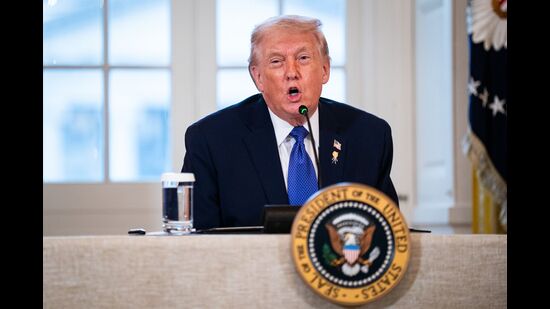
‘Venezuela is under my control, and soon we’ll get Greenland. It’s necessary for the US,’ Donald Trump said recently. This is not a threat issued by some medieval tyrant, but a chilling statement issued by the sitting President of the US — the same modern nation that claims to be the Medina of democracy. Trump has also referred to Canada as the 51st state of the US. But will he send troops to march on Canadian soil, too? Is it that easy? The answer is hidden in the events of the last week.
The Trump administration is planning to offer heavy compensation to Greenland residents instead of their wealth. This is a new version of “divide and rule” (Bloomberg)
Let’s first look at how the other countries reacted to the US invasion of Venezuela.
After the US attack on Venezuela, Beijing imposed a ban on many US products, and its banks sped up the process of shifting to settling global trade transactions in yuan instead of the dollar. China’s President, Xi Jinping, warned that if the situation didn’t improve, American companies stand to face increased restrictions. As a result, companies doing business with China saw their shares plummet on Wall Street.
Russia, on the other hand, started “repositioning” its deadliest weapons and its strongest nuclear submarines near Venezuela. Despite being bogged down by internal strife, Iran has already threatened to close the Strait of Hormuz.
Meanwhile, hackers in some US cities attacked electricity services, communications, transportation networks and hospitals, shutting these down for some time. The US blamed it on China while the latter denied any responsibility. The question is: Can the US fight on so many fronts?
Before the proposed meeting with the US secretary of State Marco Rubio, the Danish defence ministry spokesperson said the Danish government has given orders to shoot attackers who set foot on Greenland first and ask questions later. Oblivious of these developments, the Trump administration is planning to offer heavy compensation to Greenland residents instead of their wealth. This is a new version of “divide and rule”.
On Tuesday, the Pentagon captured two ships bearing the Russian flag, cocking a snook at the Russians and signalling that the US didn’t care about Russian nuclear submarines. Washington, meanwhile, is buzzing with the possibility of Venezuela-like strikes on Colombia and Cuba.
As if that wasn’t enough, Trump, through a bill, has cleared the way to impose a 500% tariff on any nation trading with Russia for oil and uranium. The Bill is clearly aimed at India, China and Brazil, all of which buy Russian oil.
The US has pulled out from 66 international bodies and treaties centred on important issues such as environment, health, education and nutrition. Trump has always called the United Nations and its agencies an unnecessary waste of resources. He has also shown total disregard for international norms.
Just a year ago, all this was unthinkable. But we are witnessing something unbelievable unfolding before us. No one can predict Trump’s next move and how the world will react to it. We are undoubtedly moving from a string of small conflicts to a bigger conflagration.
Is Trump oblivious to reality? Doesn’t he know that China can go to any extent to save its $62.5 billion investment in Venezuela? In Latin America, Russian and Chinese interests are being threatened by US actions. This is leading to strange new alliances. And every new alliance begets new assurances and tensions.
Consider the Paris Declaration of January 6. In an accord between Ukraine and the European Union, France, Britain and other partners guaranteed to safeguard Ukraine from any future Russian attack by providing the country a security shield. They pledged that after the ceasefire comes into force, they would station their armies in Ukraine and also make military bases in that country.
As expected, Moscow’s reaction was quick and sharp. Russia said it would not tolerate any European or NATO military presence on Ukrainian soil and would not hesitate to attack any such move. The Kremlin also rejected the peace proposal. Meanwhile, cracks started appearing in European unity as Hungary raised its voice against the EU-Ukraine deal. Clearly, the ideological divide is deepening in beleaguered Europe. After Venezuela, this emerging hotspot for conflict doesn’t augur well for the world.
We need to look at the subcontinent, too. Last week, the Pakistan and Bangladesh air force chiefs met and decided that Rawalpindi’s security apparatus will not only provide training but also give Bangladesh JF-17 fighter jets. This fighter jet is the product of a Pak-China collaboration. Bangladesh’s entry to this equation creates new complications.
Let me remind you of Bangladesh caretaker administration chief Mohammad Yunus’s statement during his Beijing visit last year. He mentioned the prospect of cutting off India’s Northeastern region from the rest of the country. Bangladesh is now contemplating imposing a 10-20% tariff on Indian cotton. Bangladesh is the biggest importer of Indian cotton. If the tariffs are imposed, it will create additional challenges for our economy, already reeling under the impact of the US tariffs.
This is the first time that both China and the US are simultaneously trying to encircle India, though their motives are different. Our old friend Russia is not in a position to help us for long. Will India try to wriggle out of the encirclement by opening its market for Chinese companies? External affairs minister S Jaishankar’s meeting with French President Emmanuel Macron in Paris last week gives encouraging signals.
India will have to “reposition” itself in the rapidly changing world. It is heartening to note that New Delhi is treading the path nimbly and playing its limited cards astutely.
Shashi Shekhar is editor-in-chief, Hindustan. The views expressed are personal