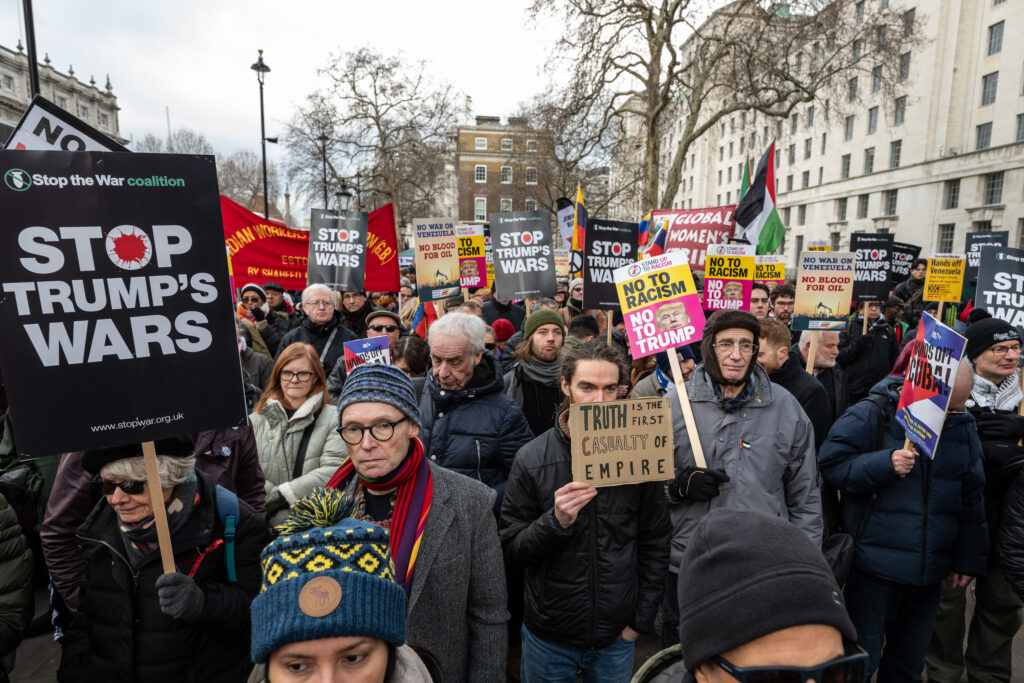
 Activists protest outside Downing street against the recent policies of Donald Trump. | Guy Smallman/Getty Images
Meanwhile, European leaders will be forced to publicly ignore Washington’s support for far-right parties, which was clearly spelled out in the new U.S. national security strategy, while privately doing all they can to counter any antiestablishment backlash at the polls.
Specifically, the upcoming election in Hungary will be a bellwether for whether the MAGA movement can tip the balance for its ideological affiliates in Europe, as populist, euroskeptic Prime Minister Viktor Orbán is currently poised to lose for the first time in 15 years.
Orbán, for his part, has been frantically campaigning to boost voter support, signaling that he and his inner circle actually view defeat as a possibility. His charismatic rival Péter Magyar, who shares his conservative-nationalist political origins but lacks any taint of corruption poses a real challenge, as does the country’s stagnating economy and rising prices. While traditional electoral strategies — financial giveaways, smear campaigns and war fearmongering — have so far proven ineffective for Orbán, a military spillover from Ukraine that directly affects Hungary could reignite voter fears and shift the dynamic.
To top it all off, these challenges will be compounded by the E3’s weakness.
The hollowing out of Europe’s political center has already been a decade in the making. But France, Germany and the U.K. each entered 2026 with weak, unpopular governments besieged by the populist right and left, as well as a U.S. administration rooting for their collapse. While none face scheduled general elections, all three risk paralysis at best and destabilization at worst. And at least one leader — namely, Britain’s Keir Starmer — could fall because of an internal party revolt.
The year’s pivotal event in the U.K. will be the midterm elections in May. As it stands, the Labour Party faces the humiliation of coming third in the Welsh parliament, failing to oust the Scottish National Party in the Scottish parliament and losing seats to both the Greens and ReformUK in English local elections. Labour MPs already expect a formal challenge to Starmer as party leader, and his chances of surviving seem slight.