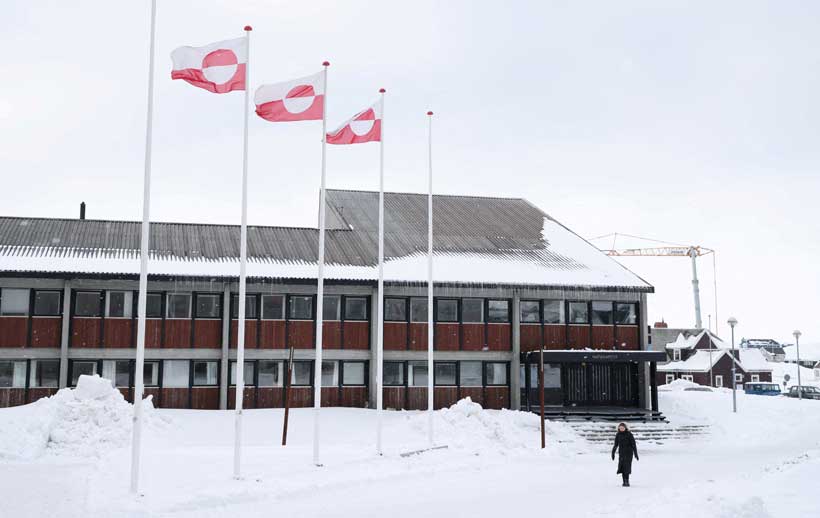
The recent remarks made by President Donald Trump that the United States should own Greenland to stop the further influence of Russia and China have brought this far-off Arctic island back to the international limelight. Greenland is a sparsely populated territory with a harsh environment that has suddenly become a hotspot in U.S. foreign policy and a guinea pig in the United States dealing with Arctic security, alliance management, and great-power rivalry. Although the concept of possessing Greenland has been broadly condemned, and the idea of it has been expressly denied by both Denmark and the island itself, the geographical, military, and competitive aspects of the available resources are the deeper strategic results.
Greenland is a semi-autonomous state of Denmark, and it occupies a critical strategic position between North America and the Arctic. Its position is sparsely populated, but it is the best place to have early warning against attacks by missiles and keep track of the activities of the navy in the North Atlantic and the Arctic. The United States has also had a permanent military presence at the U.S. Pituffik (Thule) Air Base in northwest Greenland since World War II, and according to prevailing agreements with Denmark, the U.S. is free to deploy more forces. President Trump, however, pointed out that lease efforts or temporary deals are inadequate and that nations must possess ownership and must protect ownership. Although the rhetoric of ownership has received harsh criticism, it demonstrates a revived U.S. view of Greenland as a strategic object.
The context of what Trump says is very much urgent. The management has suggested that it is thinking of purchasing Greenland, a move that had been earlier floated in 2019 and had not excluded military action. Such an announcement takes place against a backdrop of growing Russian and Chinese interest in the Arctic and fears that the ice is melting and new shipping lanes and resource access points are opening up. Although Trump has asserted without foundation that there are Russian and Chinese vessels all over Greenland, they reflect a more general panic in U.S.-level policy-making regarding the increased geostrategic significance of the Arctic.
The importance of Greenland is not limited to the issue of the military. The island is located on a high mineral and hydrocarbon base, comprising rare earth elements, uranium, iron, and possibly oil and gas deposits. With the increased meltdown of ice due to climate change, such resources are becoming less distant, giving Greenland more economic and strategic value. To the United States, the strategic location and the presence of untapped resources render Greenland to be a special asset in international competition with Russia and China, two countries that are becoming more aggressive in the Arctic region.
Nonetheless, the idea to own Greenland has been unanimously backed. Denmark has entirely ruled out the possibility of selling its territory, and that military action would compromise the transatlantic alliance. Allies of NATO, such as Canada and a number of European nations, have supported Denmark and reaffirmed that nobody can make decisions concerning the relationship of the country except Denmark and Greenland. The government and the opposition leaders of Greenland have expressed outcry, stating, “We are not Americans, we are not Danes, we are Greenlanders. The statement strengthens the role of sovereignty and self-determination, which are values embedded in international law and the UN Charter.
This backlash is an example of a larger conflict in contemporary geopolitics: the United States’ security concerns occasionally come into conflict with the sovereignty of small allies. The case of Greenland poses some fundamental questions about the management of alliances, with the NATO members juggling between collective security in the Arctic and territorial integrity. It also points out a long-standing dilemma for U.S. foreign policy, which is balancing unilateral security interests with multilateral standards and allies’ demands.
Greenland is analytically a microcosm of a number of intersecting trends. First, it is a sign of the remilitarization of the Arctic, as countries are gearing up for possible disputes over shipping paths, resources, and territorial claims. Over the last few years, Russia has increased its military presence in the Arctic, with China boasting that it is a near-Arctic state and seeking to achieve both resource and scientific interests in the area. Second, Greenland is an example of when climate change and geopolitics intersect with each other, with melting ice turning formerly unreachable territories into strategic zones. Third, it highlights the persistence of geography in U.S. strategy, when security is frequently discussed in terms of technology and cyber aspects. Strategic chokepoints such as the GIUK gap, the sea route between Greenland, Iceland, and the United Kingdom, are still important as a source of early warning and naval control.
Simultaneously, Greenland presents a problem to the identity of the U.S. foreign policy. The ownership rhetoric is a danger of outlining the United States as a force that is ready to eliminate the governmental authority of smaller allies. As much as the significance of the Arctic security cannot be underestimated, the Greenland policy should be a compromise between strategic concerns and legal, diplomatic, and ethical factors. Otherwise, it may undermine the trust of the NATO members and create a precedent in other disputable territorial conflicts around the world.
To sum everything up, Greenland has gone beyond a relative obscurity of understanding to the focus of U.S. strategic concerns, not just simply owing to the rhetoric of Trump, but it has been a confluence of geography, climate-based access to resources, and a growing competition among great powers in the Arctic. The most recent news, such as Trump and his statements, purchase or force considerations, and allies’ backlash, reminds us of how timely the current issue is. Greenland ceases to be a far-flung and lightly inhabited island to the United States, but rather, it appears as a strategic priority that has been revealed to have effects on the national security and even on the cohesion of the alliances, as well as the emerging international order. Any U.S. policy towards Greenland then should be able to maneuver between the delicate nexus of security, sovereignty, and diplomacy, between short-term strategic requirements and long-term reliability in world management.