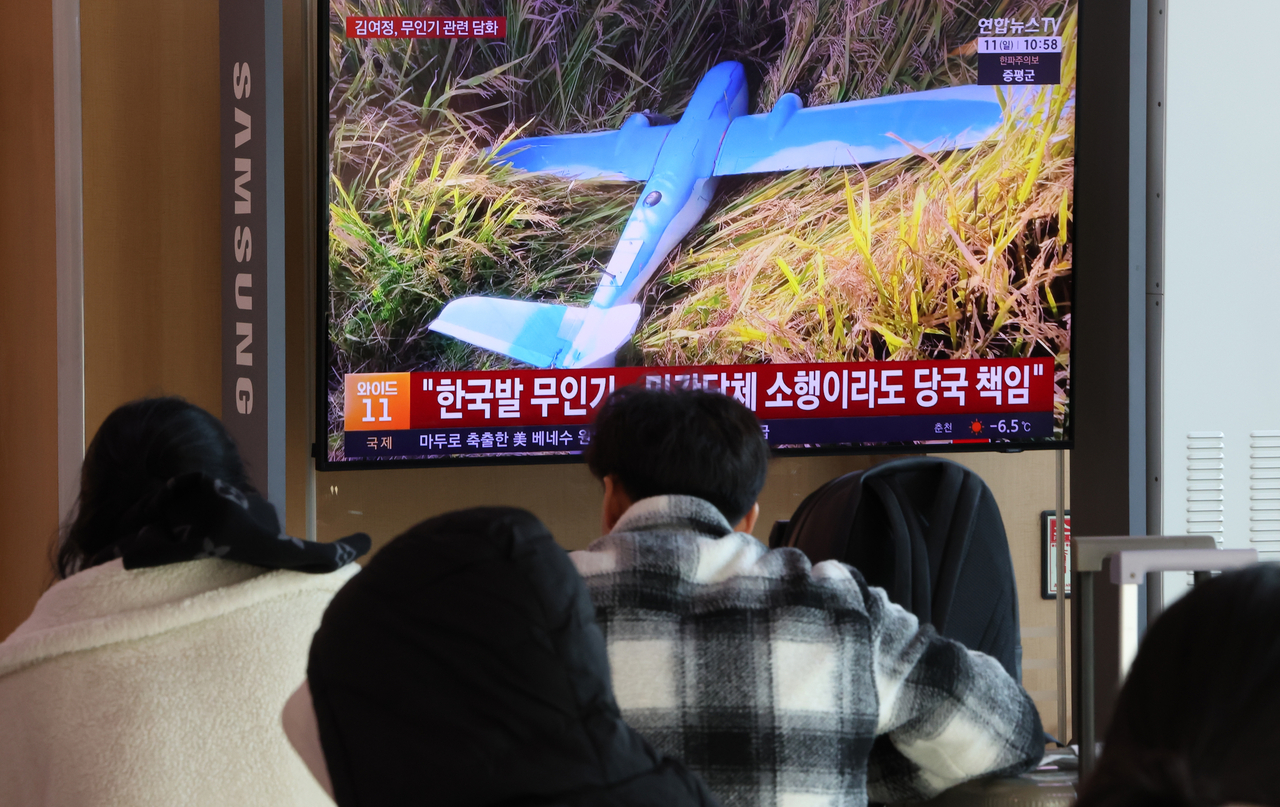
 South Korean citizens watch news coverage at Seoul Station on Sunday regarding North Korea’s claim that South Korean drones violated its airspace. (Yonhap)
 Pyongyang unlikely to repeat trash-carrying balloons, but may explore other forms of pressure in ‘gray zone,’ experts say
South Korea has launched a military-police investigation into allegations that drones originating from the South intruded into North Korean airspace, as the government moves to contain tensions and signal that the incident was not a military operation, the Ministry of National Defense said Monday.
The probe was ordered by President Lee Jae Myung on the previous day, as he directed authorities to swiftly establish the facts surrounding the alleged drone incursions and determine whether any laws were violated. Seoul said it is not ruling out a future inter-Korean joint investigation.
Defense Ministry spokesperson Chung Binna said in a regular briefing Monday that the military and police are closely cooperating, though she declined to provide details on the size or scope of the task force.
“The military is swiftly cooperating with police in line with the president’s directive, and a military-police probe is currently under way,” Chung said, adding that authorities would explain the findings once the investigation is complete.
North Korea on Saturday claimed that South Korean drones had entered its airspace in September last year and again recently on Jan. 4, alleging the flights were conducted for reconnaissance purposes with the backing of the South Korean government and military. Seoul has flatly denied the accusations, saying it does not possess or operate drones matching those described by the North.
Photos released by Pyongyang suggest the drone resembles a commercially available model produced by a Chinese manufacturer and assembled using civilian-grade components, fueling speculation that a private actor may have been involved rather than the military.
Lee said Sunday that if the alleged drone incursions prove to be true, they would constitute serious criminal acts threatening peace on the Korean Peninsula and national security, ordering a rigorous investigation. Officials stressed that Seoul has no intention of provoking or antagonizing North Korea.
The South’s joint task force is being led by police, with the military providing support, as the armed forces lack legal authority to investigate civilians. If an operator is identified, authorities could pursue charges under laws including the Inter-Korean Exchange and Cooperation Act and the Aviation Safety Act.
While North Korea has issued warnings suggesting a possible “proportional response,” analysts say a repeat of trash-carrying balloon launches, a tactic Pyongyang used in 2024, is unlikely in the near term.
“North Korea appears to be in a wait-and-see mode,” said Yang Moo-jin, a professor at the University of North Korean Studies in Seoul. “Given that President Lee has ordered a thorough joint investigation, Pyongyang is likely to closely observe how the South handles the situation rather than escalate immediately.”
Yang added that restoring confidence-building measures such as the Sept. 19 inter-Korean military agreement — reached in 2018 and suspended in 2024 — could help prevent drone operations near border areas and reduce unnecessary tensions.
North Korea began launching trash-carrying balloons toward South Korea in late May 2024, marking one of Pyongyang’s most sustained gray-zone provocations in recent years. The campaign was triggered after North Korea accused South Korean civic groups of sending anti-Pyongyang leaflets across the border using balloons, a practice the North has long denounced as a violation of its sovereignty and a threat to regime stability.
The balloon campaign continued intermittently for about five months, ending in late November 2024, after North Korea abruptly halted launches without issuing a formal explanation.
Another expert cautioned, however, that North Korea may still explore other forms of pressure in the gray zone.
Lim Eul-chul, a professor at Kyungnam University’s Institute for Far Eastern Studies, said Pyongyang’s reference to “civilian flying objects” could signal more sophisticated tactics.
“The possibility cannot be ruled out that North Korea could test South Korea’s response posture by flying its own drones into the South’s airspace to create confusion,” Lim said. “Kim Yo-jong’s remarks go beyond past trash-balloon campaigns and hint at the potential evolution of more advanced gray-zone provocations involving drone technology.”
North Korean leader Kim Jong-un’s influential sister, Kim Yo-jong, on Sunday demanded a detailed explanation from Seoul, warning of consequences if what she described as provocations were repeated, while acknowledging Seoul’s position that the incident had not been carried out by its military.
Kim Yo-jong, vice department director of the Central Committee of the Workers’ Party of Korea, said, “Fortunately, the ROK’s military expressed an official stand that it was not done by itself and that it has no intention to provoke or irritate us,” in a statement carried by the North’s Korean Central News Agency. ROK stands for the Republic of Korea, the official name of South Korea.
“But a detail explanation should be made about the actual case of a drone that crossed the southern border of our republic from the ROK,” Kim said.
Kim added that South Korea’s Defense Ministry “took a wise choice” by announcing its official stance of not provoking North Korea despite denying the North’s accusations.
mkjung@heraldcorp.com