A firm endorsement would free the president to continue using import duties as leverage in trade negotiations, an incentive for domestic production, and a source of hundreds of billions of dollars a year in government revenue. An outright rejection would raise complicated questions about refunds to tariff payers and how Trump will respond.
But it’s more likely the justices will come down somewhere in the middle, creating “ambiguity that ripples outward,” according to Harvard University economist Jason Furman.
“If some tariffs stay in place, businesses that have so far absorbed much of the costs may no longer be able to shield consumers from higher prices,” Furman, a top economic adviser to President Obama from 2013 to 2017, wrote recently. “And if any tariffs are struck down, the administration will almost certainly try to reimpose them using alternative legal authorities, which will set off still more litigation.”
Beyond the tariffs themselves, the court’s ruling could expand or curb the president’s power to advance his agenda without congressional approval.
Catch up: In November, the justices heard oral arguments in a case combining lawsuits from small businesses — including a Vermont cycling gear manufacturer — and 12 state attorneys general.
The plaintiffs argued Trump exceeded his authority under the International Emergency Economic Powers Act of 1977. Trump’s declared “emergencies” — trade deficits and fentanyl trafficking — didn’t meet IEEPA’s requirement of an “unusual and extraordinary threat,” they said.
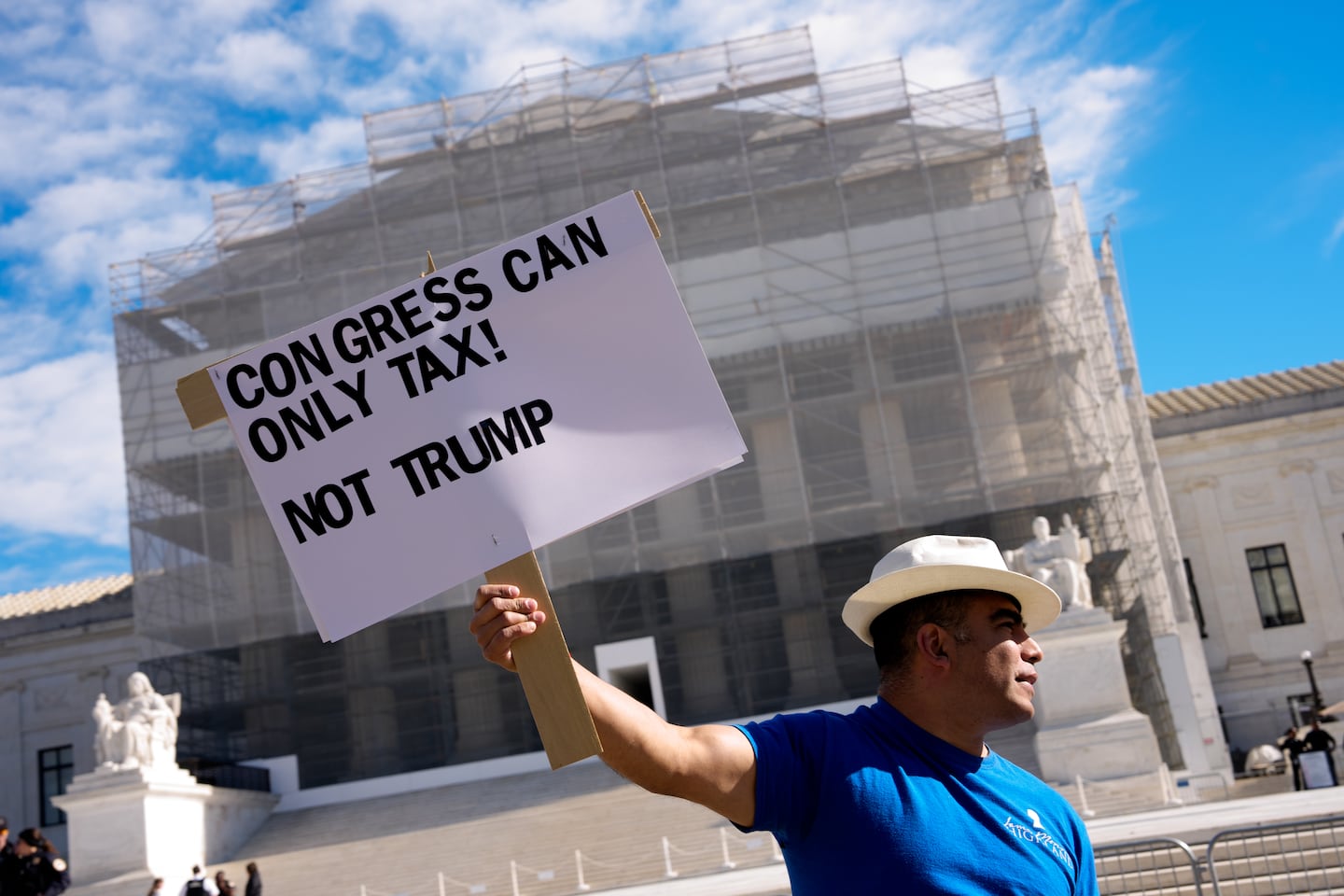
Moreover, the plaintiffs contended that tariffs are taxes, which only Congress can institute.
A majority of justices — including three conservatives — appeared skeptical of Trump’s reliance on IEEPA.
Chief Justice John Roberts noted that while tariffs involve foreign relations, where the president has a wide berth, “the vehicle is imposition of taxes on Americans.”
Solicitor General D. John Sauer, representing the administration, countered that the tariffs were regulatory tools falling within the president’s foreign affairs purview.
The justices agreed to hear the case on an expedited schedule, and court watchers say a ruling might come as soon as this month or next.
The impact: Predictions that Trump’s tariffs would tank the economy and spike inflation haven’t materialized — at least not yet.
After a sharp sell-off early in the year, the stock market rallied, ending the year up 16 percent. The economy expanded at a solid 2.5 percent average annualized rate in the first three quarters. But annual inflation, as measured by the Consumer Price Index, rose to 2.7 percent in November from 2.3 percent in April.
Research by Harvard’s Gita Gopinath and the University of Chicago’s Brent Neiman found several explanations for the muted impact.
Businesses stockpiled goods before tariffs took effect and, loath to lose customers, absorbed much of their higher costs through smaller profit margins, they wrote in a recent working paper. Actual tariff rates also proved lower than advertised because of shipping delays, product exemptions, and increased compliance with the US-Mexico-Canada trade agreement.
Zoom in: Still, it was a year marked by confusion and frustration for companies, especially smaller firms with fewer resources to adapt.
Gopinath and Neiman calculated that overall manufacturing costs rose by about 1 percentage point, with some sectors, such as heavy-duty trucks and construction machinery, seeing increases of 2 to 3.9 percentage points.
“It is exhausting to be kind of beaten down by this sense of uncertainty, checking the news every morning and checking the White House tariff schedule,” Claire Cheney, founder of Curio Spice Co. in Winchester, told the Globe’s Jim Puzzanghera last month.
What’s ahead: The high court’s 6-3 conservative majority has frequently ruled in favor of Trump in so-called shadow-docket cases. These fast-tracked cases — which usually involve limited briefing, no oral argument, and rulings with little or no explanation of the court’s reasoning — have challenged administration actions such as deportations, firing leaders of independent agencies, and DOGE spending cuts.
That record is why the skeptical grilling of the solicitor general by conservative justices during oral arguments was seen as a bad omen for the administration.
Final thought: But a Supreme Court loss doesn’t mean Trump’s tariff policy is dead.
The president could pursue congressional authorization for reciprocal duties. Or he could seek to restore them under Section 232 of the Trade Expansion Act of 1962, which allows tariffs on national security grounds, or Section 301 of the Trade Act of 1974, which covers retaliation for unfair trade practices. Both would require time-consuming investigations.
“I will tell you that’s one of the most important cases in the history of our country because if we don’t win that case, we will be a weakened, troubled, financial mess for many, many years to come,” Trump said in October.
Trump accepts few restrictions on presidential power. One Supreme Court defeat is unlikely to make him surrender on tariffs.
Larry Edelman can be reached at larry.edelman@globe.com.