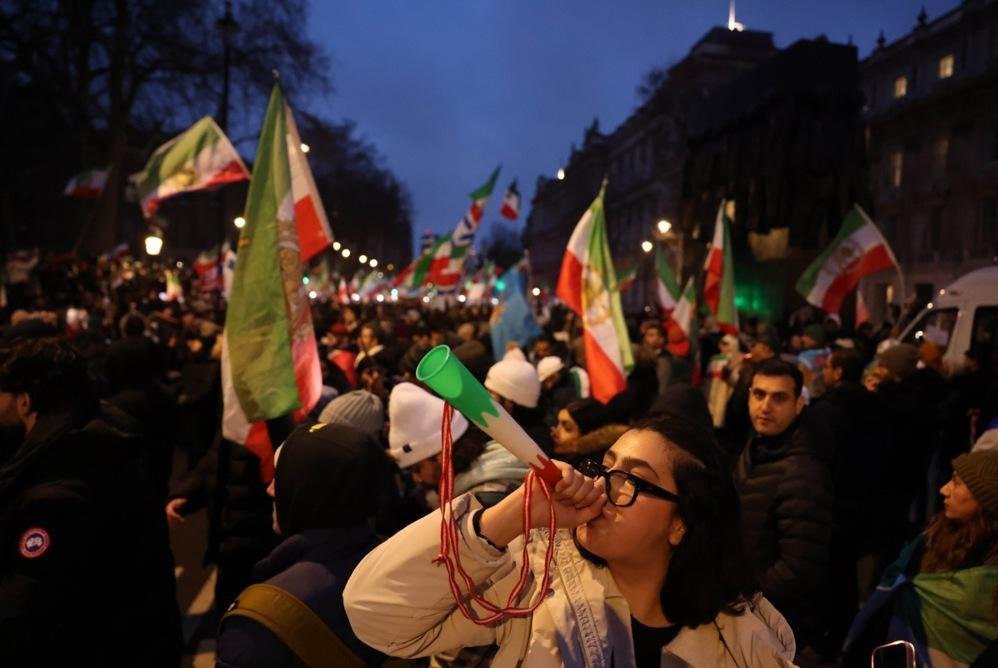
Protesters wave pre-revolution Iranian flags as they take part in a rally in support of current protest movement in Iran outside Downing Street in London on Sunday. Photo by Neil Hall/EPA
Jan. 12 (UPI) — Iran has entered a prolonged season of unrest. Protest, resistance and sporadic riots echo through cities and provinces.
The causes differ from past cycles. The grievances are not only economic. They are cultural and social. They are political in the deepest sense. They question legitimacy. They press against the coercive core of the Islamic Republic.
The Korean people in the North live under an even more totalitarian system. They endure information starvation and internal surveillance. Yet, they, too, carry memory and history.
They remember famine. They remember fracture when the markets grew in the 1990s. They watch elites compete for favor. They see China’s shadow. They see the world in fragments through smuggled phones, USB drives and whispered accounts.
Comparative dynamics
Iran’s protests emerge from a literate, connected society with deep civic networks and a strong sense of national identity. The Iranian street has learned to mobilize. It has learned to adapt. It employs decentralized tactics. It spreads narratives quickly. When repression intensifies, the unrest disperses but does not disappear. It reappears in new forms. These are indicators of a society flirting with a tipping point.
The Korean people in the North lack these networks. They lack civil society. They lack autonomous organizations. The state has long suppressed the forging of collective social capital outside the party.
Yet, they have the jangmadang economy and family networks. They have market logic and traders. They have defectors abroad. They possess a latent nationalism that is not communist in essence. It is Korean.
Narrative Power
Iran’s narrative is powerful for oppressed societies. It shows that authoritarian theocracies crack under social pressure. It shows that women can lead. It shows that betrayal from within the ruling elite can occur. It shows that economic pain fuels political awakening.
Yet, the Iranian narrative is incomplete for the Korean people in the North. Iran is permeable to outside information. It has a large diaspora. It has social media. It has foreign press. It has clerical factions in conflict. It has elections that matter just enough to create tension and disillusion. The North Korean system lacks these valves.
Still, the Iranian narrative could influence Korean thinking if the Korean people in the North received it. It would reveal that regimes which claim divine or historical legitimacy can be challenged from below. It would show that security forces may fracture. It would show that the state can lose fear. These are things the Korean people in the North rarely see.
Tipping points
Iran may be near a tipping point if four conditions converge: elite fracture, economic exhaustion, narrative coherence and mass defection from fear. Iran has the first three in partial form. The fourth remains uncertain.
Korea in the North has economic exhaustion. It lacks elite fracture visible to the public. It lacks narrative coherence for an alternative political future. It lacks mass defection from fear. The tipping point is farther away. Yet, tipping points are nonlinear. They arrive slowly at first and then suddenly.
Lessons from Iran
Three lessons stand out. First, narratives create cohesion for protest. Without a story, unrest becomes noise. Second, women and youth matter because they represent the future, not the past. Third, informal networks allow resistance to survive repression.
Lessons from Korean history
Korean history teaches that change comes through a combination of intellectual awakening, external shock, and elite miscalculation. The March First Movement began with students and intellectuals. The June 1987 uprising grew from a desire for dignity and procedural justice. Both movements benefited from international attention and media. Both movements forced the ruling elite to adapt.
Potential application
Could the Iranian narrative inspire change in the North? Yes, if two conditions are met. First, the Korean people in the North must gain access to the narrative. Second, the narrative must be framed in a Korean political idiom that resonates with dignity, unity and national restoration.
Here lies a question worth asking. What narrative would awaken the Korean people in the North? Would it be the Iranian story or would it be a Korean story of unification and freedom? The Iranian case may serve as a mirror, but mirrors only reflect. They do not ignite. The spark must be Korean.
Counterarguments
One could argue that Iran and the North are incomparable.
Iran has religion. The North has personality cult. Iran has cities with autonomous social life. The North has surveillance cities. Iran’s security forces sometimes refuse to fire. The North’s forces are tied to family loyalty, party privilege and existential fear.
These differences are real. They caution against simple analogy.
Key questions
What happens when a people realize that fear is learned and not innate?
What happens when an elite realizes that legitimacy is borrowed and not owned?
What happens when stories of resistance cross borders and undermine the myths of power?
What happens in the North if a narrative of Korean unity replaces a narrative of Kim family regime destiny?
De oppresso liber
The international community has a moral obligation to help the oppressed free themselves whether in Iran or North Korea. It is information that will help the people to create the conditions that will bring change for themselves.
Conclusion
The Iranian unrest offers insight but not a template. It offers hope but not certainty. It offers lessons in courage, network formation, and narrative power. Korean history offers lessons in national dignity, student-led movements and democratic awakening.
The real issue is whether information can reach the Korean people in the North. Without information there is no imagination. Without imagination there is no alternative future. Without an alternative future there is no political change.
Iran shows that even hardened regimes cannot extinguish imagination forever. The Korean question remains whether imagination can be seeded inside the tight shell of the Kim family regime and whether that imagination could one day bring the shell to crack.
Let the quest for freedom for all Iranian people inspire a free and unified Korea for all Korean people.
David Maxwell, executive director of the Korea Regional Review, is a retired U.S. Army Special Forces colonel who has spent more than 30 years in the Asia-Indo-Pacific region. He specializes in Northeast Asian security affairs and irregular, unconventional and political warfare. He is vice president of the Center for Asia Pacific Strategy and a senior fellow at the Global Peace Foundation, where he works on a free and unified Korea. After he retired, he became associate director of the Security Studies Program at Georgetown University. He is on the board of directors of the Committee for Human Rights in North Korea and the OSS Society and is the editor at large for the Small Wars Journal.