The EU trigger
The resurgence of protectionism in global trade has directly affected India’s access to the U.S. market. American pressure tactics, ranging from high tariffs to demands related to India’s energy imports from Russia, have complicated what was once a relatively predictable trade relationship. These measures have not only raised costs for Indian exporters but also injected uncertainty into long-term economic planning. For India, diversification is no longer optional but has become a strategic necessity. Europe, with its large consumer base and industrial strengths, has become the most viable counterweight to U.S. economic pressure.
Germany as the anchor of India’s Europe strategy
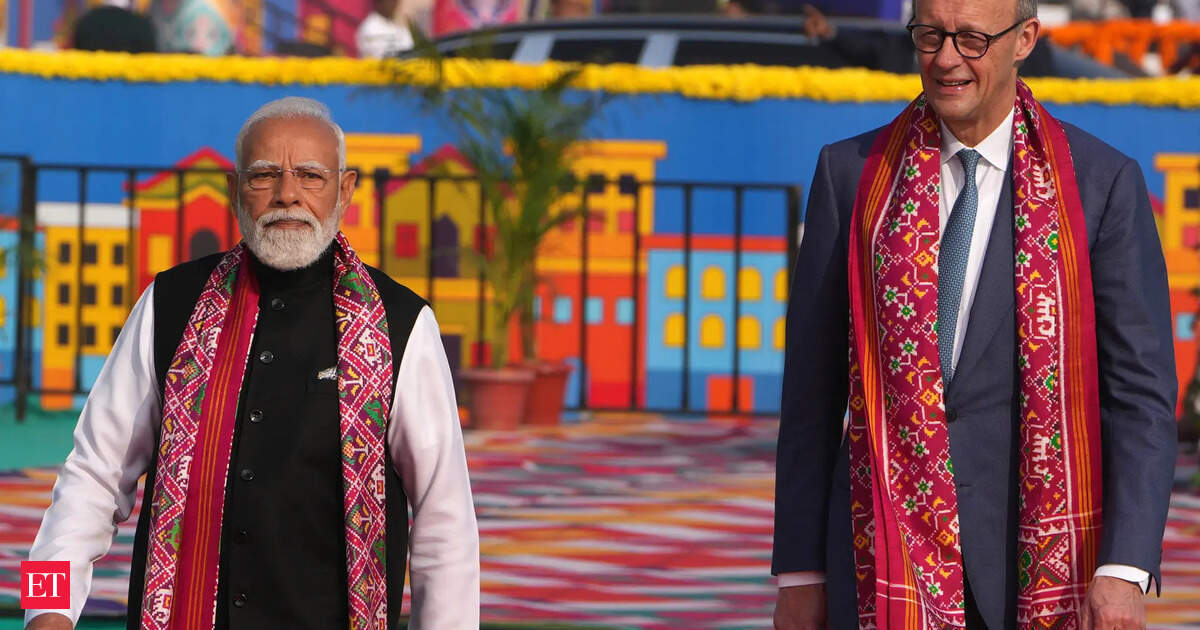
Germany’s growing prominence in India’s European outreach is evident in the breadth of outcomes from Chancellor Merz’s visit. Bilateral trade crossing $50 billion in 2024, which is over a quarter of India’s total trade with the EU, highlights Germany’s role as India’s principal economic gateway to Europe. The presence of 23 leading German CEOs alongside Merz underscores a private-sector-driven momentum that goes beyond symbolism. Germany’s advanced manufacturing ecosystem, particularly in automobiles, machinery and green technologies, aligns closely with India’s domestic industrial ambitions.
What distinguishes India’s engagement with Europe today is its expanding strategic depth. Historically, India’s defence ties with Germany were limited, but that constraint is now eroding. A possible collaboration between Thyssenkrupp and Indian firms to build advanced conventional submarines in India represents a shift toward defence industrial cooperation rather than simple arms purchases. This mirrors the role the U.S. once played as a key defence partner, though now with a stronger emphasis on technology transfer and domestic manufacturing under India’s self-reliance agenda.
The EU FTA is a structural breakthrough
The anticipated India-EU free trade agreement marks a potential inflection point. Long stalled by regulatory and political differences, negotiations have gained urgency amid global trade disruptions. Chancellor Merz’s indication that the agreement could be finalised by the end of January reflects an alignment of economic interests on both sides. For India, the FTA offers preferential access to one of the world’s largest integrated markets at a time when U.S. tariffs are eroding competitiveness. For Europe, India represents a high-growth market capable of absorbing exports and attracting investment as transatlantic and China-centric supply chains become less reliable.

Europe’s increasing relevance for India is also shaped by shared vulnerabilities. German industry has suffered from Chinese export controls on critical minerals and semiconductors, while India has long sought to reduce dependence on concentrated supply chains. Cooperation in semiconductors, critical minerals and advanced manufacturing reflects a convergence of interests driven by the U.S.-China trade war and China’s retaliatory measures. In this sense, Europe is not merely becoming a new market for India but also a partner in building resilient, diversified supply chains.
Germany’s engagement is part of a wider European mobilisation. France’s diplomatic preparations for President Macron’s upcoming visit, Poland’s outreach through its foreign minister and the revival of formats such as the India-Weimar Triangle illustrate a coordinated continental approach. India’s diplomacy mirrors this trend. External Affairs Minister S. Jaishankar’s recent engagements in France and Luxembourg, and his emphasis on strengthening India-EU ties, demonstrate that India now views Europe as a unified strategic space rather than a collection of bilateral relationships.Europe can gradually perform the role of economic balancer for India amid trade tensions with the U.S. Unlike the U.S., European leaders have framed cooperation with India in terms of shared resistance to protectionism rather than coercive conditionalities. Chancellor Merz’s remarks on the “renaissance of unfortunate protectionism” resonate strongly with Indian concerns. This rhetorical and policy alignment reinforces Europe’s appeal as a stable, rules-based partner at a time of global fragmentation.
India’s deepening engagement with the EU is not a short-term response to U.S. tariffs but a structural realignment in its foreign economic policy. Trade, defence, technology, climate action and higher education are now woven into a comprehensive partnership that increasingly mirrors, and in some respects might also replace, the role once played by the U.S.