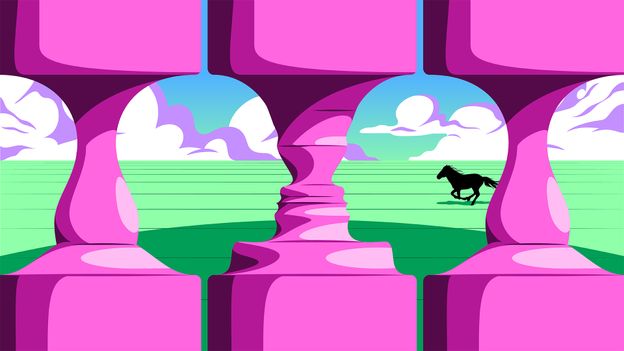
Inspired by this work, Ivan Maksymov, a research fellow at Charles Sturt University’s Artificial Intelligence and Cyber Futures Institute in Bathurst, Australia, developed a model that combined quantum physics with AI to see if it could simulate the way we perceive the Necker cube and a similar illusion called Rubin vase, where we see either a vase or two faces in profile. He designed a deep neural network that processes information using a phenomenon called quantum tunnelling. The system was then trained to recognise the two illusions.
When one of the illusions was input into the system, it would generate one of the two interpretations. Maksymov found that the AI would regularly switch between each of them over time – much as humans do. The time intervals of these switches were similar too.
“It’s quite close to what people see in tests,” he says.
Maksymov doesn’t think this suggests that our brain has quantum properties, although it is an active field of research. Instead, he thinks that it shows that certain aspects of human thought, such as how we make decisions, can be better modelled by using quantum theory, the basis of a field called quantum cognition. With the illusions, our brain is choosing one version or the other, for example.