Staff Writer Isabella Steiner examines the recent capture of Nicolás Maduro within the wider context of the crises Venezuela has faced for the last 26 years, and what a future for Venezuelans, by Venezuelans might look like under the watchful eye of the Trump administration.
Since the rise of Hugo Chávez in 1999, and even more since Nicolás Maduro’s rise to power, the people of Venezuela have been held hostage long enough to feel as though any hope for political change has long been obliterated under their feet. Decades of poverty, fraudulent elections and imprisonment of opposition leaders has forced around eight million Venezuelans to flee their nation.
As a Venezuelan, this is not a distant crisis I suddenly became aware of when the US captured Nicolás Maduro in the military operation ‘Absolute Resolve‘. The situation in Venezuela is a reality I have witnessed and carried with me as a Venezuelan immigrant, who hasn’t returned to her country or seen her family since migrating in 2018.
Venezuela has suffered through years of political oppression, nearly eight million people needing humanitarian aid and a monthly minimum wage of 130 bolivars (£0.30) which has not increased since 2022. The inflation rate is estimated to be at 682% by the International Monetary Fund, sending “the cost of food beyond what many can afford“. It is therefore greatly surprising that the crises in Venezuela seem to have now somehow been reduced to focus on the capture of its dictator.
.jpg) Credit to: Reg Natarajan, CC BY 2.0 , via Wikimedia Commons, available at https://commons.wikimedia.org/wiki/File:Venezuelan_Refugees_in_Bogot%C3%A1_Selling_Crafts_Made_of_Worthless_Venezuelan_Cash_%2849070277587%29.jpg
Credit to: Reg Natarajan, CC BY 2.0 , via Wikimedia Commons, available at https://commons.wikimedia.org/wiki/File:Venezuelan_Refugees_in_Bogot%C3%A1_Selling_Crafts_Made_of_Worthless_Venezuelan_Cash_%2849070277587%29.jpg
Abuses and Fraudulent Elections by the Venezuelan Government
In a December 2025 update on the situation in Venezuela to the Human Rights Council, UN High Commissioner for Human Rights Volker Türk stated that, “Journalists, human rights defenders, opposition figures, and even humanitarian workers continue to face threats, harassment, and the risk of arbitrary detention – simply for doing their jobs.” He also expressed deep concern regarding a “persistent lack of food and medicine and the denial of family visits” in detention centres.
Hence, for Millions of Venezuelans across the globe, Maduro’s capture and indictment by the US government on the basis of narcoterrorism, and drug trafficking is not something to repudiate. Rather, it marks a seemingly definitive action taken against a government whose alleged electoral victory in 2024 was rejected by all 27 EU foreign ministers and the US, along with the United Nations Panel of Electoral Experts and the Carter Center, who “raised serious concerns about the legitimacy of the results“.
Human Rights Watch published a report in April 30, titled Punished for Seeking Change: Killings, Enforced Disappearances and Arbitrary Detention Following Venezuela’s 2024 Election, detailing the various human rights abuses that occurred in the wake of the election, “implicat[ing] Venezuelan authorities and pro-government groups” for these abuses.
And although it may be difficult for Western nations to believe, Maduro’s capture goes deeper than the US being imperialistic. And it is of great concern to millions of Venezuelans across the globe that the criticism of Trump’s actions appears to be louder than the global condemnation expressed against Maduro’s government over the last decade.
This does not deny that by definition, Trump has illegitimately breached international law by entering another country via military force and infringed on Venezuela’s sovereignty. Nor does it deny the consequences and dangers of foreign intervention, particularly by the US in South American countries (e.g. Ecuador in 1963, Brazil, Chile, and Bolivia in 1964, and Panama in 1981).
But the suffering of Venezuelans is not about ideological theory or rhetoric. It is about the country’s popular sovereignty having already been breached by its own government for years. As American-Venezuelan journalist Mariana Atencio noted, “When a country’s wealth funds repression while ordinary people can’t reliably get the basics, ‘sovereignty’ becomes a word used against the very people it’s supposed to protect.”
In 2024, opposition leader María Corina Machado (the 2025 recipient of the Nobel Peace Prize) and her unity candidate Edmundo González, ran for presidency, triumphing with over 70% of the national vote. Yet, instead of stepping down and delegating the presidency to the opposition, the “Maduro-controlled National Electoral Council (CNE)” announced fraudulent election results of 51.20% of the national vote, giving Maduro the “victory”. With these falsified results, Maduro foiled yet another attempt by the Venezuelan populace to democratically change their government.
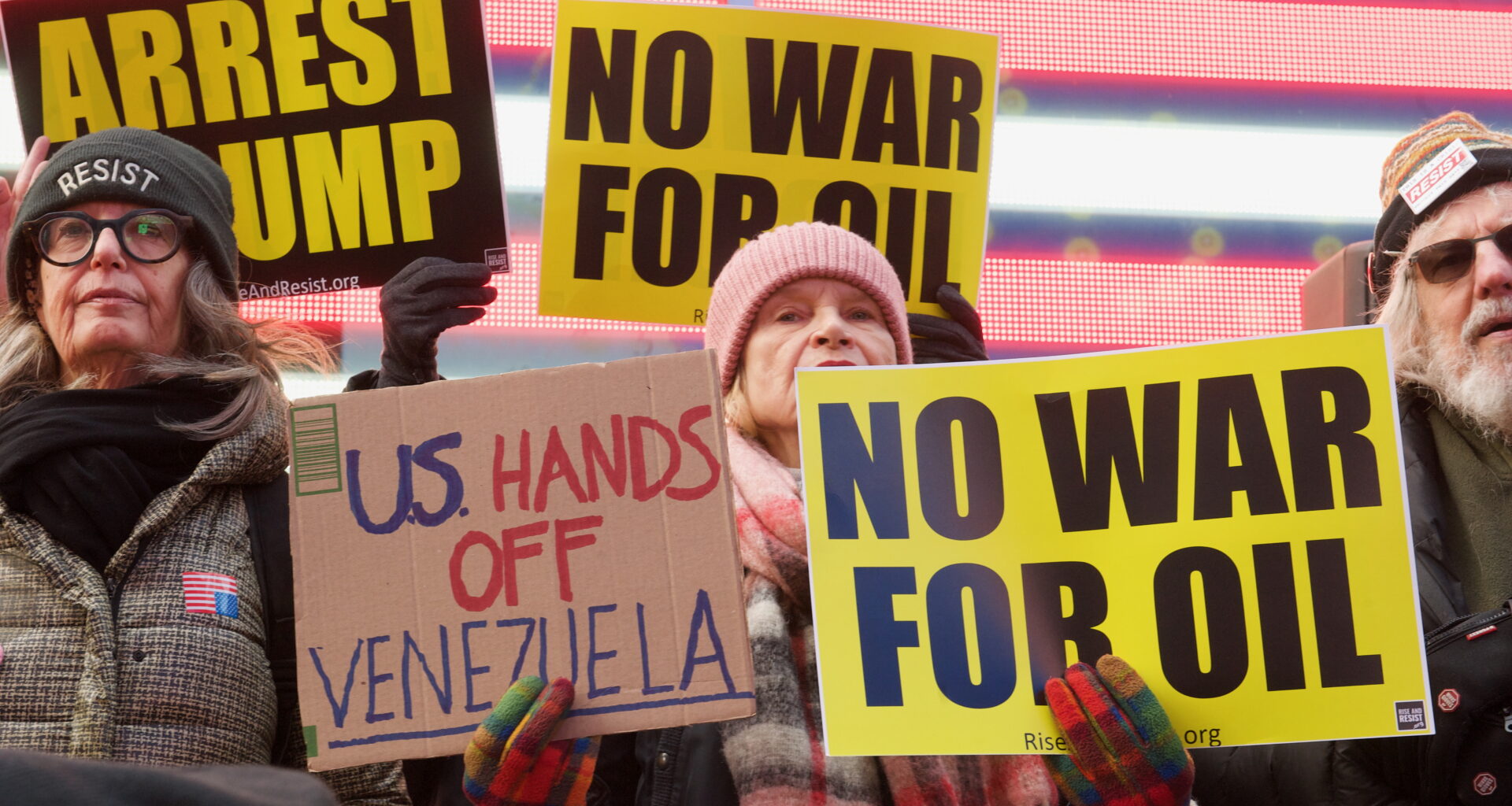
This is what protestors across New York, Canada, and London chanting “Free Maduro right now!” or writing “Hands off Venezuela” on their placards “Yankee go home,” fail to understand. The same words they chant and write are borrowed from the playbook the Maduro regime have used to keep themselves in power for so long.
 Credit to: SWinxy, CC BY 4.0 , via Wikimedia Commons, available at https://commons.wikimedia.org/wiki/File:2026-01-03_Venezuelan_protests_in_NYC_021.jpg
Do Trump’s Primary Interest Truly Lie in Venezuela’s Oil?
Venezuela currently holds the largest crude oil reserves in the world. With 303 billion barrels, this amount surpasses leading countries such as Iran and the United Arab Emirates. Venezuelans like myself do not believe that Trump has come as a pioneer of democracy to be praised without any skepticism. To have that conviction would suggest we are naive and unacquainted with familiar patterns of US foreign policy.
Trump’s oil aspirations are no secret, especially following the US seizure of an oil tanker called ‘Skipper’ off the coast of Venezuela in December 2025, after which Trump stated, “We’re going to keep it.” However, the incessant violation of Venezuelans basic human rights and their unsuccessful attempts at voting Maduro out has forced an unpleasant question upon us: might freedom from an oppressive regime be worth the seizure of Venezuelan oil by an intervening foreign power?
The international community’s concerns about the US exploiting Venezuela are legitimate. However, the oil industry in Venezuela has long been deeply mismanaged and heavily affected by “lack of investment and sanctions”. Thus, to profit from Venezuelan’s oil sector, the US might have to invest “$100 billion or more” and possibly require “a decade to fix it” and of course, lift sanctions.
Venezuela Faces Other Potential Threats
Making the oil industry profitable will not be the only hurdle the Trump administration will face in Venezuela. Although the US removed Maduro, there is still a real danger that the same government remains in power, simply without Maduro as its acting head. Many of the key players of the Chavismo government such as Diosdado Cabello (Minister of Interior, Justice and Peace), Delcy Rodríguez (the former Vice President, now interim President) and her brother Jorge Rodríguez (President of the National Assembly) retain significant real and soft power.
Another significant threat to Venezuelan stability is posed by the notorious “colectivos”, paramilitary groups loyal to Maduro, who have been used to repress opposition. For instance, in 2014, during the zenith of civilian-led protests, the colectivos attacked government protestors and sent death threats to reporters.
This might explain Trump’s worrisome comment made during a recent Mar-a-Lago press conference where he claimed that Machado, the opposition leader, does not have domestic respect or support to govern.
This comment was concerning for many Venezuelans who consider Machado to be a vital facilitator of Venezuela’s fight for democracy. It also exacerbated anxieties over the US administration’s interest being purely about oil without the inclusion of a legitimate change in government.
However, placing Machado in power now would likely be unwise, risking both her life and Venezuela’s future, as the previously mentioned members of Maduro’s government and colectivos still seem to have enough power that they could prevent Machado from making any successful shift to the country’s structure.
The possibility of a coup d’etat would also proliferate even further, especially as interim president Delcy Rodriguez stated on January 5th that she “won’t rest her arm” until she sees Venezuela in its rightful destiny.
While it could be argued that Trump’s interest in the country is not at all altruistic, if this intervention, unlawful as it may be, results in a democratic regime change, a transactional relationship with the US may be acceptable to Venezuelans because, “…the demand for change is not ideological, or or limited to new leadership. Venezuelans want change in their quality of life.“
Arguably, for the US to profit from oil, there may need to be a change in Venezuelan government, Venezuelan foreign policy, and alliances, as Maduro had strong ties and economic arrangements with Iran, China, and Russia.
There are other reasons as to why Trump might possibly be skeptical of Venezuelan opposition bringing legitimate political change.
Former political leaders such as Henrique Capriles, a politician who opposed Hugo Chavez in the 2012 elections and then opposed Maduro, now hesitates to outright condemn the Maduro regime. In an August 2025 interview with the BBC he stated, “Maduro is in power today and there is no sign that there is an internal fracture within the institutionality that defends and supports him.” As a result, some now perceive him as a traitor, as this comment seemed to suggest that he abandoned the fight for Venezuelan freedom.
Similarly, Juan Guaidó, another prominent leader of the opposition who was Venezuela’s interim president between 2018 and 2021, faced accusations of internal corruption and embezzlement of aid money, tarnishing the opposition’s reputation in the international community.
Machado, unlike the opposition leaders above, seems to have been loyal in her fight to bring freedom to Venezuela, arguably giving Mr. Trump no legitimate reason to distrust her mission for a free Venezuela. Considering this, Trump’s remarks on Machado are and should be more unsettling, to Venezuelans and non-Venezuelans alike, increasing doubts Trump’s plan might potentially not include a democratic regime change.
So Where Does This Leave Us?
Trump has done the heavy lifting of removing Maduro from power, but the future of Venezuela remains uncertain, especially in the hands of the Trump administration. This tasks the international community across the West with focusing less on futile protests with misleading rhetoric and rather ensuring that the “human rights” they so loudly tout are actually protected in Venezuela.
Optimally, this would include supporting Machado and Edmundo González’ efforts to be re-elected to govern, and for Maduro’s loyalist circle to be ousted from the country they are responsible for damaging. If the US is to be involved in this transition, the international community should help ensure that President Trump and his administration fulfil their promises of granting Venezuelans a “safe, proper and judicious transition”. This would truly protect the real sovereignty and freedom that Venezuelan children and families like my own have long yearned for.
 Credit to: Kevin Payravi / WikiPortraits, CC BY 4.0 , via Wikimedia Commons, available at https://commons.wikimedia.org/wiki/File:Mar%C3%ADa_Corina_Machado_greeting_crowd_during_Nobel_Week_2025_02.jpg