Nothing much shocks us anymore regarding the Guardian’s malign obsession with the Jewish state.
So, while it normally would be surprising, to say the least, for a major British outlet to focus on Israel in an editorial about a major Iranian uprising against the despotic Islamist regime, we didn’t blink an eye when we saw that their official ‘Guardian View” on the protests was on both the Israel and Iran pages of their site.
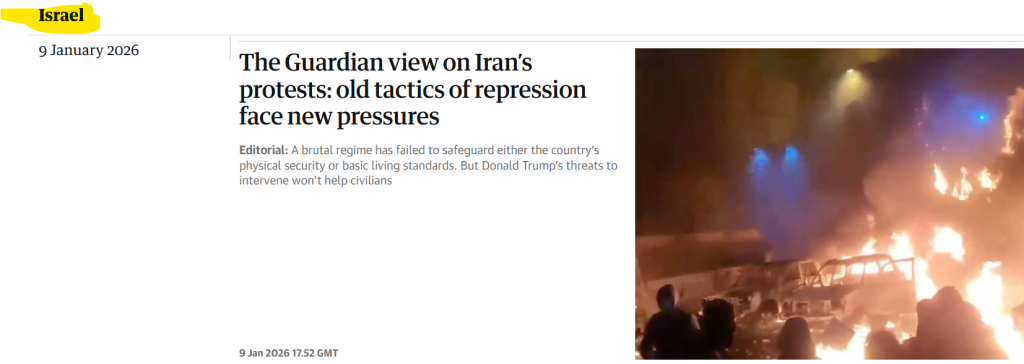
After five paragraphs (313 words) of timid criticism of Iran’s government, which, unsurprisingly, cited a death toll from the regime’s violent repression of the protests that was lower than even the lowest estimates by human rights groups at the time, Guardian editors devoted most of the final three paragraphs (223 words) highlighting the role of Israel and the dangers of Donald Trump’s threats of military action.
Here are the two most relevant paragraphs:
Following his reckless and illegal seizure of Venezuela’s Nicolás Maduro, Mr Trump’s threats may give the leadership some pause for thought. But they have also allowed it to delegitimise Iranian citizens with genuine, deeply held grievances as the pawns of foreign aggressors.
Flush with victory from the Venezuela decapitation, Mr Trump seems to believe that there are easy wins from foreign intervention. Benjamin Netanyahu has talked up the possibility that “Iranian people are taking their fate into their own hands” and has a history of persuading the US president into reckless and dangerous ventures. An Iran embroiled in domestic chaos would suit the Israeli prime minister well. But Iranian civilians and others in the region would pay the price.
Presumably, this “history” of persuading the US president into reckless and dangerous ventures” editors are referring, in part, to the US President’s decision to take part in the June war between Israel and Iran by bombing three of the country’s nuclear sites – despite the fact that there were no US (or Iranian) casualities from the operation.
They also evidently believe that the US Air Force was ordered to attack the Fordow Uranium Enrichment Plant, the Natanz Nuclear Facility and the Isfahan Nuclear Technology Center not based on Trump’s own long-held animosity towards the Islamic Republic (or that of his Secretary of State), or because it’s been US policy for decades to deny Iran nuclear weapons, but, rather, because of Netanyahu’s persuasion.
Though the Guardian editorial’s narrative on Israel’s putative influence over Western policy is more subtle than in the past, it nonetheless represents another example of the outlet evoking the toxic, conspiratorial ‘Israeli dog wagging the US tail’ libel. Indeed, as we documented here at the time, following the US strikes on June 22, Andrew Roth, the Guardian’s global affairs correspondent, wrote an analysis denying the mercurial US president agency, writing that “the Israeli PM has manoeuvred the US into striking Iranian uranium enrichment sites”.
Additionally, the Guardian – as always – fails to provide vital context about Iran’s malign influence in the Mid-East, which of course includes their vital financial and military support for Hamas’ Oct. 7 massacre, their proxy militias in Lebanon, Yemen and Iraq, as well as their role in the murder of scores of Americans since the 1979 revolution.
In addition to Tehran’s ubiquitous “Death to America” threats, which Iranian Supreme Leader Ayatollah Ali Khamenei made clear is a policy, not just a slogan, the regime and its proxies have committed scores of deadly attacks against Americans, and attempted assassinations of US leaders, over the decades.
However, even leaving aside the editorial’s predictable, though nonetheless disgraceful, Israel angle, it’s notable that the piece didn’t use the term “human rights” once, despite the fact that the country has one of the worst records on political rights and civil liberties on the planet – falsely framing the protests, instead, as solely about economic issues.
The editorial by the outlet – which, in should be noted, published a propagandistic opinion piece by Iran’s foreign minister on the third day of the protest – can be understood by quoting from a Free Press essay by Yascha Mounk on what he termed the “deafening silence” by many Western leftists on what’s arguably the most important human rights story.
“For far too many progressives and leftists”, Mounk wrote, “their founding commitment is not to some principle or aspiration for the world.” It is, instead, “to believing that their own countries and societies are at the root of profound evil”. This, he added, “creates in their minds a simple demonology: Anybody who is on “our side” must be bad, and anybody who is on the “other side” is presumptively good”.
While the Guardian won’t go all the way toward celebrating Khamenei, his country’s role as an enemy of the Jewish state they loathe means that their editors will never bring themselves to encouraging the downfall of the totalitarian regime and ‘axis of resistance’ he built.
Related Posts
Telegraph corrects article on Angelina Jolie’s Gaza visit