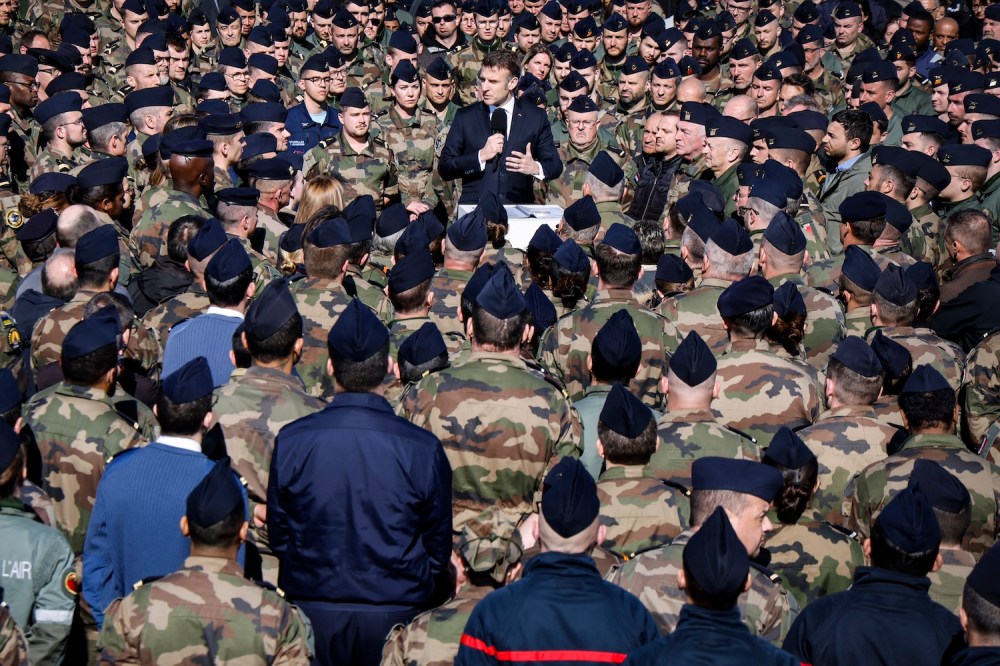
Rarely have so few done so much to unsettle so many. Over the past few months, political and military leaders in France, with their eyes fastened on Russia, have declared that while their fellow citizens might not be interested in war, war is nevertheless interested in them. Not just any war, moreover, but one whose hybrid character—already apparent in Russia’s use of rogue drones and cyberattacks in NATO countries—will be unprecedented and whose timing, with the fraying of traditional alliances and weakening of national economies, could not be more unfortunate. Contrary to the old saw that generals always plan for the last war, the French military is now scrambling to plan for the next war.
Its efforts, however, have been haunted by ghosts of wars past.
Rarely have so few done so much to unsettle so many. Over the past few months, political and military leaders in France, with their eyes fastened on Russia, have declared that while their fellow citizens might not be interested in war, war is nevertheless interested in them. Not just any war, moreover, but one whose hybrid character—already apparent in Russia’s use of rogue drones and cyberattacks in NATO countries—will be unprecedented and whose timing, with the fraying of traditional alliances and weakening of national economies, could not be more unfortunate. Contrary to the old saw that generals always plan for the last war, the French military is now scrambling to plan for the next war.
Its efforts, however, have been haunted by ghosts of wars past.
Last November, France’s military chief of staff, Fabien Mandon, addressed the annual conference of mayors. Rather than the usual boilerplate, his speech had the impact of a bomb. The soft-spoken general warned that, given Russia’s actions since its 2008 invasion of Georgia, Europe’s flaccid responses have convinced Russian President Vladimir Putin that “Europeans are weak.” And Putin, Mandon continued, was right to come to this conclusion. “We live in a risky world and may have to use force to protect who we are,” he observed, yet the French refuse to acknowledge this reality. The subject of war has “completely disappeared from our family discussions,” he remarked, yet the near future portends the likelihood that his fellow citizens will “suffer economically because priorities will go to defense production.” After a pregnant pause, he concluded that the nation must be “ready to accept losing its children.”
Mandon’s speech sparked a firestorm of outrage. The leader of the far-left La France Insoumise, Jean-Luc Mélenchon, lambasted Mandon’s call for the French to accept “without being asked … sacrifices that would result from our diplomatic failures.” The only prominent political figure to rally to Mandon’s speech was Raphaël Glucksmann, a European deputy and co-leader of the party Place Publique. In a statement, he slammed the “ostriches” who by attacking Mandon reflect “the power of denial and the spirit of capitulation at the heart of the French political class.” At the other political extreme, the vice president of the far-right National Rally, Sébastien Chenu, also questioned the general’s legitimacy to make such claims. Such decisions, he insisted, belong to the so-called “domaine réservé,” the phrase identifying those responsibilities that belong to the president.
Yet President Emmanuel Macron’s response was yet another instance of his famous “en mème temps,” where “at the same time” he would join two apparently contradictory notions. Shortly after Mandon’s speech, government spokesperson Maud Bregeon sought to reassure the nation. “Let us be clear: Our children are not going to fight and die in Ukraine,” she said. Yet in a national address a few days later, one perhaps timed to follow Mandon’s initial sortie, Macron revealed his “other hand.” Declaring that the “nation must not give way to fear or panic, lack of unpreparedness or division,” he warned that dangers cannot be solved by avoiding them. Instead, “they can be avoided only if we prepare for them.” Trying to put some heft to his claim, Macron then announced plans to reintroduce a national military service that would lead to 50,000 recruits by 2035.
Macron thus violated the hard rule that his hero Pierre Mendès-France acted on when he became prime minister in a crisis-plagued France in 1954: “Gouverner, c’est choisir.” Instead, for Macron, to govern is to choose not to choose, at least for now. He did not propose to resurrect national conscription and its fabled lévée en masse, a practice that had continued ever since the French Revolution and was ended in 1996 by President Jacques Chirac. Instead, it would be voluntary, if only at first.
In this regard, Macron took the same path that his neighbor on the eastern front had first blazed. Last month, German Defense Minister Boris Pistorius pushed through his government’s bill on military conscription and emphasized that military service would, at first, remain voluntary. But if the various means to attract new recruits through enhanced salaries and training fall short—something the German government, thanks to its greater margin of financial maneuver, enjoys unlike a seriously pinched France—it seems clear that both countries might have no choice but to revert to mandatory conscription. (Tellingly, German Chancellor Friedrich Merz argued, unsuccessfully, against this approach, calling for an immediate reintroduction of the draft.)
The bleeding of the past into the present helps explain the care and caution being exercised by the political leadership in France, as well as Germany and even Britain. The past has warps and memory wefts that weave and carry into the present. Though worn through overuse, William Faulkner’s observation remains apt: “The past is never dead. It’s not even past.” The past is especially not dead when, paradoxically, it involves the dead. Perhaps the most telling response to Mandon’s speech came from Fabien Roussel, the leader of the French Communist Party. Upon hearing Mandon’s “chilling” remarks, he exploded on social media, “Are the 51,000 monuments across France to fallen soldiers not enough?”
What Roussel did not say, no doubt because he assumed most everyone in France knew it, is that these monuments are scattered across the nation, often located in the main squares of towns or in front of mayoral buildings. There is no common theme to the monuments; some feature an idealized poilu, or soldier, towering above the inscription “Glory to our heroes.” Others are simply granite steles reaching skyward, with the simple inscription “To our children who died for France.” Yet others support a mourning mother and children, with a laconic “To our dead” engraved on the base. “The notion of erecting monuments to the dead in France did not start with the ‘Great War,’” the historian Antoine Proust notes, “but no war was ever as great as that war.”
Indeed. More than 8 million were called to the colors—this phrase itself bathed in meaning—between 1914 and 1918, 1.4 million killed, and three times that many wounded, including the thousands of “gueules cassées,” or “broken faces,” who served as another kind of monument to the inhuman nature and costs of the war. This experience sped up the growth of pacifism in France during the interwar period, one that remains alive today, thanks to France’s catastrophic wars in Indochina and Algeria. Roussel’s outburst, shared by other political figures—especially those on the far left and far right—serves as an important reminder.
But another element must not be overlooked. The sacrifice that the French are now being asked to accept is no longer on behalf of the patrie but instead on behalf of Europe. In the lead-up to World War II, the battle cry of French opponents to war was that, in a phrase coined by the collaborationist Marcel Déat, they refused “to die for Dantzig.” (The German name for present-day Gdansk in Poland.) But the French government is now asking young people to be willing to die for Kyiv. The reestablishment of voluntary service, as the historian Annie Crépin rightly observes, “is a half-measure to persuade the public to accept the idea that Ukraine … is indirectly our new frontier.”
Regardless of the words used by political and military leaders, the public remains sharply divided on the growing prospect of war against Russia and the burning question of military conscription. According to the political scientist Bertrand Badie, the French public falls roughly into three camps on the question of Russia: those who are indifferent, those who dismiss the prospect of war, and those who fear “a return to Chemin des Dames”—the site where perhaps the most senseless slaughter of French troops occurred in during World War I. Moreover, while Macron’s initiative to create a volunteer army wins overwhelming support, it is nevertheless more pronounced with older than younger generations, a division that sharpens markedly when it is a matter of mandatory conscription.
In 1981, the British historian Michael Howard observed that his generation, born shortly before World War II, knew “from experience that no society has dispensation from catastrophe, and that history provides no sure formula for avoiding one.” Certainly, there is no clear formula for Europe’s political leaders for avoiding the next one, but surely it must involve finding not just the money to fund the current effort but also the words to bridge generational and political divides, convincing as many as possible that patriotism must be European or cannot be at all.