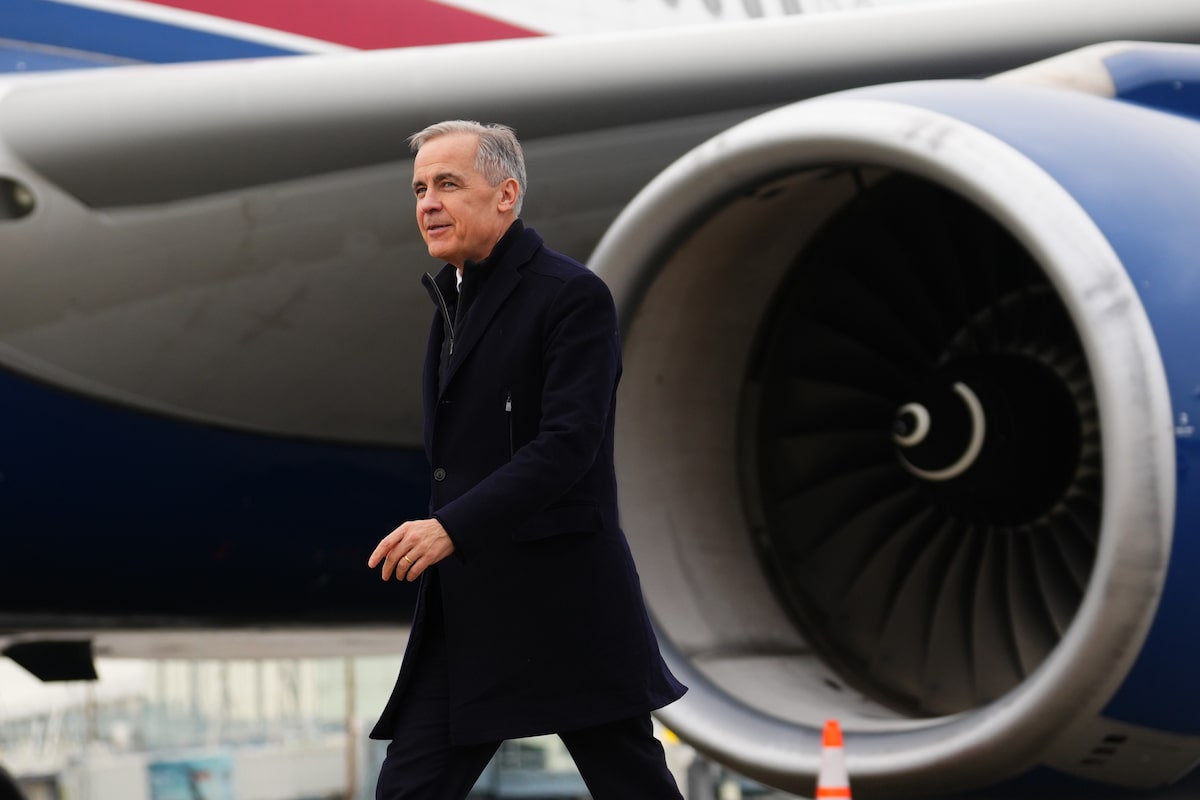
Prime Minister Mark Carney departs Vancouver International Airport on Tuesday for a nine-day trip to China, Qatar and Switzerland.Sean Kilpatrick/The Canadian Press
U.S. President Donald Trump said Tuesday the United States-Mexico-Canada trade agreement is “irrelevant” to him, a day before Prime Minister Mark Carney was set to arrive in China for a visit aimed at repairing frayed economic ties with Beijing.
Mr. Trump, speaking during a visit to a Ford auto assembly plant in Dearborn, Mich., sought to focus attention on his economic agenda at a time of heightened anxiety about affordability and job growth.
“There’s no real advantage to it, it’s irrelevant,” Mr. Trump said of the USMCA. “Canada would love it. Canada wants it. They need it.”
The comment was an especially pointed dismissal of the USMCA from a president who has repeatedly expressed ambivalence toward the agreement, which was negotiated and signed during his first term.
His statements have rattled Canada and Mexico ahead of an expected renegotiation this year of the continental trade pact. Dominic LeBlanc, the minister in charge of Canada-U.S. relations, is set to meet with U.S. counterparts in mid-January to launch formal USMCA talks.
The USMCA continues to shield most Canadian exports from the punitive tariffs Mr. Trump has introduced during his second presidency.
But he has imposed some tariffs that apply regardless of the USMCA, including levies on the non-U.S. content in automobiles assembled in Canada and Mexico. And he has repeatedly said, including during his Dearborn visit Tuesday, that the U.S. doesn’t need Canadian-built vehicles at all. Major automakers, whose supply chains grew to encompass all three countries over the course of decades of continental free trade under the USMCA and its predecessor, the North American Free Trade Agreement, have called for the USMCA to be extended.
The uncertainty Mr. Trump’s trade agenda has created for Canada’s auto industry is likely to weigh on Mr. Carney as he arrives in China on Wednesday. Among the topics he is expected to discuss with Chinese officials, including President Xi Jinping, is Canada’s 100-per-cent tariffs on Chinese electric vehicles, introduced in co-ordination with then-president Joe Biden as part of a strategy to defend the continental auto industry from inexpensive imports.
Opinion: Canada needs less confrontation with China and more trade
Lifting the tariffs could help revive trade with China, which has imposed countertariffs on Canadian agricultural exports, and provide a useful counterbalance to Mr. Trump’s protectionist economic policy.
But such a move could also endanger Ottawa’s delicate relationship with Mr. Trump, who has sent signals he expects allies to support his tough-on-China agenda. And it could layer more pressure on a domestic auto industry already under threat from Canada’s largest trading partner, the U.S.
Chris LaCivita, the co-manager of Mr. Trump’s 2024 presidential campaign, appeared to reference the possibility of a rupture with the President in a social-media post on Tuesday.
“Prediction – this won’t end well for Carney,” Mr. LaCivita wrote in response to a news story that said China wants Canada to break from U.S. influence as part of this rekindling of the Ottawa-Beijing relationship.
In Toronto, Ontario Premier Doug Ford, whose province is home to much of the country’s auto industry, repeated his opposition to the lifting of Canada’s tariffs on Chinese-made electric vehicles on Tuesday, but said he had not spoken to Mr. Carney about the issue in advance of his trip to Beijing.
Mr. Ford said he was “100 per-cent dead set against” lifting the EV tariffs.
Saskatchewan Premier Scott Moe, who is joining Mr. Carney in China, and others have called for an end to the EV tariffs, to get China to lift its retaliatory action on Canadian soy and canola. Mr. Ford said he understood that Mr. Moe also had to advocate for jobs in his province, but that he was focused on saving Ontario’s auto sector.
“It would not be good for Ontario and Canada, and sure the heck it wouldn’t be good for the U.S.,” Mr. Ford said. “And it wouldn’t be good for negotiating with President Trump.”
But Mr. Ford also reiterated his position that he would be open to easing the EV tariffs if Chinese automakers committed to building plants in Canada and hiring Ontario workers.
“If they’re willing to come here, invest in a plant, just like GM, Stellantis, Ford, Volkswagen, Honda, Toyota, and come here and manufacture and create jobs and create parts here, well now we’re on a whole different page,” Mr. Ford said.
The Premier said he would text Mr. Carney on Tuesday and voice his concerns and that he expected to sit down with the Prime Minister after his return from China, along with other premiers.
“He knows how I feel, very clearly,” Mr. Ford said. “I’ll be reaching out to him.”
Mr. Ford was also at odds with Manitoba Premier Wab Kinew, who repeated a public plea to urge Mr. Ford to drop his plan to ban Crown Royal whisky from Ontario liquor-store shelves. The Ontario Premier has threatened the unusual move to punish the brand’s British parent company, Diageo PLC, for shutting down a bottling plant in the province.
But the liquor is made in Gimli, Man., where Mr. Kinew spoke to reporters on Tuesday and warned that Mr. Ford’s ban would cost jobs there.
“God bless him. He’s doing his job,” Mr. Ford said of Mr. Kinew. “He’s trying to protect jobs in Manitoba. I’m protecting jobs here in Ontario. And he respects that and I respect him.”
With reports from Steven Chase, Jeff Gray and Reuters