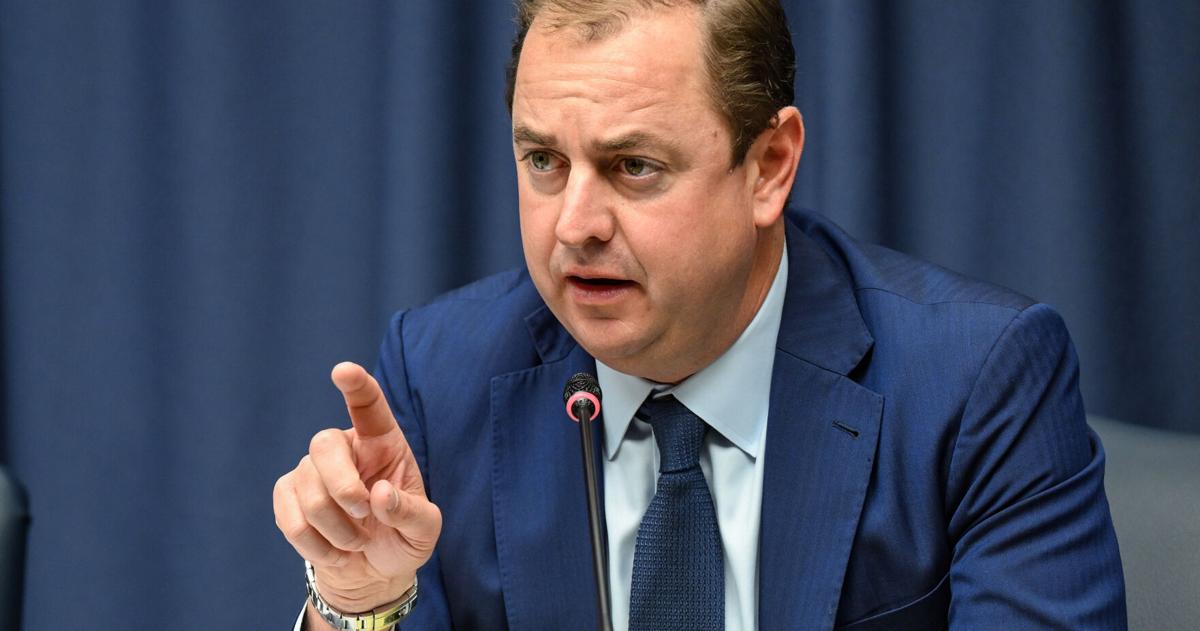
A prominent state lawmaker is facing allegations of using his perch as chair of the state Senate Health and Welfare Committee to enrich his personal furniture business, with competitors claiming he has cornered much of the market in the local health care sector.
State Sen. Patrick McMath, R-Covington, who owns Southern Interior Solutions, has won several contracts from health systems affected by his committee, according to an investigation by WWL-TV.
Several furniture dealers told the station that competing with the powerful lawmaker “contradicts industry standards for fairness” and risks putting health systems in “potentially compromised positions.”
“As small business owners, we expect a level playing field without the optics of or potential for political influence,” said the owners of CI Group, Workplace Solutions, AOS Interior Environments and IDI Workspaces in a statement to WWL-TV. “Louisiana small businesses should not have to compete in the private and public sectors with elected officials who hold legislative or regulatory decision-making over the entities with which they seek to do business.”
McMath does not appear to be violating state ethics laws, which only prohibit lawmakers contracting with the state government.
The lawmaker, who has risen to prominence in part by championing legislation in line with Robert F. Kennedy Jr. and President Donald Trump’s “Make America Healthy Again” movement, denied wrongdoing.
In a response to questions from The Times-Picayune, McMath said by text message that his company first landed health care contracts before he was elected, and that his business dealings don’t influence his legislative work. He added that he’s been careful to not violate state ethics laws.
“Louisiana has a part-time legislature, and the ethics code is designed to allow people to maintain private businesses — but only within clear boundaries. I take those boundaries seriously, and I’ve stayed within them,” McMath said. “I also understand why competitors who are losing business might be frustrated. But frustration isn’t an ethics standard. We compete on price, service, and performance — and we win on those terms.”
Lawmakers say it’s a byproduct of the state having a part-time Legislature, and they’re doing nothing wrong. But critics in the past have said state lawmakers should do more to disclose how their work at the Capitol also affects their personal pocketbooks, and the state should adopt stronger ethics laws.
Few state lawmakers have faced consequences at the Louisiana Ethics Board. When they have, the cases have largely centered on campaign finance problems rather than concerns about how they used their political cache.
Before Louisiana reformed its ethics system in 2008, lawmakers sometimes got in trouble for self-dealing. Former speaker of the Louisiana House Charlie DeWitt, for example, paid a $5,000 penalty over an instance in 2003 when he proposed legislation to help the New Orleans Fair Grounds make more money from video poker. DeWitt had previously received a share in two race horses from the Fair Grounds’ owners.
State ethics laws have gone through several changes since then. Most recently, Gov. Jeff Landry and his Republican allies in the Legislature last year weakened the powers of the board that enforces state ethics laws.
WWL reported that McMath’s business has pursued several contracts with hospitals, including two parish-owned systems in his district.
In 2022, North Oaks Health System in Hammond spent $1.3 million in public funds to buy furniture from SIS, WWL reported. McMath became chair of the Senate Health and Welfare Committee in 2024, one of the most powerful assignments at the state Capitol.
John Jacobs, owner of DKI, a Metairie furniture business, told WWL that a contact at a local health system told him that they were replacing his company with SIS because they were “instructed to use SIS,” the news station reported.
Reached by The Times-Picayune, Baton Rouge-based ethics attorney Gray Sexton and New Orleans-based campaign finance attorney Stephen Gelé both declined to comment. Sexton said he represents McMath, while Gelé said he represents an entity associated with McMath.
Steven Procopio, head of the Public Affairs Research Council of Louisiana, told WWL that while the state law only prohibits lawmakers doing business with the state, the law doesn’t always cover broader public expectations.
Staff Writer Bob Warren contributed to this story.