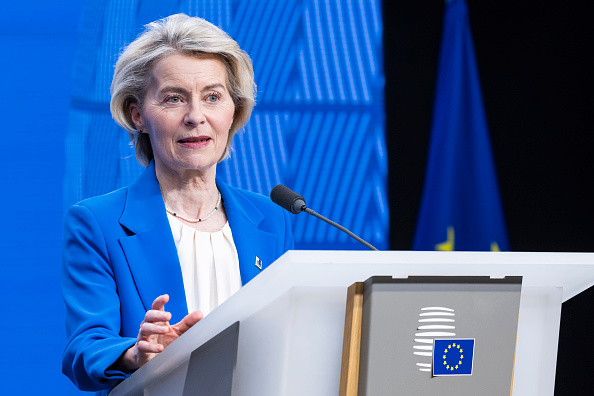
The European Commission formally presented a €90 billion loan package to Ukraine on Wednesday, as Brussels races to support Kyiv’s war effort amid increasingly fierce Russian attacks and US-led efforts to end the war.
Two-thirds of the package will be used to provide military assistance to Ukraine, which could involve procuring weapons and ammunition from outside the EU, Commission President Ursula von der Leyen said. The remaining €30 billion will be used to plug Kyiv’s looming budget hole.
Ukraine requires €135.7 billion in military and budgetary support in 2026 and 2027, according to the Commission. This includes €52.3 billion in fiscal support and €83.4 billion in military assistance. Kyiv is expected to run out of money in April, according to the Commission.
“With this support, we are making sure that Ukraine can, on one hand, bolster its defence on the battlefield and strengthen its defence capabilities – so all the military needs – and on the other hand, keep the state and the basic services running,” von der Leyen told reporters.
She added that the military support will function on a “cascading principle”, whereby the EU would only source weapons from outside the bloc if no adequate European military equipment is available.
“European preference first, and then if not possible, then the purchase abroad,” von der Leyen said.
France has long pushed for a ‘European preference’ in procuring military equipment. However, Germany and many Eastern EU countries argue that the bloc should remain open to purchasing defence equipment from Washington, despite waning US support for Kyiv and recent tensions over President Donald Trump’s threats to invade Greenland, a semi-autonomous Danish territory.
The loan will operate on the basis of “enhanced cooperation” among EU countries, allowing Hungary, Czechia, and Slovakia to opt out of the scheme. The three countries are deeply sceptical about providing financial assistance to Kyiv.
EU refuses to tap Russian reserves for Ukraine
EU leaders failed at a high-stakes summit on Thursday to agree on a plan to…
4 minutes
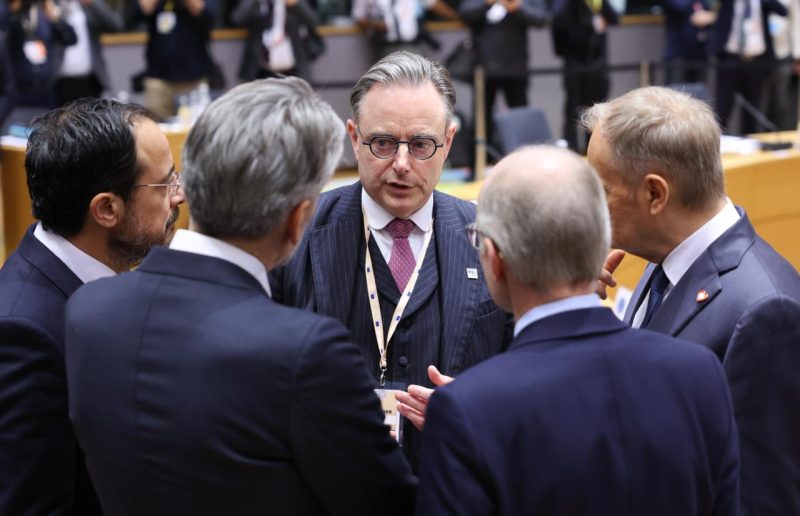
Wednesday’s proposal also comes after the Commission and Germany, the EU’s largest economy, failed last year to persuade Belgium to back a ‘reparations loan’ to Kyiv using frozen Russian sovereign assets. Belgium holds the vast majority of the €185 billion in Kremlin funds immobilised by the EU after Moscow’s full-scale invasion of Ukraine in 2022.
Von der Leyen, however, suggested that the reparations loan “remains on the table”.
“It’s … very important to send a stark reminder to Russia that we reserve the right to make use of the immobilised Russian assets,” she said, adding that the assets will remain frozen until the war ends and that Ukraine will only have to repay the loan once Moscow pays reparations to Kyiv.
The plan also follows a night of fierce bombardment by Russian forces on Ukraine, including in the Dnipro, Zhytomyr, Zaporizhzhia, Kharkiv, Kherson, Chernihiv, and Kyiv regions.
Ukrainian President Volodymyr Zelenskyy said on social media that the barrage included 113 attack drones as well as three ballistic missiles. “It is very important to reinforce our warriors now,” he said.
The loan must be approved by the European Parliament and EU countries. The Commission is aiming to make the first disbursement by April, von der Leyen said.
(vib, mm)