(Jan 14): Trade frictions across the European Union are more onerous than the highest tariff US President Donald Trump threatened to slap on the bloc last year, according to research by the European Central Bank (ECB).
Barriers such as differences in national rules and regulations, cumbersome administrative procedures and anti-competition practices are responsible for intra-EU trade costs equivalent to levies of 67% for goods and 95% for services, economists including Lucia Quaglietti and Vanessa Gunnella wrote in an article published Wednesday.
Before a trade agreement with the US clinched last summer, Trump had considered charging 50% on all shipments from the EU.
The analysis adds to the ECB’s case in pushing European governments to deliver reforms that would strengthen the bloc’s single market of 450 million people and 26 million businesses. President Christine Lagarde regularly stresses that unlocking its full potential is crucial for the economy to thrive.
“The single market delivers broad economic and strategic benefits” and “stands as Europe’s first line of defence in the face of a rapidly evolving geopolitical landscape”, the ECB economists wrote. Overcoming its limitations “is essential for further strengthening the EU’s resilience, fostering competitiveness, enhancing defence capabilities and safeguarding economic stability”.
In their article, the authors recognise that it’s not feasible — or even desirable — to eliminate all of the barriers they identified, especially if they relate to preferences, home bias or limited tradability.
But matching the standards of the Netherlands — a country that has achieved relatively high integration — would already make a big difference. In such a scenario, intra-EU trade frictions could be lowered by about eight percentage points for goods and nine percentage points for services, raising cross-border commerce and welfare in turn, according to the report.
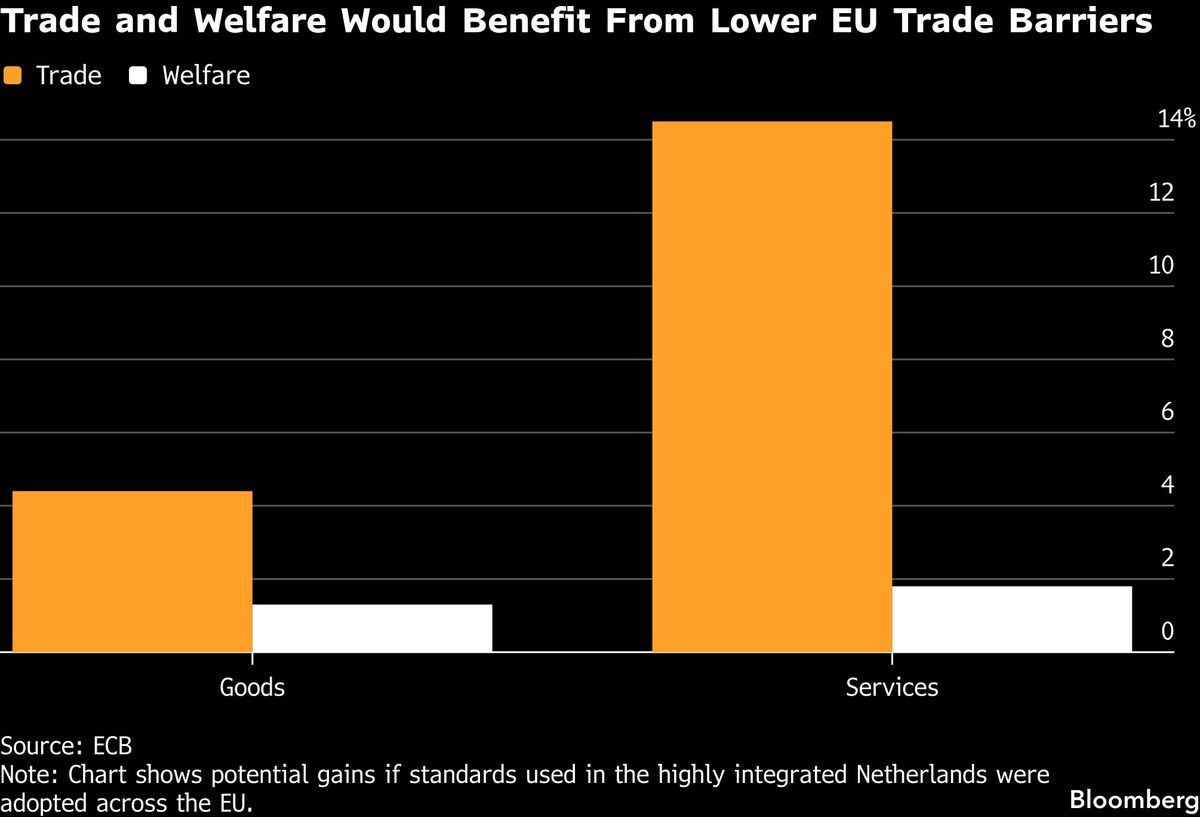
Even more modest progress would be meaningful. The economists argue that a reduction of just 2% in goods and services barriers within the single market could fully compensate for the projected impact of higher US tariffs on output in the long run.
“The estimates highlight the potential to take advantage of the vast size of the EU internal market,” Quaglietti and colleagues wrote. “In the current geopolitical context, enhancing EU integration is especially important to mitigate the adverse effects of external trade tensions.”
Pressure on the bloc is unlikely to cease, not least since Trump’s threat this week to impose an extra 25% on any country doing business with Iran. That could affect the EU, which imported goods worth about €660 million (US$769 million or RM3.12 billion) from the Islamic Republic between January and October last year.
Along with Quaglietti and Gunnella, the other authors of the report were Roberto Bernasconi, Naïm Cordemans and Giacomo Pongetti.
Uploaded by Chng Shear Lane