
If you’re reading this, congratulations. You’ve made it past the winter solstice, the darkest part of the year, and the light is already returning as we speak. This is purely a technicality at this point, as the mere seconds of light that are added each day of January are nearly imperceptible to the miserable human experience, but it doesn’t hurt to remind yourself of them every waking second of the next month to get you through it. I, on the other hand, have essentially surrendered myself to the endless onslaught of the forces of darkness, and I’m ashamed to admit that I can kind of actually appreciate this time of year. So you essentially have three options here: 1. dream about the light, 2. become one with the darkness or 3. run away, run far away.
Since I’ve already admitted to being a little unhinged, I wouldn’t blame you for not taking my advice. So in that case, let’s seek the ancient wisdom of those who’ve come before us, the Icelanders who were dumb enough to stay on this forlorn island but strong enough to live to tell the tale. Okay, okay, not so ancient, as these folktales were collected and recorded by Sigfús Sigfússon, who lived from 1855-1935. Although they were likely from the 1800s, many are more detailed evolutions of much older motifs. So in the end, how did people survive (or not)? The short answer is food. The long answer is not very good food.
The Tale of the Trickster
This little ditty has a few versions. Since it has the feeling of some indie darling director’s A24 horror film debut, I’m giving you the director’s cut with all the gruesome details. (I know that’s what you’re into, you sick fuck!). It starts with three brothers, two of whom are hardworking and one who is especially lazy. Anyone who has worked with Icelanders would know this is statistically unlikely, but we’ll let it slide because you’ll soon see it doesn’t work out for the promising ones. In this case, “good guys finish last” becomes “good guys get finished first.”
Some of their sheep go missing and as the primary food source around here for like a thousand years, they kinda need to find them. So the oldest brother, Sigurður, sets off to look for them. He gets lost and finds himself at the farm of some creepy old fuck, his wife, and daughter. He is literally named Bragðakarl, which means “trickster.” That doesn’t bode well, but I guess hardworking is not necessarily synonymous with smart, so our boy decides to stay and work for him in order to get their sheep back (which this man presumably stole).
“Apparently hanger has made him homicidal, so he heartily agrees and then he kills the dog too. Bragðakarl appears angry about this but denies it.”
Bragðakarl has some weird-ass rules: Sigurður must eat from the dog bowl, he must investigate any mysterious wailing he might hear, and if either of them ever gets angry, the other has the right to kill him. That’s not sus at all, right? So Sigurður is like, “It’s a deal!” When Sigurður is served his dog food, he hears a bloodcurdling scream and goes to investigate, but he finds nothing. When he returns, the dog has eaten all the food, obviously, so he becomes hangry, and Bragðakarl kills him.
Some time later, the next brother arrives and oops, he winds up as dog food himself. Probably with a great sigh of dramatic resignation, the lazy brother Ásmundur sets out and finds himself at the same place. He introduces himself as Hvekkur, which itself is a kind of trick or prank, like when you jump out to startle someone. Let the Great Prank Off of 1899 begin!
Also known as Tale of Hvekkur
“Hvekkur” is not falling for Bragðakarl’s bullshit. He keeps his cool when the dog eats his food and pretends he doesn’t hear anything weird. After three days, he finds the source of the wailing: Bragðakarl has his parents locked up and starving in a shed, forcing them to lure in passersby with their screams. Apparently hanger has made them suicidal, so they beg Hvekkur to kill them. Apparently hanger has made him homicidal, so he heartily agrees and then he kills the dog too. Bragðakarl appears angry about this but denies it.
Later, Bragðakarl sends Hvekkur to the house to fetch some wood for him. When he finds the wife and daughter there, he tells them he has been sent to sleep with them. When the wife doesn’t believe him, he calls out, “You do want me to take them both?” and Bragðakarl replies, “Yes,” assuming he means the wood. So everybody gets some wood, I guess, because obviously it’s not up to the women to decide for themselves.
Bragðakarl is visibly enraged by this but he denies it once again, instead insisting that Hvekkur marry his daughter.
Both women are pregnant at the wedding. Bragðakarl instructs Hvekkur to set up a “well-horned” (rectangular) hall and “cast friendly eyes” (smile) at the guests. He cuts all the horns from Bragðakarl’s rams and lines the walls with them, then he gouges out the eyes of the horses and pelts the guests with the eyeballs. Bragðakarl finally loses his shit, and Hvekkur kills him and his wife, apparently along with his unborn child. He marries the daughter anyway, takes his sheep, and returns triumphant to his farm. I’m sure he’s not truly the sadistic motherhvekkur he appears to be. He was just hangry, right? Right?
The Spirits of the Season
Okay, that one got pretty grim, so let’s end with something relatively light-hearted to leave you with a bit of hope. (Note the use of “relatively.”) This next one starts with a couple that lives on a farm with their mothers-in-law. The woman and her mother are lovely, but the man and his mother are son of and bitch, respectively. He sends his wife’s mother out to live in a hut in the wilderness through the winter, sending only measly scraps of food to her in hopes that she starves to death.
“You’d be forgiven for not knowing that the Old Norse people had a different calendar and that this was used well after the Middle Ages in Iceland.”
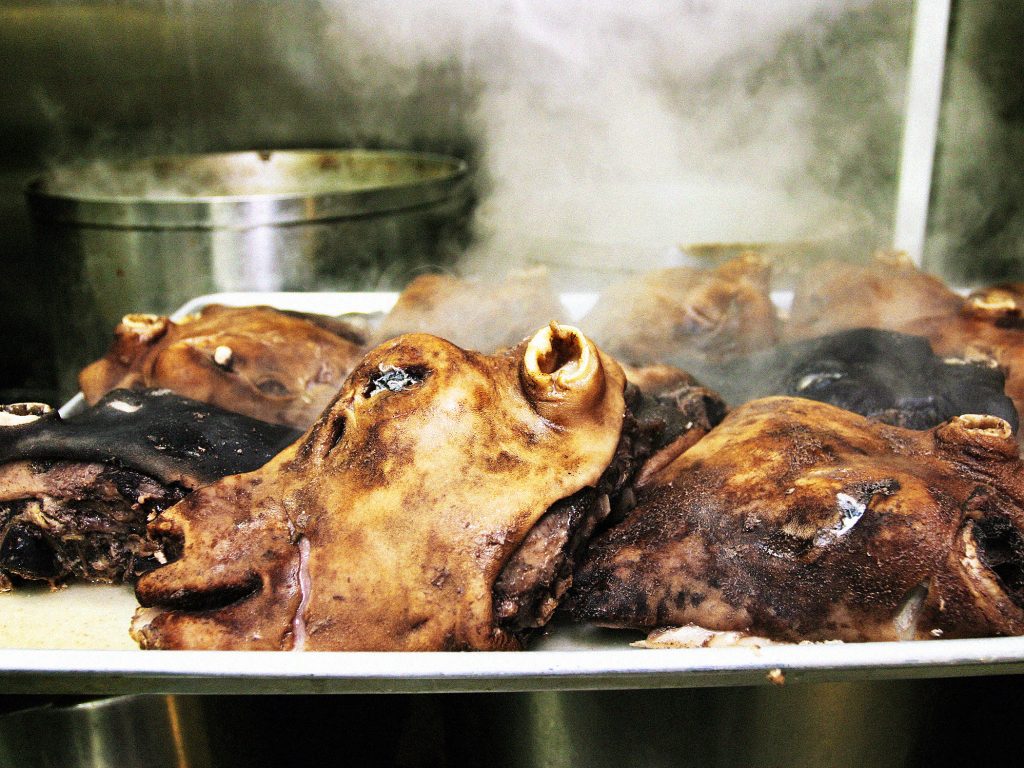
You’d be forgiven for not knowing that the Old Norse people had a different calendar and that this was used well after the Middle Ages in Iceland. The midwinter month was called Þorri, and it started near the end of modern-day January. This is where the name Þorrablót comes from, literally meaning the Sacrifice of Þorri, and today it’s when people still eat the traditional foods that seem like challenges from Survivor: fermented shark, sheep’s brain jelly, and ram’s balls, and whole-ass sheep’s faces, eyes and all.
So the mother survives the early winter on the scraps she’s given and the night before Þorri begins, she goes and thanks Þorri for its bounty. The next morning, the personification of Þorri himself arrives to gift her a whole whale’s fluke that feeds her for the next month. She prays to the gods of the following months and they show up like the pizza delivery guy to save your hangover. Let’s just say she’s eatin’ good. When the couple come to check on her on the first day of summer, the man is annoyed to find her not only not dead, but fat and happy.
That night, the woman’s mother dreams of Harpa, the goddess of the first month of summer. She says she has a gift to give her son-in-law so that he will treat her well but when he awakes and finds the treasure chest, she keeps it for herself. The man’s mother is jealous and demands to spend the winter in the hut. The man sends her Erewhon smoothies and Wagyu beef but the delivery man hates her, so he never delivers it. The man’s mother starves to death in the hut and then he’s nice to his wife and mother ever after. I guess the true treasure wasn’t Harpa’s gift, it was the parents we starved in huts along the way.