
The XRP price rose after reports that Ripple secured preliminary approval for an Electronic Money Institution (EMI) license in Luxembourg.
This regulatory milestone marks another significant step for the blockchain payments firm as it expands across Europe.
Sponsored
Ripple’s Europe Strategy Is Coming Into Focus — And XRP Sits Inside the Rails
Ripple said Luxembourg’s financial regulator, the Commission de Surveillance du Secteur Financier (CSSF), has issued an initial “green light� for the EMI license, subject to remaining conditions.
If finalized, the authorization would allow Ripple to offer regulated payment services involving stablecoins and other digital assets across the European Union through passporting, using Luxembourg as its regulatory base.
The development places Luxembourg at the center of Ripple’s European strategy. An EMI license in the country would enable Ripple to operate under harmonized EU rules. This gives it access to multiple member states without seeking separate approvals in each jurisdiction.
For a sector facing increasingly strict oversight, the ability to scale compliantly across borders has become a decisive advantage.
Ripple investors appeared to welcome the news, with the XRP price climbing as traders digested the implications of Ripple’s expanding regulatory footprint in Europe. As of this writing, XRP was trading for $2.14, up by nearly 4% on the news.
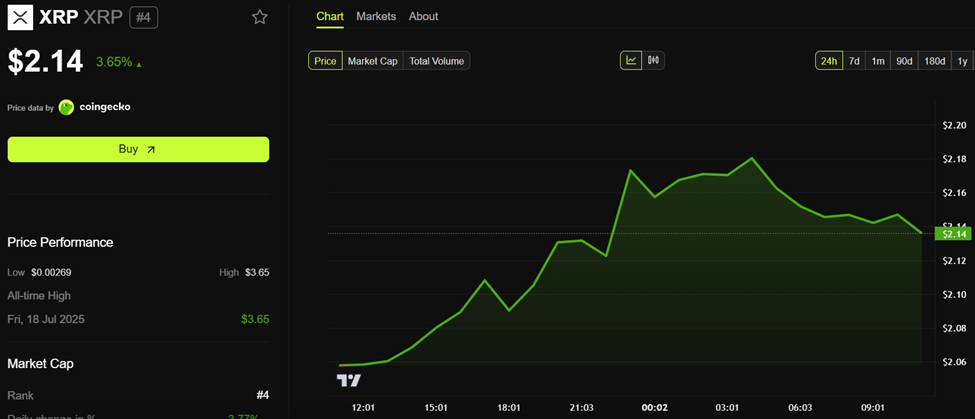 XRP Price Performance. Source: BeInCryptoSponsored
While price reactions to regulatory developments have often been uneven, the Luxembourg approval reinforces a growing narrative that Ripple is emerging as one of the most institutionally compliant crypto firms operating in major financial markets.
UK and Luxembourg Licenses Signal Ripple’s Broader European Regulatory Strategy
The Luxembourg progress follows closely on the heels of Ripple’s recent regulatory win in the UK. Last week, the company confirmed that its local subsidiary, Ripple Markets UK, secured both an EMI license and crypto-asset registration from the Financial Conduct Authority (FCA).
As BeInCrypto reported, clearing FCA scrutiny is a rare achievement in the crypto industry, with the majority of applicants failing to meet the regulator’s standards.
Together, the UK and Luxembourg approvals signal a coordinated effort to integrate Ripple’s payments business into Europe’s regulated financial system.
Sponsored
The company is also pursuing authorization as a Crypto-Asset Service Provider (CASP) under the EU’s Markets in Crypto-Assets (MiCA) framework. This positions it to align fully with the bloc’s new digital asset rules as they take effect.
Ripple said the European approvals add to a global portfolio of more than 75 regulatory licenses, including US money transmitter licenses and authorizations in jurisdictions such as Singapore and Dubai.
The firm has increasingly emphasized regulation as a competitive moat, particularly as banks and payment providers avoid working with unlicensed crypto counterparties.
“The EU was amongst the first major jurisdictions to introduce comprehensive digital assets regulation, which provides the certainty financial institutions need to move blockchain from pilots to commercial scale,� Ripple President Monica Long said in a statement, describing the Luxembourg approval as part of a broader effort to modernize cross-border payments infrastructure.
Sponsored
Cassie Craddock, Ripple’s Managing Director for the UK and Europe, said Luxembourg’s regulatory approach has made it a hub for financial innovation.
She also noted that the preliminary approval enables Ripple to deliver compliant blockchain infrastructure to clients across the EU.
For XRP, the significance goes beyond headlines. An earlier BeInCrypto analysis highlighted how Ripple’s UK licensing quietly allowed XRP to be used within regulated payment flows, rather than remaining confined to exchange trading.
The Luxembourg EMI license opens the door for that model to be replicated across the EU’s single market. This could embed XRP deeper into institutional payment rails over time.
Sustained XRP demand will ultimately depend on real payment volumes rather than regulatory announcements alone.
Nonetheless, Ripple’s latest approval strengthens its position as one of the few crypto firms capable of operating at scale within Europe’s tightening regulatory perimeter.