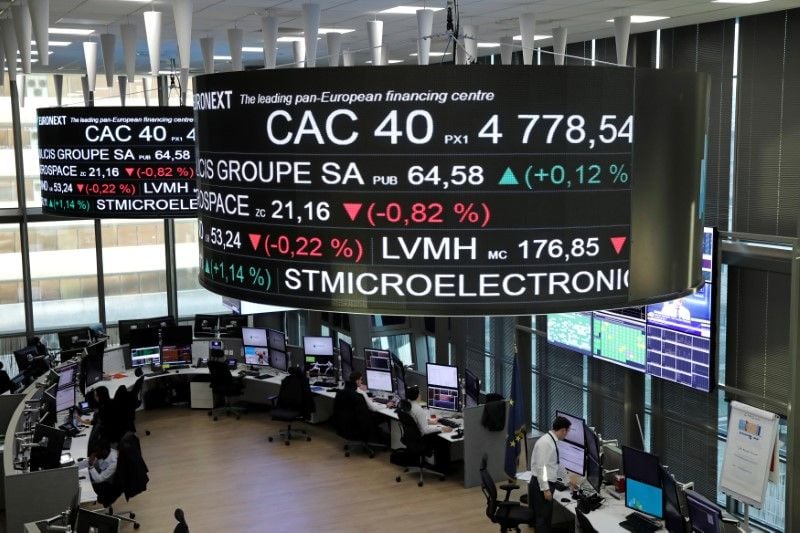
European stock markets closed mixed after contrasting economic indicators in the United States and disappointing results from American banks. The CAC 40, which reached a new high in the morning, slipped by 0.19% to 8,330.97 points. Among the main indices on the Old Continent, only the FTSE managed to finish higher: +0.46%.
American banks once again took center stage following
JP Morgan
‘s earnings yesterday, which kicked off the reporting season.
Quarterly results from
Bank of America
(-4.25%),
Wells Fargo
(-4.73%), and
Citigroup
(-4.07%) weighed on the sector. The S&P 500 banking index fell by 1.45%, after a 1.2% drop yesterday. At midday, the Dow Jones was down 0.35%, the Nasdaq 1.17%, and the S&P 500 0.68%.
A few statistics were on the agenda on Wall Street. Retail sales rebounded by 0.6% in November, beating the consensus of 0.5%, after a 0.1% decline the previous month. Producer prices met expectations in November, with the PPI rising 0.2% month-on-month after +0.6% in October (revised from +0.3%). Additionally, U.S. business inventories increased by 0.3% in October month-on-month, after +0.3% in September, according to the Commerce Department.
Market participants are also keeping an eye on a possible decision from the U.S. Supreme Court, which could rule on the legality of the tariffs imposed by Donald Trump.
“The year is shaping up to be a new stress test: change at the helm of the Fed, U.S. midterm elections, trade fragmentation, rising risks to financial stability (debt servicing, high AI valuations), and geopolitical uncertainties. The key challenge will be to avoid reigniting inflation with stimulus in an already solid economy. In this context, Europe appears most vulnerable, while the main hope rests on a German revival, as it alone has the budgetary leeway to boost investment,” notes Oddo BHF in its 2026 economic outlook.
Pictet Wealth Management maintains an optimistic view on European equities, highlighting two key sectors: automotive and luxury. The former is emerging from a deep recession. There is a noted strategic shift in response to China, with discussions about direct Chinese investment in Europe or joint ventures. In luxury, “the outlook is less negative than last year, supported by a gradual recovery in Chinese demand,” explains Frederik Ducrozet, head of macroeconomic research at Pictet WM.
Turbulence for Air France-KLM
On the Paris market,
EssilorLuxottica
(+0.50%) ended in positive territory, buoyed by HSBC raising its recommendation to Buy on the stock. Meanwhile,
Air France-KLM
(-5.15%) finished as the biggest loser on the SBF 120 after Jefferies lowered its price target to 126 euros from 134 previously, while maintaining its Hold recommendation.
In the healthcare sector,
Ipsen
(+6.90%) managed to stand out (+5%), after the FDA granted its drug IPN60340 “breakthrough therapy” designation for first-line treatment of ineligible acute myeloid leukemia.
In London, publisher
Pearson
(-9.55%) plunged despite confirming its medium-term targets.
On the commodities market, copper prices hit a historic high of $13,407 per ton on the London Metal Exchange this Wednesday, before pulling back to around $13,240.
Meanwhile, oil prices continued to climb, with Brent crude up 0.81% by 17:40 and its U.S. counterpart, WTI, up 0.61%.
At the close, the euro was up 0.12% and trading at $1.1657.