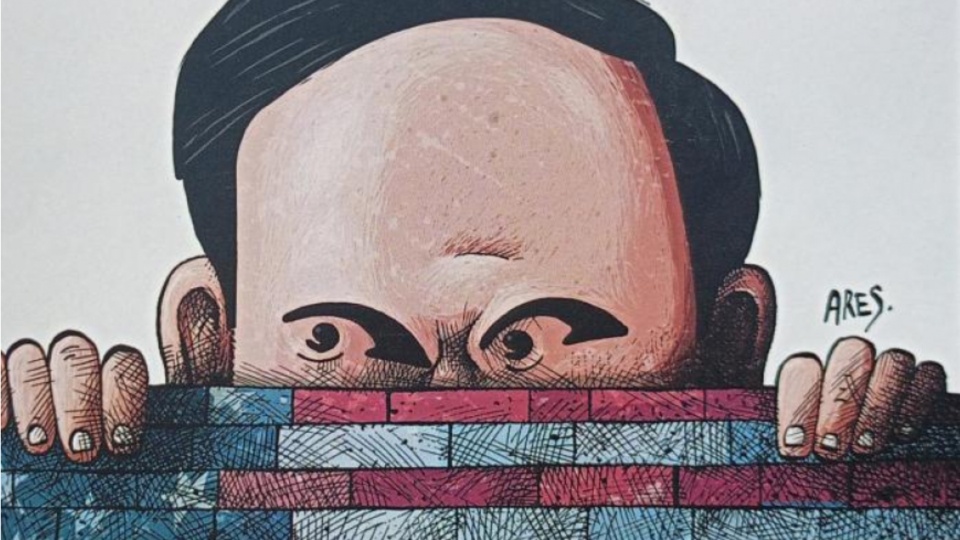
Artwork from the cover of the new book, ‘Rubio: An Uncontrollable Mythomaniac.’ | Ares / via Granma
Marco Rubio, an American of Cuban descent and Secretary of State of the United States, has been characterized throughout his political career by a lack of ethics, corruption scandals, an extreme tendency to lie, far-right positions, and an unhealthy obsession with overthrowing the progressive governments of sovereign nations in Latin America—mainly Cuba, Venezuela, and Nicaragua, and lately Brazil, Colombia, and Mexico, as well.
As author René González Sehwerert wrote in the prologue my new book Rubio: An Uncontrollable Mythomaniac, the work “could have been titled Marco Rubio: A Man of His Time, the Worst of His Time.”
Rubio was born in Miami on May 28, 1971, to Cuban parents who had emigrated to the United States. It was a turbulent time in Miami, when drugs, crime, and intolerance toward anything said in favor of the Cuban Revolution were rampant. The United States had created an émigré community to which it granted all kinds of privileges to counter Cuba, while continuing to intensify the economic, commercial, and financial blockade against the island.
To understand this environment, Manuel Giberga, the highest-ranking Cuban-American among the island’s emigrants at the time and an advisor to the Director of the Federal Bureau of Narcotics, stated in an interview with Réplica magazine that “an Al Capone-style mafia was being forged in Miami.”
One of Rubio’s first lies was recorded in his official Senate biography, in which he claimed that his parents fled Cuba after Fidel Castro took power in 1959. He followed the claim in a television interview, in which he emphasized: “My parents lost everything: their home, their family, their friends, even their country. But they also found something: the United States.”
In October 2011, this lie began to be exposed in various media outlets, such as The Washington Post, which, with official documents, specified that during his political career, Rubio always claimed to be the son of exiles from the Castro regime, a claim he repeatedly made in his last campaign for the U.S. Senate and which, until a few days ago, was included in his official biography on the Senate’s website.
The truth was that his parents left Cuba for the U.S. in 1956—three years before the revolution. This deception was essential to win over the intransigent right-wing population of Miami.
This character’s life is also closely linked to drug trafficking. When he was 16, his brother-in-law, Orlando Cicilia, was arrested in 1987 for trafficking a huge shipment of drugs, valued at $15 million. He lived with Barbara, Rubio’s sister, very close to the house where Marco lived with his parents. At the trial in 1989, Rubio, then 18, refused to testify whether he or his family had received money from Cicilia.
The drug trafficker, who was sentenced to 25 years in prison, was released 12 years later after reaching an agreement with the prosecution, and his brother-in-law, who was already a member of the Florida House of Representatives by then, used his position to get Cicilia a real estate license. These tangled relationships have led him to be known in Miami as “Narco Rubio.”
Reaffirming his narco-corrupt “vocation,” Rubio influenced Trump to recently pardon drug trafficker and former Honduran President Juan Orlando Hernández, who was imprisoned in the United States with a 45-year sentence, imposed by judges in the Southern District of New York, for the crime of exporting and introducing 400 tons of cocaine into U.S. territory.
After his release, and following international condemnation of Hernández’s acquittal, Trump himself stated that he did not know or have much knowledge of who this man really was. Of course, Rubio knew him well, because, as the Canadian magazine Vice reports, he received more than $600,000 to fund his election campaigns through the BGR Group.
Then-Senator Rubio arrived in Honduras in 2018, had his picture taken, hugged Hernández, and, at a press conference in Tegucigalpa, praised the president “for his fight against drug trafficking.” The BGR Group was hired to clean up the former president’s image in New York.
While Speaker of the Florida House of Representatives from 2007 to 2009, Rubio was investigated for fraudulent operations and enrichment at the expense of the state for using public money for his personal expenses, but as always happens in Miami, when a person has powerful friends and abundant capital, the charges were dismissed.
Rubio’s relationship with former U.S. Rep. David Rivera also has a long history tainted by allegations of corruption and money laundering. The two bought a house in Tallahassee which some say was to coordinate their misdeeds and help steal the Venezuelan company Citgo, a subsidiary of PDVSA in the United States, which was handed over to the “ghost president” Juan Guaidó. Rivera was arrested in December 2022 and acquitted the next day, as is always the case in Miami with wealthy criminals.
Then there is the current U.S. Secretary of State’s relationship with the National Rifle Association. He has received more than $4 million from the NRA, which it could be argued politically obliges him to defend it under any circumstances.
For example, when a mass shooting occurred on Dec. 2, 2015, in San Bernardino, Calif., where 14 people were killed and 21 others were wounded, then-Sen. Rubio immediately came out in defense of the NRA, and during a campaign event, he declared: “I went to buy a gun on the 24th, Christmas Eve, a weapon, and both my wife and I have weapons of this type.”
Rubio is known as a staunch Zionist and has benefitted from his connection to the American Israel Public Affairs Committee (AIPAC), which has given him large sums of money and supports him unconditionally in his political campaigns.
Rubio has promoted and supported the genocide and extermination of Palestinians in the Gaza Strip. He was one of the first to call Benjamin Netanyahu and visit Israel in April and November 2023 to offer his full support to the prime minister.
Ever since he arrived in the Florida House of Representatives in 2000, Rubio has been engaged in a quarter-century-long propaganda campaign against Cuba. He has proposed and co-sponsored countless laws against the island’s government. As a U.S. senator during Trump’s first term, and supported by another shady former senator, Bob Menéndez, Rubio led the way in imposing 240 different sanctions against Cuba. Upon becoming secretary of state, he reinforced his infamous propaganda against medical missions abroad and against the countries that accept them.
In writing the epilogue to the book Rubio: An Uncontrollable Mythomaniac, the president of Casa de las Américas, Abel Prieto Jiménez, stated: “This work is very useful for understanding what José Martí called ‘the poisons of the soul’ that stain the nature of the United States. He was referring to greed, the cult of money, the lack of ethics, the shameless use of lies, opportunism, and the corruption of politicians. The character portrayed in the pages of this work epitomizes the moral crisis of the empire’s elites, particularly those in Miami.”
This article originally appeared in Granma. As with all op-eds published by People’s World, the views reflected here are those of the author.
We hope you appreciated this article. At People’s World, we believe news and information should be free and accessible to all, but we need your help. Our journalism is free of corporate influence and paywalls because we are totally reader-supported. Only you, our readers and supporters, make this possible. If you enjoy reading People’s World and the stories we bring you, please support our work by donating or becoming a monthly sustainer today. Thank you!
CONTRIBUTOR