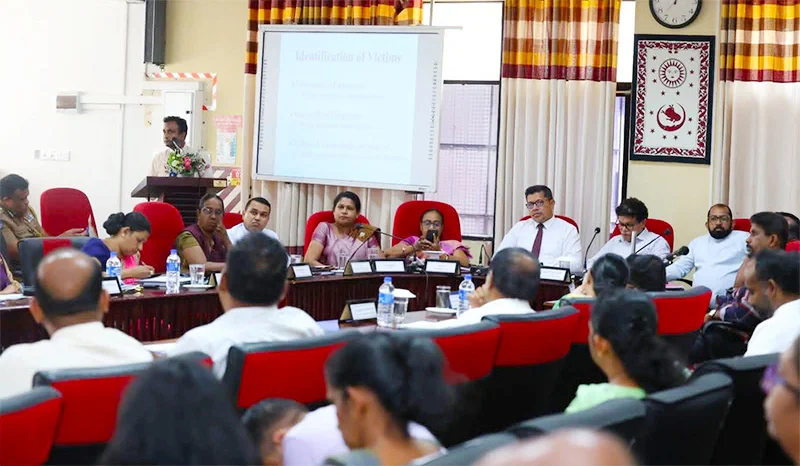
As Sri Lanka presses ahead with IMF-backed fiscal and governance reforms, the Kegalle District Planning Committee (DPC) was formally established yesterday as a standing sub-committee of the District Coordinating Committee (DCC), in a move aimed at tightening control over public investment, reducing duplication and strengthening monitoring at district level.
The committee was constituted under Home Affairs Circular No. 03/2025 issued by the Ministry of Public Administration, Provincial Councils and Local Government, and was inaugurated at the Kegalle District Secretariat auditorium under the leadership of Environment Minister and DCC Co-Chair Dr. Dhammika Patabendi and District Secretary H.M.J.M. Herath.
Addressing officials, Dr. Patabendi said the new structure directly responds to long-standing weaknesses in public investment management that have come under scrutiny during Sri Lanka’s engagement with the International Monetary Fund.
“Under the IMF programme, we cannot afford fragmented planning, overlapping projects or weak monitoring. This committee is about discipline—ensuring that limited public funds are allocated according to national priorities and deliver measurable outcomes,” Dr. Patabendi said.
He stressed that district-level planning must now align with national fiscal consolidation goals, with a stronger emphasis on value-for-money, results-based implementation and accountability.
The District Planning Committee will function as a permanent sub-committee of the DCC, chaired by the district’s Cabinet Minister, with the District Secretary serving as Secretary and the Director of Planning as Convener. Members include officials from district-level price and food committees and heads of government institutions or their nominees.
A central mandate of the committee is the preparation of an Annual Integrated District Development Plan, covering all funding sources—including foreign-funded and donor-supported projects—for approval by the District Coordinating Committee.
Officials said this would help rationalise project selection, prioritise urgent district needs and prevent the duplication of monitoring and evaluation systems, a key concern raised in public investment reviews under the IMF programme.
Dr. Patabendi noted that better coordination of state, private and non-state sector investments at district level would also support macro-level reform objectives by improving spending efficiency without increasing fiscal pressure.
“Fiscal adjustment does not mean stopping development. It means doing development better—through planning, coordination and proper evaluation,” he said.
The committee will oversee the operational rollout of DCC-approved projects, provide advisory support to implementing agencies, and monitor whether projects are delivered within approved timeframes and achieve stated targets.
Progress reports will be submitted to the Presidential Secretariat, Ministry of Public Administration, Ministry of Finance and the District Coordinating Committee, strengthening upward accountability.
At yesterday’s meeting, officials reviewed development proposals linked to the 2026 Budget, with focus on education, health, agriculture, infrastructure, industry, environment and tourism—sectors seen as critical for growth and social protection during the reform period.
Implementation challenges faced by projects carried out in 2025 across several Divisional Secretariat areas were also examined, with discussions centred on resolving bottlenecks early in 2026 and aligning future investments with the district’s five-year development plan.
Senior provincial and district officials, Members of Parliament from Kegalle, local authority heads and divisional secretaries attended the meeting.
Dr. Patabendi said the establishment of the District Planning Committee marked an important step towards embedding IMF-aligned public financial management reforms at the grassroots level, ensuring that development spending contributes to economic recovery while safeguarding fiscal sustainability.
By Ifham Nizam