Photo by Guy Corbishley/Alamy Live News
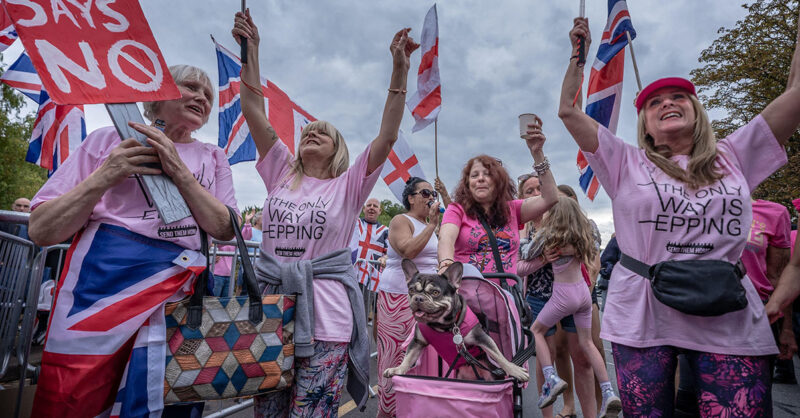
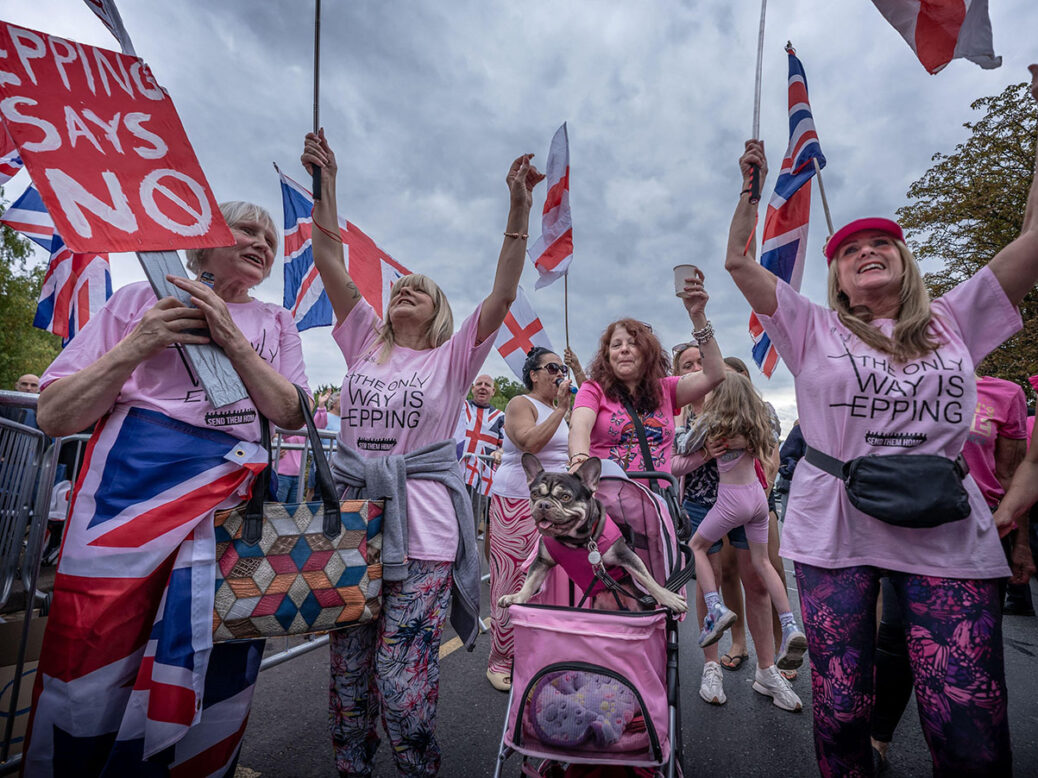
It was autumn, grey, a familiar British divide. “They’re pro-immigration,” a police officer standing on Whitehall told me, pointing to a chanting group organised by Stand Up to Racism. “We are women, black and white, we say smash the far right,” chanted the protesters. “They’re anti-immigration.” He gestured at the opposite pavement, where a larger group of pink-clad women wrapped in Union Jacks danced to “I Will Survive” and occasionally gave the anti-racists the middle finger. “They don’t like each other,” he explained. “That’s why we’re here.”
This second group was the Pink Ladies, as they have been known since they formed in summer. They had organised this march – alongside their weekly protests in other parts of the country – to make the female case against illegal immigration, which they argue makes British women unsafe. In the next few months, they plan to continue their weekly protests in Epping and Essex, and demonstrate in Wolverhampton and outside the Home Office in London. On6 January 2026,they sent Shabana Mahmood a letter asking for a meeting to discuss how she planned “to keep us safe from unknown and unchecked foreign nationals arriving by illegal means”. The Home Secretary has not yet replied.
Among the 200 people at the Whitehall “pink protest” were some stars of the right-wing fringe: the failed Tory mayoral candidate Susan Hall, Ukip leader Nick Tenconi, commentator Sophie Corcoran and Jess Gill, founder of Women’s Safety UK. Lucy Connolly, recently freed after ten months in jail for tweeting, after the Southport attack, “set fire to all the fucking hotels full of the bastards”, was taking selfies with the Ladies. “Keep fighting – I’m so proud of you all,” she told the group. The energy was on this side of the road.
Orla Minihane, a 50-year-old consultant from Essex and the unofficial leader of the Ladies, addressed the crowd. “Every country has their murderers and their rapists and their sex pests,” she said. “But not every country has open borders… They cannot speak English, they have drug problems and they are criminals. And they are waiting to come here.”

New year, new read. Save 40% off an annual subscription this January.
Minihane is always sleek, well made-up with long, blonde hair. At protests she sometimes wears a long coat and a pink beret, sometimes a pink baseball cap, pink sweater, diamond earrings. She has lived between the edge of London and Essex all her life. “If you are here to cause trouble you can leave immediately or you will meet some very nasty women from east London,” she warned the few men who had joined the Whitehall protest.
“There are some quite good-looking men as well,” she conceded, winking at the crowd. “Bit of eye candy.”
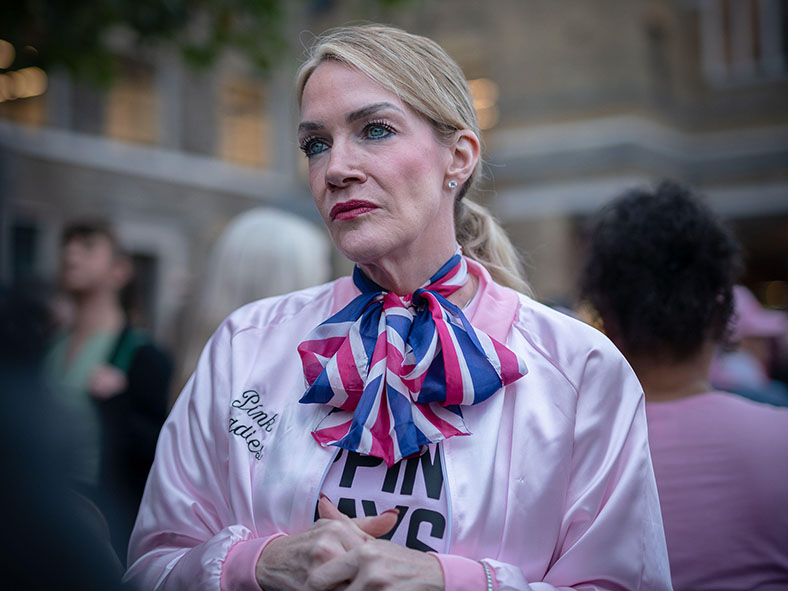 Orla Minihane, the vice-chair of Epping Forest Reform UK, joins the “Pink Ladies” protest movement outside the Tower Hamlets council offices on Whitechapel Road, east London. Photo by Guy Corbishley/Alamy Live News
July 2025: Hadush Kebatu, an Ethiopian asylum seeker living in the Bell Hotel in Epping, was charged with the attempted sexual assault of a 14-year-old girl – he was later found guilty of this and a number of other sexual offences. His arrest triggered nationwide anti-immigration protests. In the days after Kebatu was charged, protesters mobbed the Bell. They threw fireworks and eggs at police and smashed the windows of police vans. Members of the neo-Nazi groups White Vanguard and Blood & Honour were among the protesters. Several people were arrested. But Epping had been angry before Hadush Kebatu. The Bell Hotel had housed asylum seekers since 2020, and local women had long told each other stories of asylum seekers lingering on the streets, sleeping in Epping Forest, following and filming children.
Minihane didn’t want Epping’s rage to be seized by violent thugs. Her worry, she told me, was about her own children’s safety. She organised a Zoom call with a few protesters from the community. “We’ve got to change the narrative,” she told them. “We’re going to lose public support.” At the next protest that weekend, a group of women held hands at the front and chanted “protect our kids”. Footage of them was shown on GB News, and Minihane realised this could become something bigger. Her husband suggested that the next time they protest, they should all wear the same thing. “I was like, ‘OK, fine, good. We’ll wear pink.’ I actually said red initially, but then I thought it’s a bit too aggressive.” Their next protest was the last Sunday in July. Minihane spent £500 of her own money on posters reading: “Stop the boats”. The Ladies were all in pink.
Since then, the Pink Ladies have been intent on radicalising Britain. Where many political groups are male-dominated, theirs is female-led and based explicitly around their identity as women. Minihane estimates there are around 2,000 members spanning 25 regions. It’s growing fast: the Romford Pink Ladies had to rebrand as the Havering Pink Ladies when over 600 women from across the borough joined. By tapping in to the rightward shift in public opinion on issues like crime and immigration, they have pushed the focus of the immigration debate from state capacity and fairness to the threat of violence to women. They are at the forefront of a movement that could affect British politics for years.
For the past six months, a core group has protested each Sunday for two hours outside the Bell in Epping, and the Ladies flock to any area where there are rumours of trouble. Former Reform MP Rupert Lowe’s group Restore Britain gives them funding and advice. New branches are springing up across the country, guided by Minihane. She offers them advice about how to reach out to local women and host get-togethers. “I’m no guru,” she insisted to me. The Pink Ladies often emphasise their lack of experience compared to seasoned male agitators. Many have never protested before. “We’re just little women,” they said. “We’re an innocent little bunch”. “Just normal girls from Epping.” One woman told me the bright pink they wear represented their gentle nature – their “real, pure, loving hearts”.
The Ladies host Zooms and coffee mornings and Christmas lunches. They organise protests as well as boycotts of businesses that “employ illegals” and vigils for victims of asylum seeker violence. On Facebook pages and WhatsApp groups, they share tips about self-defence and fund raise to hand out rape alarms and pepper sprays. They post affirmations – “Grounded, United, Unapologetic” and “Buckle up bitches, here we go again”.
Some are teenagers; several are in their mid-90s. Many work at food banks or volunteer in their area. Minihane tries to remember everyone’s names. “They ring me all the time,” she said. “It’s given people that kind of old East End sense of community we haven’t had.”
Minihane believes the Pink Ladies have granted women the space to voice fears they thought they couldn’t discuss. “Last night, at my meeting, this woman said: ‘I know I’m paranoid, and I feel I can’t talk to anyone. I can’t talk to my family, they think I’m a lunatic.” Minihane said women tell her stories daily of asylum seekers spitting or masturbating at them, following them, lurking in the bushes. “And the thing is, even if they’re not doing anything sexually wrong, there’s still men sitting there drinking all day, intimidating people,” she said. “The only reason I know about it is because I’ve got this network of women. There’s a woman in Yorkshire who said to me she knows of 23 sexual assaults and six rapes that had never even made local news.” (This could not be confirmed.)
There’s no clear data on rates of asylum seeker sexual violence. As the Oxford Migration Observatory put it in December: “Official data on migration and crime is full of holes.” Violent and sexual crime in Epping has increased by 35 per cent over the past year, but it’s not broken down by nationality. Minihane believes most incidents aren’t recorded.
From 1945 up until the 2017 general election, British women were more likely to vote Conservative than men, in part because of fears around crime. But women, particularly younger women, have voted more progressively than men in recent years. This trend could now be reversing.At the 2024 general election, around 1.4 men voted Reform for every woman; this had reduced to 1.2 by September 2025. Reform now has a marginally more female supporter base than Labour. A turn against immigration is part of this: an Ipsos poll from November 2025 found 46 per cent of women think immigration is “much too high”, compared to 40 per cent of men. Women are also more likely than men to think immigrants have a negative effect on levels of crime in Britain.
Minihane told me she has always voted for the Conservatives. Her family were working-class Irish Catholics, who she said came to the UK with nothing. She went to school in London, but when her dad’s business began to do well the family moved to Woodford in Essex. Instead of going to university, she trained as an estate agent and went to work in the City.
At the last election, when she went to vote in Epping Forest, she was surprised to see there was no Reform candidate. Minihane went home and researched the party; she is now vice-chair for Reform’s Epping Forest local branch and the parliamentary candidate for the constituency, although she plans to stand as a councillor in May first. When Nigel Farage called her a few months ago, she told him she wanted to be minister for women and children. She promised she’d personally drag illegal migrants out of their houses and put them on a plane. Farage laughed and told her to get elected as a councillor first.
The Pink Ladies welcome people from all political wings, Minihane said. (Potential left-wing Ladies might be put off by their regular chant, “Never trust a lefty with your kids”.) She wouldn’t call herself a nationalist; she believes there are “true” asylum seekers. “If you’re going to come and add value and you’re going to integrate and you’re going to be respectful, that’s fine. It’s when you’re not, that’s the problem.” It’s not about race, Minihane says: it’s just not nice to live next to undocumented, unemployed men who have already broken the law by entering the country.
Not all Pink Ladies are so conscientious. One woman who knew I was a journalist added me to a WhatsApp group titled “Pink Protest” with four pink heart emojis, in which nearly 50 regular Epping protesters sent hundreds of messages a day – about their health issues, cleaning products, hairdresser recommendations and many, many news stories about asylum seekers and crime. Minihane told me she removes “any kind of racism” in the WhatsApp groups. I saw messages calling migrants “c***s” and “feral oversexed dirty inbreds”. “Iv [sic] just watched a scruffy looking Pakistani man… looking really shifty,” one woman wrote. “I followed him with the dogs.”
One man regularly seen with the Pink Ladies is Callum Barker, a former member of ethnonationalist party Homeland, a splinter group from neo-Nazi Patriotic Alternative. Barker helps the women set up equipment, Minihane said. On Barker’s views, she said: “They’re a little bit more extreme than mine.” He was only 22, she said. He could be her son. “He’s so respectful. He’s such a gentleman with all the elderly ladies,” she said. “He’s very much a nationalist, very patriotic.”
Some Conservatives, including Robert Jenrick and Kemi Badenoch, have visited Epping and spoken to the Pink Ladies. Labour has largely ignored them. But in early October, two Labour councillors from Tower Hamlets, east London, put forward a motion condemning protests outside an asylum hotel on the Isle of Dogs, one of the locations the Pink Ladies targeted. The motion argued that “local residents have valid concerns around safety, security and equity, but… these concerns have been allowed to escalate and become entwined with far-right narratives under the banner of keeping women and children safe”. It didn’t mention the Pink Ladies, but they took it as a threat; many of the women see east London as their ancestral home.
The afternoon of the council vote, a group travelled from Essex to Whitechapel. Counter-protesters led by the trade union Unison gathered at the town hall. “We have a fantastic diverse multicultural community that we’re so proud of in Tower Hamlets,” a Unison officer told the crowd. “The Pink Ladies are racist.”
The women had grouped nearby and a teenager followed them with a camera. “Can we all say ‘no to racism’?” he asked two of them. “We’re not racist!” they shrieked. He looked confused. “I think this lot” – he pointed to the counter-protesters – “think you are members of the EDL.” One of the women informed him that the English Defence League had been disbanded years ago. “The worst we would do is whack you with a mop.”
A few feet away stood a woman whose body was painted pink, up to her chin, dressed in pink underwear and pink trainers, clutching a pink Union Jack. This was Sarah White, one of the original Epping protesters, who was arrested and held for 24 hours in August on suspicion of breaching a public order act. Several YouTubers were circling her. “They don’t integrate,” she said. “They’re not evolved like us. They’ve not got the same views and the same morals.”
White, from Chigwell, Essex, is a member of Advance UK, a party founded by Ben Habib and backed by Tommy Robinson. She told me an asylum seeker had exposed himself to her, and another had spat at her. She couldn’t understand why the government wasn’t deporting more of them. “I don’t care if someone calls me a racist,” she told me. “I don’t care if someone calls me a Nazi, because it’s not true.”
That evening, the councillors passed the motion arguing that far-right narratives were entwined with asylum hotel concerns. “We are officially Far Right Extremists in Tower Hamlets,” Minihane wrote on WhatsApp.
For months, the Pink Ladies had planned a bigger protest in Chelmsford in November, near where a barracks was used to house asylum seekers. They had buses to transport the women and hoped 1,000 people might attend. But on the day, the weather was foul. Only a few dozen stood in the square. On a stage, in front of an image of a sad white woman and the words “WHO is paying the price of multiculturalism?”, the former TalkTV presenter Mike Graham praised the crowd. “You guys are fucking inspirational,” he said. “I don’t care about these BBC types who go, ‘Well, surely you’re not saying they’re all rapists?’ Actually, I am saying they’re all fucking rapists.”
There seemed to be more men than usual. A 57-year-old man named Keith was wearing a crusader’s outfit, which had taken him three months to put together. “We’re being invaded,” he told me. Another man said he’d heard rumours immigrants were being brought in for something he called the “one world army”. “How true it is, I’m not sure,” he said. “But food for thought.” Callum Barker was mingling with the Ladies. I asked if he’d call himself far right. He smiled. “I’m not far left, am I?”
People were showing off their Tommy Robinson hoodies, jackets and badges. A middle-aged woman wearing sparkly pink eyeshadow told me she’d been at September’s Unite the Kingdom march, where some 110,000 protesters descended on London for a demonstration organised by Robinson, who has been convicted in the past of assault and stalking. At least 25 people were arrested and 26 police officers were injured. “You felt safe, that’s the thing,” she told me. Among the protesters at Chelmsford was former Reform MP James McMurdock, who was jailed in 2006 for an assault in which he repeatedly kicked his ex-girlfriend. He posted a selfie from the rally on X. “This brave lot are standing up for the safety of women and girls,” he wrote.
Concern for women’s safety has become a cover for many anti-migrant agitators: two in five arrested in the wave of riots following the Southport stabbings in 2024 had previously been reported for domestic abuse. Minihane told me Robinson’s team has reached out to her “loads of times” offering to come to Epping and inviting her to appear at his London march. She was clear she didn’t want men in the Pink Ladies. “This is a women’s movement, because women are the people that give birth to children and reproduce,” she said. “We are the ones who are producing the next generation.” She said she couldn’t help who turned up at events she organised.
Three-quarters of Britons expect large-scale public unrest in 2026. Minihane doesn’t want disorder, she said – but what do you expect when the government keeps ignoring peaceful protesters like her? “It’s inevitable, when people aren’t listened to.” Not everyone wants peaceful protest. Islamophobic hate crimes are at record levels. Last year, a man was jailed for life for stabbing an asylum seeker in the chest and hand. He said he was “angry and frustrated” and wanted to target “one of the Channel migrants”. Whether or not asylum seekers are responsible for a disproportionate number of sexual offences, it remains the case that they are involved in only a fraction of total crimes against women in this country.
This, of course, means little to people who feel afraid. At one protest I spoke to an older woman who was sitting on the pavement. She told me she had fostered an Afghan refugee. “He was aged around 15 – they don’t know how old they are, they have to guess.” One day, she said, when she was hanging up his washing, her four-year-old granddaughter told her he’d taken off his clothes and touched her. “I just froze. I asked her a few simple questions, and I called the police.” She told me a sexual health clinic had found evidence that the girl had been penetrated. “She said it was him, but it never went to court,” she said. “They just moved him to another place.” Politicians don’t understand, she said. “They think they’re being nice.” She would not give me any other details and there was no way to verify the story – but she told me that her granddaughter wasn’t speaking about it now. “We think she’s tucked it away in her brain somewhere.”
On a wet, black Sunday in November, I went to the Bell Hotel. It was Minihane’s birthday and the Ladies had brought a plastic table and laid out a cake with pink icing, sausage rolls and pink jammy dodgers on pink paper plates. The street was lined with St George’s flags and passing cars honked in support; people cracked their windows and raised their fists. The women remained mostly on the opposite side of the road to the hotel, but across the street male protesters in black hoodies gathered in the car park, filming the building. They drank beer and rattled the fence while police watched, ready to enforce the 6pm curfew.
Bonfire Night was in three days; the sky crackled red and yellow. “The aliens have discovered fireworks!” one man shouted, to laughter. Another pointed to the hotel window: “You can see them in there, having their dinner.” Any minute now, the police would make the protesters depart. Behind flimsy white curtains, I could just make out the glow of a phone screen and the hunched shapes of a few men, watching the crowd, waiting.
[Further reading: Cracks in Iran’s brutal regime are now visible]
Content from our partners
This article appears in the 14 Jan 2026 issue of the New Statesman, Battle for power