From January to November 2025, China’s passenger vehicle exports remained resilient despite a high base, with overall volumes staying near historic highs. At the same time, the export mix and regional landscape showed clearer differentiation. Conventional internal combustion engine (ICE) vehicle exports continued to underpin total volumes but saw notable pullbacks in some highly volatile markets, while new energy vehicle (NEV) exports kept expanding, emerging as a key driver of overall growth and new market expansion.
Differences across countries and regions in demand structure, growth pace, and model preferences are also prompting Chinese automakers to further segment and refine their product portfolios, powertrain strategies, and overseas approaches. Against this backdrop, the export performance of both conventional and NEVs jointly reflects the evolving stage of international competitiveness of China’s automotive industry.
Top 10 destination countries by China’s passenger vehicle exports
Russia: 59,517 units in November and 490,304 units (–47.7% YoY) from January to November 2025
Mexico: 73,427 units in November and 451,966 units (+39.9% YoY) from January to November 2025
UAE: 50,739 units in November and 438,108 units (+60.0% YoY) from January to November 2025
UK: 23,918 units in November and 269,900 units (+54.0% YoY) from January to November 2025
Brazil: 27,270 units in November and 267,342 units (+23.8% YoY) from January to November 2025
Belgium: 11,107 units in November and 266,609 units (+4.6% YoY) from January to November 2025
Australia: 21,707 units in November and 230,084 units (+61.2% YoY) from January to November 2025
Saudi Arabia: 13,583 units in November and 218,885 units (+10.9% YoY) from January to November 2025
Iran: 34,978 units in November and 191,837 units (–19.7% YoY) from January to November 2025
Kazakhstan: 17,373 units in November and 166,712 units (+77.7% YoY) from January to November 2025
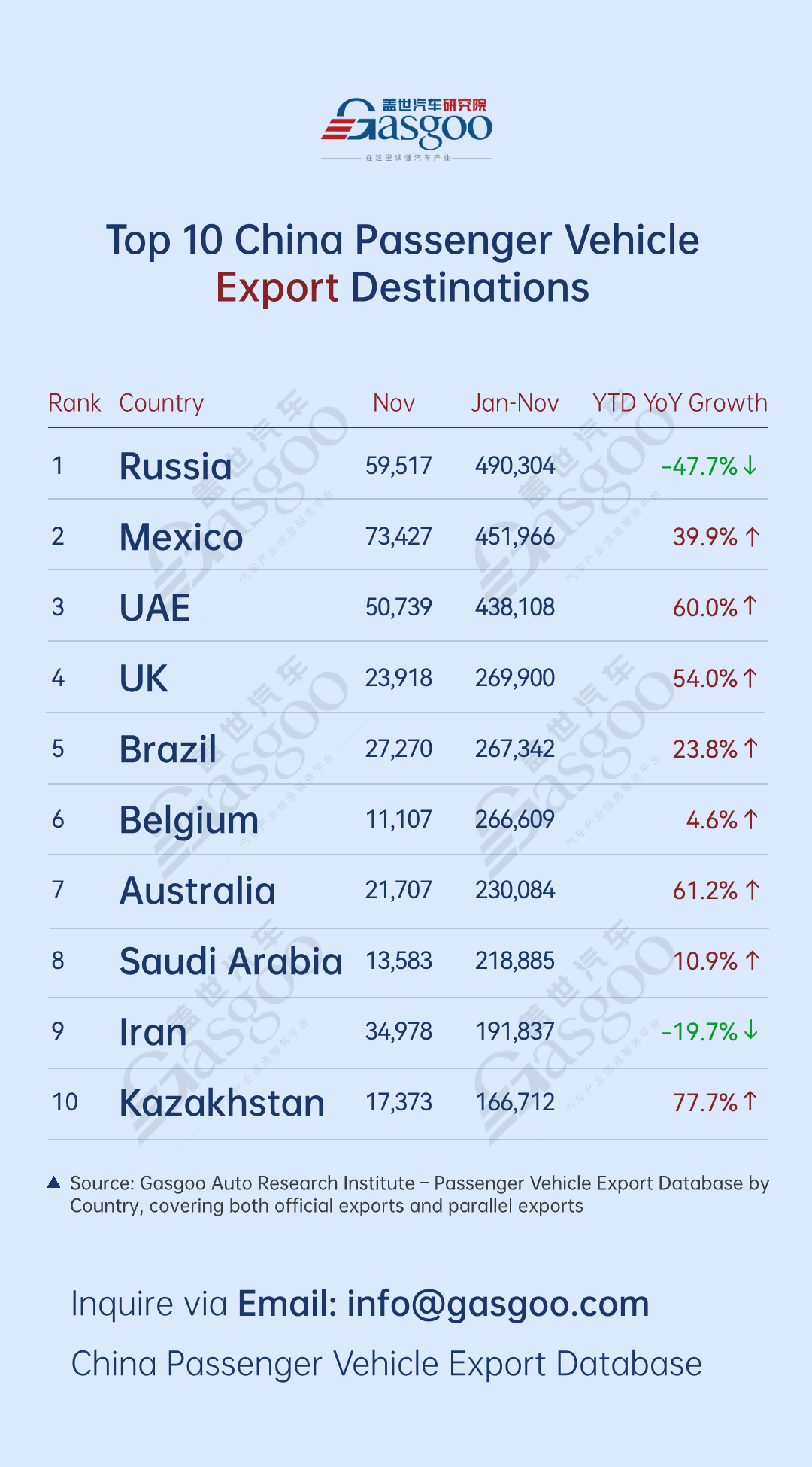
From an overall scale perspective, the top 10 destinations for China’s passenger vehicle exports from January to November 2025 showed clear structural divergence and a shift in regional focus. Russia remained the largest market with 490,304 units, but cumulative exports fell sharply by 47.7% YoY. In contrast, markets such as Mexico and the UAE recorded strong growth, highlighting a transition in which traditional high-base markets were entering an adjustment phase while emerging and alternative mature markets were scaling up rapidly.
The pullback in Russia and Iran stood out as the most notable shift within the rankings. Russia still recorded 59,517 units in November, indicating resilient short-term demand, but cumulative exports fell by nearly 50% YoY, reflecting the combined impact of tariffs, expected scrappage taxes, and currency fluctuations. Iran also saw a 19.7% YoY decline, underscoring how policy and financial conditions constrained export momentum.
At the same time, North America and the Middle East emerged as key growth engines. Mexico ranked second with 451,966 units, up 39.9% YoY, while November shipments surged to 73,427 units. With Mexico set to raise tariffs on China-origin vehicles from 20% to 50% starting January 1, 2026, some automakers accelerated shipments ahead of the policy change, providing a short-term boost to export volumes. The UAE recorded cumulative exports of 438,108 units, up 60.0% YoY, reinforcing its role as a regional hub and driving spillover demand across neighboring markets.
Europe and Oceania reflected a pattern of steady expansion. The UK and Belgium ranked fourth and sixth, recording YoY growth of 54.0% and 4.6%, respectively. The faster growth in the UK pointed to rising acceptance of Chinese brands in the local market. Meanwhile, the strategic importance of Latin America and Central Asia continued to increase. Brazil exported 267,342 units, up 23.8% YoY, maintaining stable volume growth, while Kazakhstan, though smaller in absolute terms, posted a sharp 77.7% increase, emerging as a bright spot in Central Asia and partially offsetting the pullback in Russia. Overall, China’s passenger vehicle exports were shifting from reliance on a single high-growth market toward more balanced, multi-regional support.
Top 10 destination countries by China’s new energy passenger vehicle exports
Belgium: 10,375 units in November and 255,915 units (+6.0% YoY) from January to November 2025
UK: 17,886 units in November and 188,753 units (+71.6% YoY) from January to November 2025
Brazil: 14,382 units in November and 170,756 units (+19.7% YoY) from January to November 2025
Mexico: 43,191 units in November and 156,611 units (+140.8% YoY) from January to November 2025
UAE: 25,540 units in November and 134,878 units (+104.1% YoY) from January to November 2025
Australia: 9,337 units in November and 110,917 units (+63.6% YoY) from January to November 2025
Indonesia: 17,131 units in November and 98,964 units (+143.0% YoY) from January to November 2025
Thailand: 8,366 units in November and 90,687 units (+35.9% YoY) from January to November 2025
Israel: 10,759 units in November and 89,176 units (+40.0% YoY) from January to November 2025
Spain: 4,627 units in November and 77,057 units (+38.7% YoY) from January to November 2025
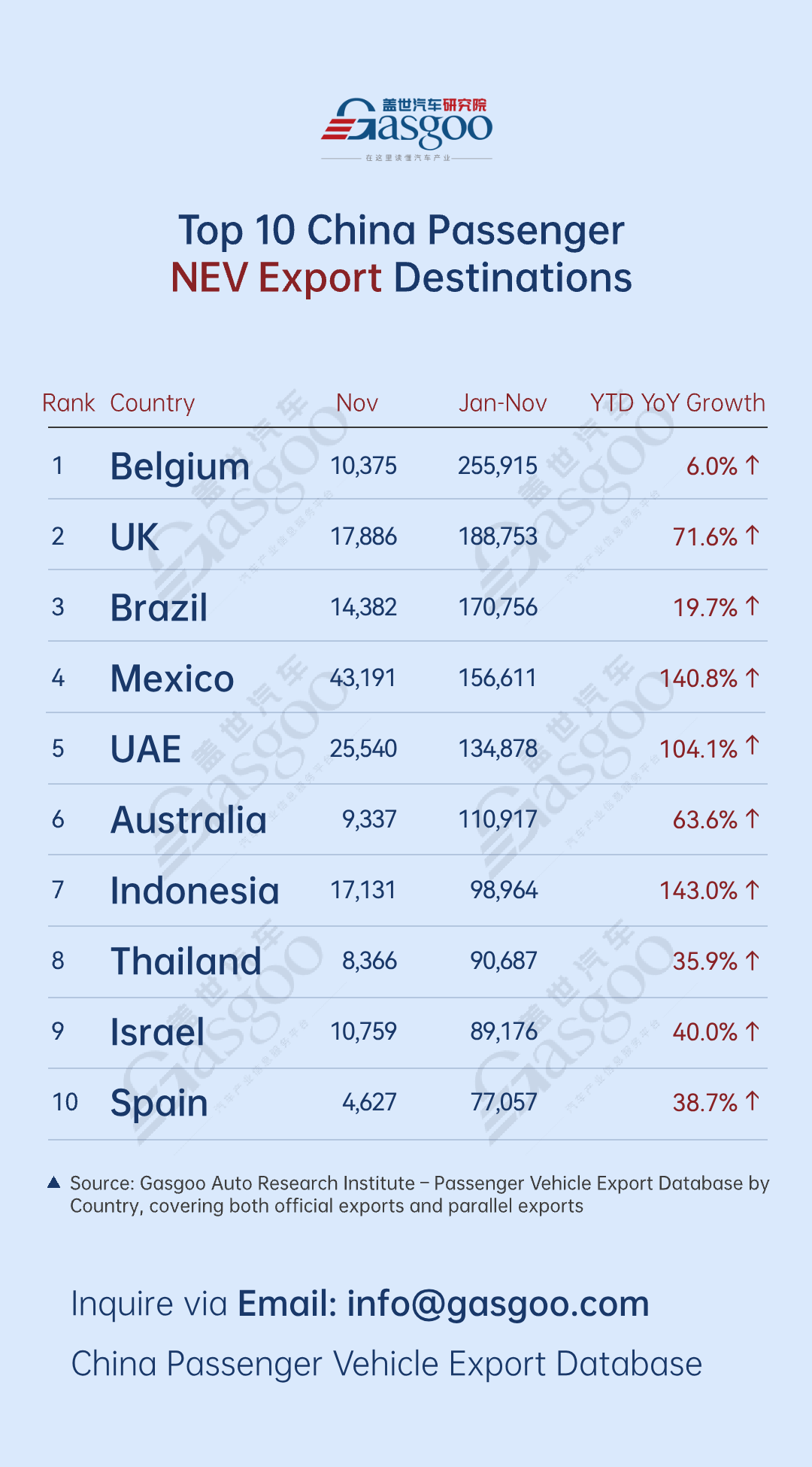
Structurally, China’s NEV exports show a dual pattern of “stable Europe + high-growth emerging markets.” Belgium remains the top destination with cumulative exports of 255,915 units and 10,375 units in November, primarily serving as a European distribution and transit hub. This reflects the “eline” role of Chinese NEVs within Europe’s channel system, though YoY growth has noticeably slowed, indicating a transition into a relatively mature stage.
The UK and Brazil ranked second and third, representing two different market dynamics. The UK, driven by rising NEV penetration and supportive policy windows, maintained high growth and served as one of China’s core NEV end markets in Europe. Brazil, by contrast, benefited from the early stage of local NEV adoption and strong demand for mid- to low-priced models, showing steady but more measured growth. Notably, markets such as Mexico, the UAE, and Indonesia experienced explosive expansion. Mexico functioned both as a consumer market and a potential manufacturing and transit hub, while the UAE and Indonesia represented accelerated NEV adoption in the Middle East and Southeast Asia, with strong acceptance of Chinese brands and rapid volume growth, making them key sources of incremental exports.
Overall, China’s NEV exports have shifted from “single-market breakthroughs” to multi-regional coordinated expansion. Europe remained the hub for scale and brand presence, while emerging markets contributed the bulk of incremental growth. Going forward, export performance will increasingly depend on local market adaptability, channel depth, and the ability to respond quickly to changes in policy and trade environments.
All Rights Reserved. Do not reproduce, copy and use the editorial content without permission. Contact us: autonews@gasgoo.com