
Company Logo
The space rescue operations market is thriving due to increased space missions, expanding telemedicine, autonomous rescue tech, and global collaborations. Key opportunities lie in developing rapid response systems, supporting commercial missions, and enhancing modular rescue solutions amid growing demand for crew safety in space.
Space Rescue Operations Market
Space Rescue Operations Market
Dublin, Jan. 15, 2026 (GLOBE NEWSWIRE) — The “Space Rescue Operations Market Report 2026” has been added to ResearchAndMarkets.com’s offering.
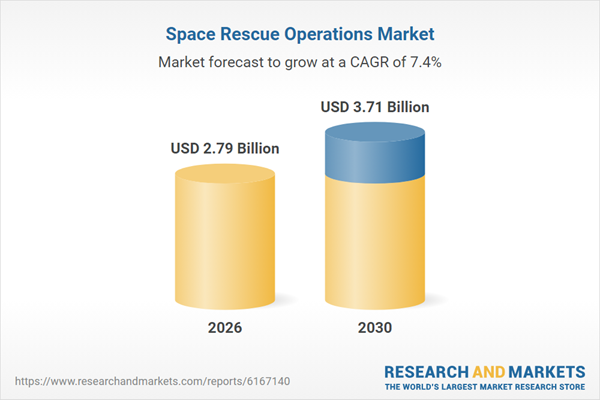
The space rescue operations market has shown significant growth, set to expand from $2.59 billion in 2025 to $2.79 billion in 2026, enjoying a CAGR of 7.7%. Historical growth factors include the development of emergency protocols for low Earth orbit missions, advancements in communication for distress signal monitoring, and the introduction of telemedicine for astronauts.
Forecasts predict the market will reach $3.71 billion by 2030, with a CAGR of 7.4%. This growth is driven by the expansion of dedicated space rescue fleets, the integration of autonomous response systems, and increased investment in remote health technologies. An increase in international collaborations is also expected to enhance rescue operations.
Key trends during the forecast period include the rising demand for rapid on-orbit emergency systems and an increased need for rescue support in commercial space missions. The expansion of telemedicine capabilities and advancements in multi-vehicle coordination techniques reflect these dynamics. More space missions are anticipated, fueled by the demand for advanced communication and satellite deployment services, thereby boosting the space rescue operations market further.
For example, according to a Space Foundation report, 2024 featured 223 launch attempts with 212 successes. Commercial launches surged by 50%, deploying over 2,800 satellites. Consequently, the growth in space missions propels the demand for rescue operations, ensuring crew safety and mission success, and enabling ambitious explorations with enhanced risk management.
Innovations are at the forefront, with companies like NASA and SpaceX conducting missions to retrieve crew using commercial spacecraft. Notably, in May 2025, NASA partnered with SpaceX to launch the Crew-10 mission using the Dragon spacecraft, successfully retrieving crew stranded on the ISS due to the Starliner mission’s technical failures. This underscores commercial spaceflight’s critical role in emergency recovery and the importance of public-private partnerships in enhancing mission safety and resilience.