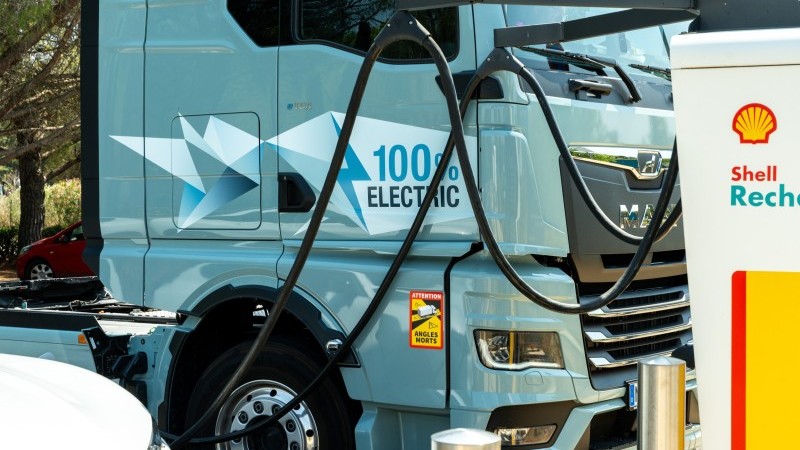
A crucial condition for the future of e-trucks is charging infrastructure. Massive development across Europe will be required in the coming years, and progress will be assessed alongside fleet growth and market share when evaluating CO2 legislation for trucks. While most trips fit within range limits, public fast charging is essential for a broader adoption and expansion of the market. Under the European AFIR directive, fast-charging stations (≥350–370 kW) must be available every 60km along major corridors by 2030, enabling approximately 250km of range per hour of charging. Eventually, a network of mW charging (MCS) stations will need to be introduced as well.
ICCT projects that, in total, 150,000-175,000 private chargers and 60,000-80,000 public chargers for heavy-duty vehicles ranging between 22kW-750kW will be necessary by 2030, as well as 4,000-5,300 megawatt chargers. 20 minutes of charging would then suffice for 250-300 km. Milence has opened several locations in the past years, mainly along the so-called TEN-T corridors, with more coming. By mid-2025, however, the EU only counted roughly 1,100 public charging stations (mostly in Northwestern Europe), highlighting the challenge here.
Installing suitable charging facilities at private sites is not always straightforward. In some countries, grid capacity is a major constraint. For example, in the Netherlands, waiting times for grid upgrades can exceed five years, while France faces fewer congestion and capacity issues. These challenges complicate the transition and slow progress. While TCO is important, infrastructure may ultimately be the decisive factor for growth.