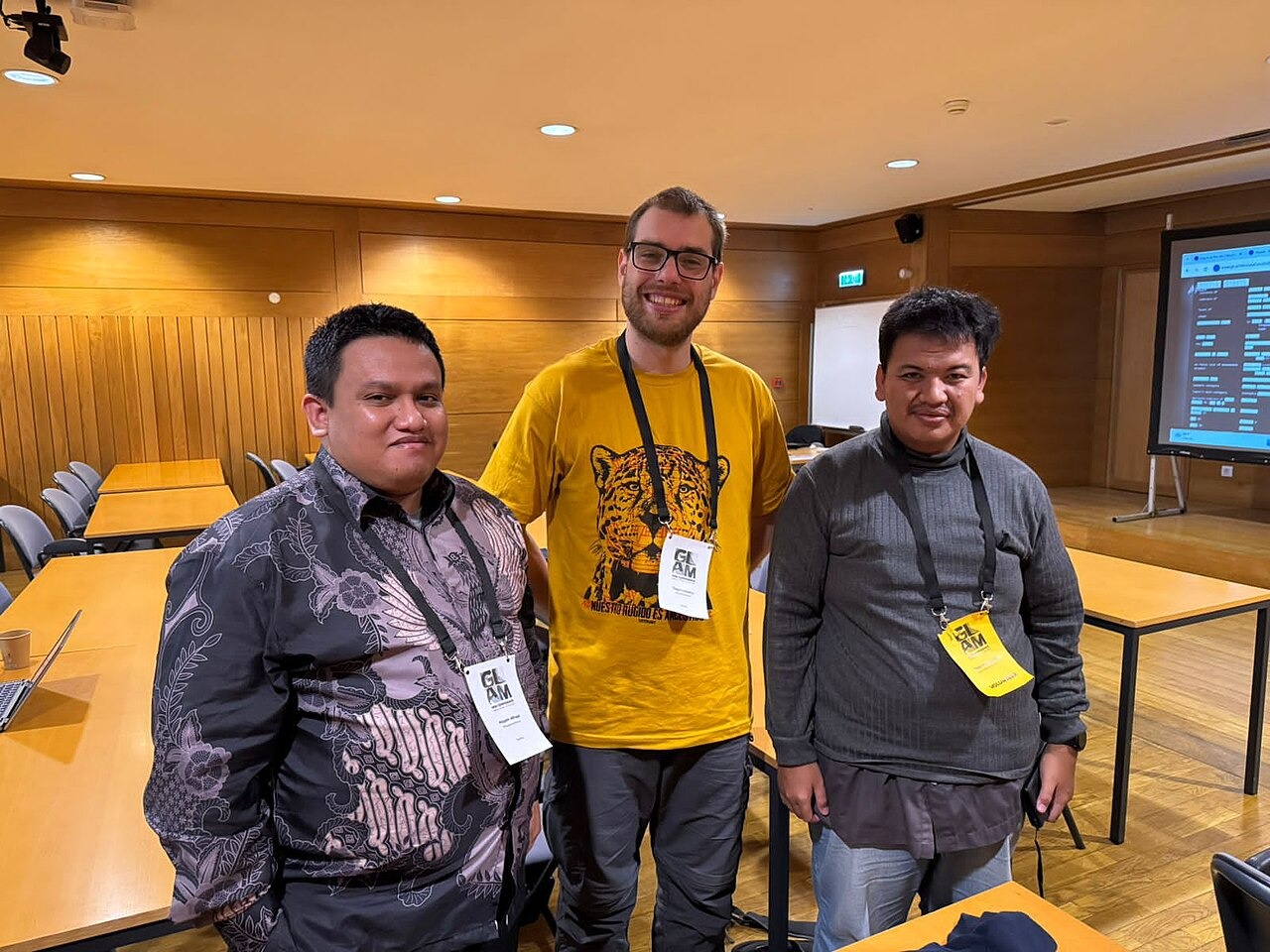
In October 2025, I had the opportunity to participate as a scholar at the GLAM Wiki Conference 2025 in Lisbon, Portugal, representing Wikimedia Indonesia. The conference brought together Wikimedians, cultural practitioners, and technologists from around the world to reflect on how the Wikimedia movement collaborates with galleries, libraries, archives, and museums (GLAM), particularly in the context of open knowledge and data.
I joined the conference as part of the Technology Lightning Talks track. This format allows participants to share focused experiences and ideas. This event was a significant opportunity, both for me and for Wikimedia Indonesia in general, to contribute Indonesian perspectives and connect local experiences with global discussions.
Representing Wikimedia Indonesia
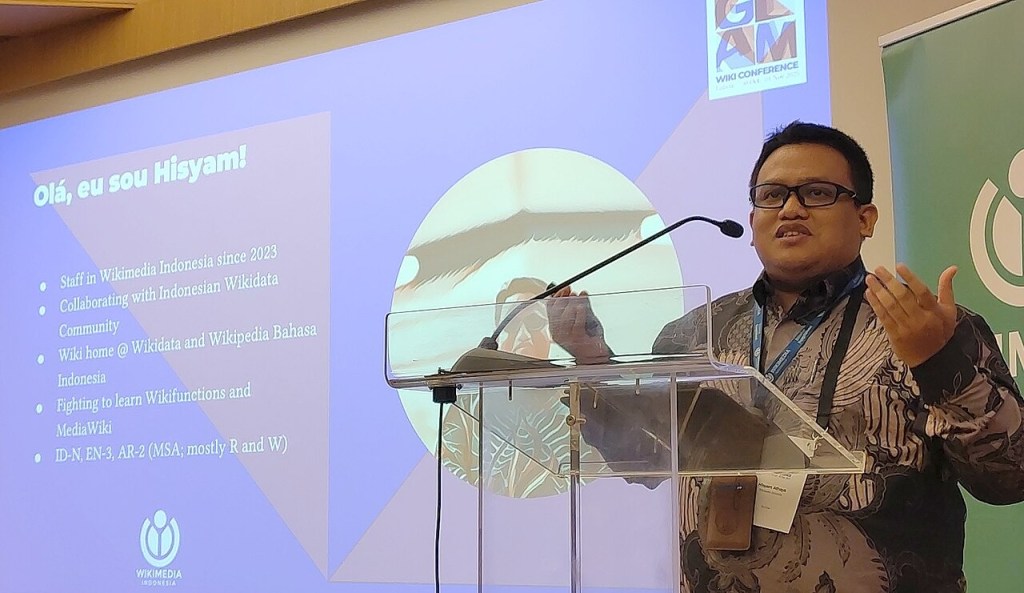 Me presenting Technology Lightning Talk (Valerio Bozzolan, Speaker – 2 – GLAM Wiki 2025, Lisbon, Portugal, CC BY-SA 4.0)
In my presentation, titled “Maintaining and Reusing Cultural Heritage Data with Wikidata: Experience from Wikimedia Indonesia”, I explained how Wikimedia Indonesia supports data contribution and maintenance through several activities. These include WikiLatih Wikidata workshops that introduce Wikidata to new contributors, Datathons that focus on structured data editing and enrichment, and a Data Visualization Competition that encourages the leverage of Wikidata reusability through visual storytelling and written analysis. I also highlighted our efforts to introduce Wikidata to academics through academic outreach and the Wikidata Research Fund.
Conversations and Reflections from the Session
One of the most valuable aspects of the conference was the conversations that followed the sessions. After my presentation, I discussed with Sandra, a Wikimedian from the Netherlands, about cultural data related to the Nyah Lasem Museum in Indonesia and how she could be connected with Wikimedia Indonesia to explore future collaboration. I also met Tiago, a Wikimedian from Brazil, and we discussed the use of Wikidata in academic research.
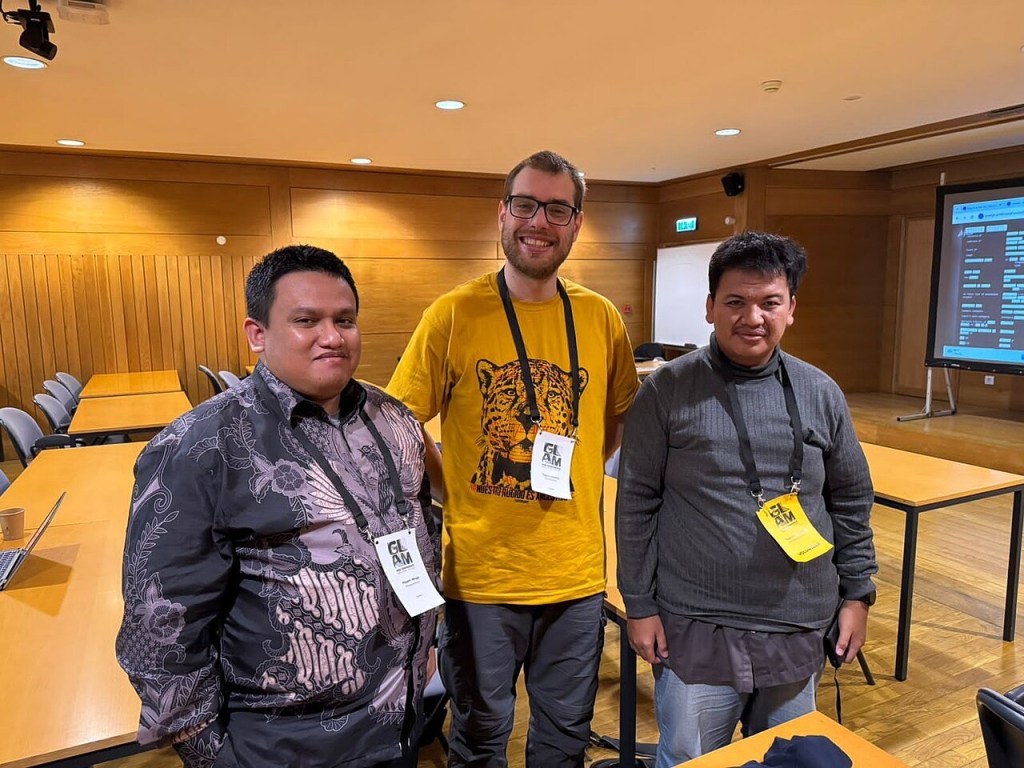 Me with Ilham (Indonesia) and Tiago (Brazil) (Ilham Mufti Laksono, Ilham with Participants of GLAM Wiki 2025 003, CC BY 4.0)
At the same time, the conference highlighted some contrasts. In many countries, cultural and knowledge institutions appear more open to sharing data and collaborating openly. In Indonesia, we still face challenges in building lasting partnerships, and authoritative data is often fragmented and inaccessible due to bureaucratic processes and institutional silos.
Learning from GLAM Wiki 2025
One key insight from the conference was the critical role of knowledge institutions in countering what is often described as “AI slop”: content produced by artificial intelligence, published without sufficient curation, and later reused by other AI systems as reference material. In his talk “Data is Everything: Why Knowledge Institutions are the Future of AI,” Greg Leppert from the Harvard Institutional Data Initiative described how this creates a vicious cycle, where low-quality or synthetic data is repeatedly recycled, leading to further degradation of information quality.
At the same time, Greg showed that this cycle is not inevitable. He shared an example from his work using Tesseract to process scanned newspaper archives. While the model was able to read large volumes of historical text, it also made mistakes, especially when dealing with degraded or imperfect scans. Instead of treating the output as final, Greg’s team reviewed and corrected the results, allowing the system to learn from authoritative human input. This illustrates how technology can support the extraction and retrieval of knowledge from imperfect sources, provided it is paired with careful curation and stewardship by knowledge institutions.
Connecting Global Ideas to the Indonesian Context
In Indonesia, creating authoritative and centralized data sources remains a significant challenge. Frequent changes in government structures, fragmented data ownership, and institutional views of data as a commodity all contribute to this difficulty. Based on insights from the GLAM Wiki 2025, one approach that resonated with me was the importance of building coalitions and consistently promoting open data to a wide range of stakeholders, with the hope that awareness and trust will grow over time.
Looking ahead, one concrete follow-up is to strengthen collaborations with data-holding institutions and universities. Universities are particularly important partners, as they often have access to primary data, the capacity to produce citable secondary data for Wikimedia projects, and established links with other data-producing institutions.
Looking Forward
Participating in the GLAM Wiki 2025 reaffirmed the importance of international exchange for Wikimedia affiliates like Wikimedia Indonesia. Sharing local experiences while learning from others helps us reflect critically on our own challenges and possibilities. I hope the connections and insights gained in Lisbon will continue to inform our work in maintaining and reusing cultural heritage data in ways that are open, collaborative, and locally meaningful.
In order for this article to reach as many people as possible we would like your help. Can you translate this article to get the message out?
Related