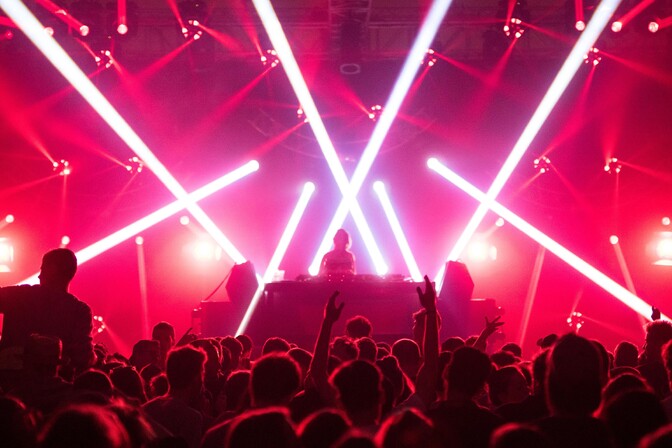
In the 19th century, dancing at night was generally frowned upon. Yet it was the grand society halls, such as Estonia and Vanemuine, that became places which could be considered Estonia’s first nightclubs.
Nightlife has a fairly simple definition: it includes everything that takes place in a city from 7 p.m. to 7 a.m., encompassing not only entertainment but also social services, mobility and public services.
Karin Leivategija, a researcher at the Estonian National Museum and a doctoral student in ethnology at the University of Tartu, recalled how traces of night culture in Estonian-language media go back to the 19th century when nighttime dancing was met with strong disapproval.
“It was seen as a virus or some kind of illness that even doctors couldn’t cure —because they themselves were infected,” Leivategija said. She added that the physicality and sensuality associated with nighttime dancing were seen at the time as a moral problem. Still, she noted, it was precisely the grand society halls — from Estonia to Vanemuine — that eventually became the places where dancing regularly brought people together. In their own way, they were Estonia’s first nightclubs.
The night is inevitably associated with something uncontrollable and suspect, a mindset that has carried into the present day. “People kept complaining: Why does it have to happen at night? Can’t they dance half as long and wrap it up earlier? That physical darkness gets tied to a kind of mental darkness — a belief that night and culture don’t go together,” Leivategija said.
Airi-Alina Allaste, professor of cultural diversity at Tallinn University, cited earlier research in which the pioneers of alternative club culture in the early 1990s deliberately distanced themselves from the party culture of the Soviet era. “They saw the house music parties they organized as a completely different world compared to the parties back then, where in their view there was a lot of drinking, fighting and attempts to hook up. For them, a party was something entirely different — a place to go listen to good music and, what was still rare at the time, dance alone,” Allaste explained.
The lack of awareness and control over what happens at night has led to biased perceptions, making it very difficult for nightlife venues to gain public support. Leivategija noted that it’s often best not to mention that an event or project takes place at night: “It instantly strips it of legitimacy,” she said.
Nighttime, in fact, gives people a chance to step outside their routines. According to Leivategija, nighttime is freer and more fluid. “It’s a time when you can dance, listen to music, discover others and explore your own identity,” she said. Many creative ideas, new collectives and even clubs have, according to her, been born out of late-night conversations. “It’s a great space-time where people can be a little different and maybe it’s just more comfortable in the dark,” she admitted.
Allaste emphasized that alternative club culture in particular fosters cultural diversity and creativity, acting as an incubator for the emergence of new music styles and subcultures.
But the nighttime hours also carry a deeper social dimension. Night has provided a sense of belonging for those who find themselves on the margins or excluded altogether. “Many marginalized groups have found refuge in the night,” Leivategija said, citing LGBTQ+ communities as an example. For them, nighttime clubs have offered a chance to meet and shape their identity, safely out of sight of the daytime world.
Former Tallinn nightlife advisor Natalie Mets, whose master’s thesis examined the integration of Estonian- and Russian-speaking people through club culture, said that for some interviewees, the nighttime environment felt like a sanctuary. “It was the first place where they could just be without being looked down on. Queer youth, who had to hide their very existence at school and at home, were accepted in nightlife spaces. In reality, nobody even cares how tall you are, what color you are, what language you speak or what your sexual orientation is,” Mets said.
According to Allaste, nightlife also plays a key role in relieving tension: “A lot of people use nightlife to build a sense of community and research shows that safe dancing reduces anxiety and improves stress tolerance,” she said.
Of course, nightlife isn’t without its dark side. Safety, substance abuse and conflicts are real issues that need addressing and in many places, they already are: training sessions on preventing harassment, more intentional space design and clear rules have been implemented. Some cities have taken it even further. “In Berlin, clubs are officially recognized as cultural institutions and are eligible for equal funding. That’s a very important development,” Leivategija noted. Even so, she said, economic times are tough there too, and the city and ideally the state should step in. One remarkable example is Zurich, where techno music has been included on UNESCO’s cultural heritage list since 2017.
A paradox emerges: nightlife is often described in terms of vice, but its real meaning and appeal lie in community, creativity and in making the invisible more visible. “When we have amazing Estonian DJs and hundreds of people dancing all weekend long, it’s a shame that this isn’t seen as culture,” Leivategija said.
This article was produced as part of the University of Tartu course “Journalism Internship.” The authors are master’s students Anna-Liisa Sootalu, Henrik Laever and Mark Joonas Toomsalu.
—
Editor:
Sandra Saar. Marcus Turovski