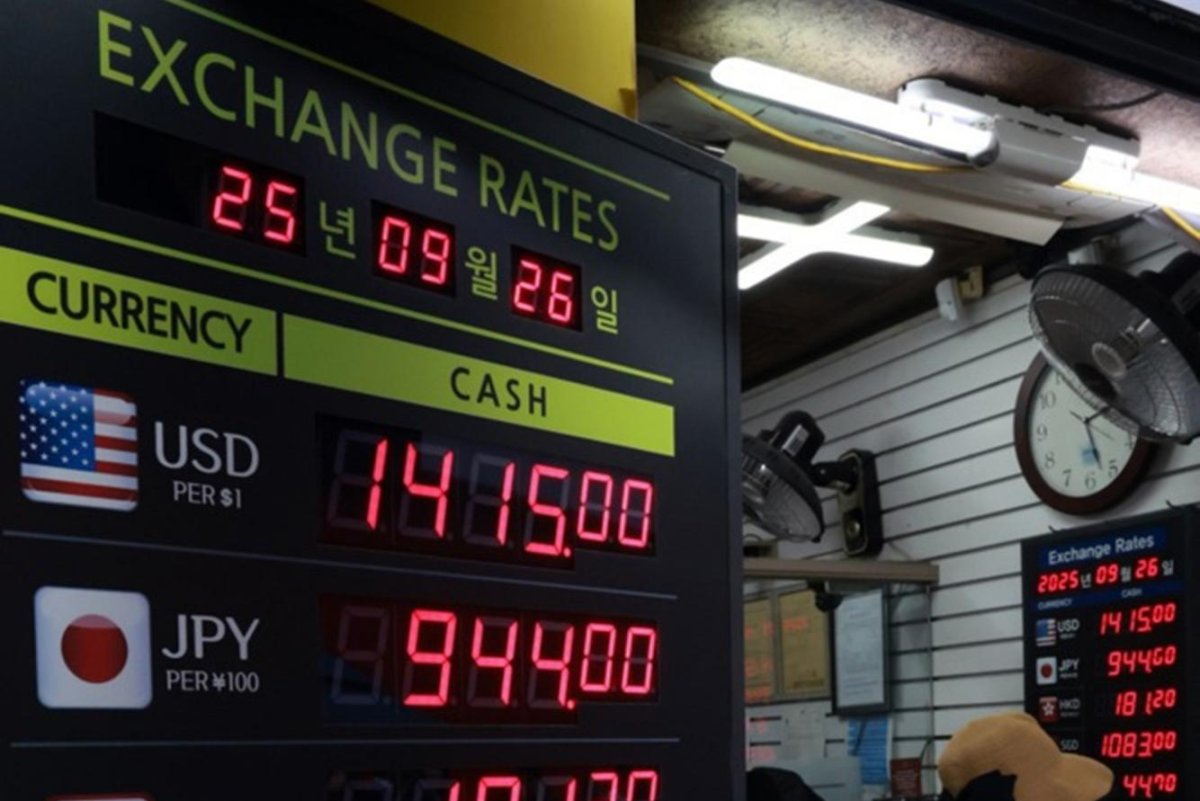
A sign showing the exchange rates of the South Korean won against other currencies informs people that the won is exchanged at 1,415 won per one US dollar at a foreign exchange booth in Myeongdong, a shopping mecca in Seoul, South Korea, 26 September 2025. File. Photo by YONHAP / EPA
Jan. 18 (Asia Today) — The International Monetary Fund warned that South Korea’s U.S. dollar-denominated assets are exposed to outsized currency risk relative to the depth of the country’s foreign exchange market, increasing the chance of volatility during periods of rapid hedging.
In its Global Financial Stability Report released Sunday, the IMF said South Korea’s ratio of dollar-denominated assets exposed to exchange-rate risk to the size of its foreign exchange market, measured by monthly trading volume, stands at 25. The IMF described the metric as a structural gauge of how well a country’s foreign exchange market can absorb exchange-rate shocks.
The IMF said some countries hold dollar asset exposure that is disproportionately large compared with the depth of their foreign exchange markets. It cited South Korea, Canada and Norway as having particularly high ratios, while major European economies such as Germany, France and Italy remained in the single digits.
For non-reserve-currency economies with high dollar exposure, the IMF said it can be difficult for local foreign exchange markets to absorb sharp moves in the dollar’s value over the short term.
The IMF said volatility could intensify if global investors rush to hedge currency risk at the same time, especially in markets with high dollar exposure.
In response, the National Pension Service has recently begun what it calls “strategic currency hedging,” while the Ministry of Economy and Finance is preparing products that would allow individual investors to sell foreign exchange forward, the report said.
The IMF said Taiwan posted the highest ratio at 45 because its foreign exchange market is smaller, despite having a dollar asset base similar to South Korea’s. Japan had the largest absolute dollar asset holdings, but its larger foreign exchange market kept the ratio below 20, the report said.
— Reported by Asia Today; translated by UPI
© Asia Today. Unauthorized reproduction or redistribution prohibited.