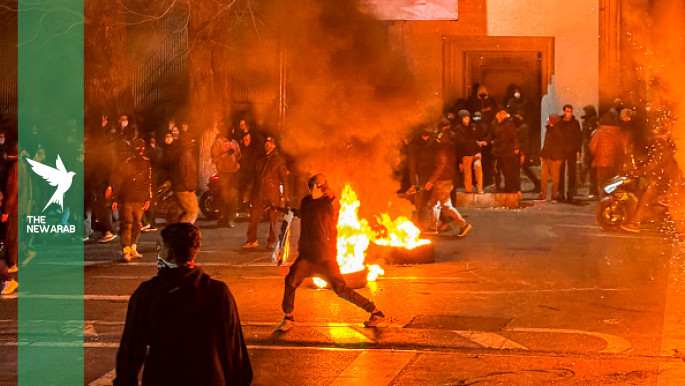
The protests quickly grew into a nationwide uprising which was violently quelled by security forces [Getty]
Conflicting figures have emerged over the death toll from protests in Iran, following a security crackdown that authorities say was aimed at restoring order, with reported numbers ranging from several thousand to tens of thousands.
The unrest began in late December, as demonstrations against worsening economic conditions spread to multiple cities, with most protests turning violent.
The scale of the unrest has led to death toll estimates that exceed those reported during previous episodes of protest in the country since the 1979 revolution.
During the height of the demonstrations, authorities restricted internet access, a move officials said was intended to curb unrest but which significantly limited the flow of information from inside the country and complicated efforts to assess events on the ground.
Footage circulating online, which could not be independently verified by The New Arab, appeared to show large numbers of bodies stored at a coroner’s facility.
Varying death toll estimates
Iran’s Supreme Leader Ali Khamenei said last week that “thousands” of people had been killed during the unrest, including Iranian security members, without providing a specific figure.
Iranian officials have repeatedly blamed foreign meddling, including the United States and Israel, for encouraging riots, accusing some demonstrators of acting as “foreign agents”.
An Iranian official based in the region told Reuters on Sunday that authorities had verified at least 5,000 deaths, including around 500 members of the security forces.
The official, who spoke on condition of anonymity, said the highest number of casualties occurred in Iran’s northwestern Kurdish regions, where clashes have historically been more intense during periods of unrest.
The official added that the verified figure was not expected to “increase sharply”.
Kurdish-majority areas like Sanandaj, Saqqez and others have repeatedly been at the forefront of opposition movements in Iran.
Separately, the US-based Human Rights Activists News Agency said it had documented at least 3,766 deaths as of Sunday, revising its earlier estimate of 3,308, while warning that the true figure could be higher.
Meanwhile, the UK-based Sunday Times reported it had obtained testimony from medical sources inside Iran suggesting that between 16,500 and 18,000 people were killed, with between 330,000 and 360,000 injured, many during a short period of intense violence.
The British right-wing paper reported that the data was allegedly compiled by staff at multiple hospitals and emergency departments, and included women, children and pregnant women. It also claimed that hundreds of people had suffered severe eye injuries.
US-based CBS News, citing two sources last week, reported estimates ranging from at least 12,000 deaths to as many as 20,000.
According to a report in Human Rights Watch, Iranian authorities have coerced families to make statements that their relatives and loved ones were members of the Basij forces and killed by protesters, or have to pay large sums of money to receive their bodies.