Ongoing calls for U.S. intervention in Iran reflect the triumph of hope over history. With the Trump administration reportedly still weighing an attack on the Iranian regime, now is the moment to ask what the goals of an intervention would be, whether they are achievable, and what risks they carry.
Unfortunately, a look back at recent U.S. interventions in the Middle East, including several that I was personally involved in as a diplomat, suggest that the answers to these questions are not encouraging.
Ongoing calls for U.S. intervention in Iran reflect the triumph of hope over history. With the Trump administration reportedly still weighing an attack on the Iranian regime, now is the moment to ask what the goals of an intervention would be, whether they are achievable, and what risks they carry.
Unfortunately, a look back at recent U.S. interventions in the Middle East, including several that I was personally involved in as a diplomat, suggest that the answers to these questions are not encouraging.
American outrage at the brutality of the Iranian government is reasonable and proper. But this doesn’t mean that hitting Iran militarily will facilitate a peaceful political transition with no negative consequences. Moreover, President Donald Trump’s policies toward Venezuela remind us that he is not interested in supporting democracy globally. Thus, his motives and commitment can’t be trusted in Iran.
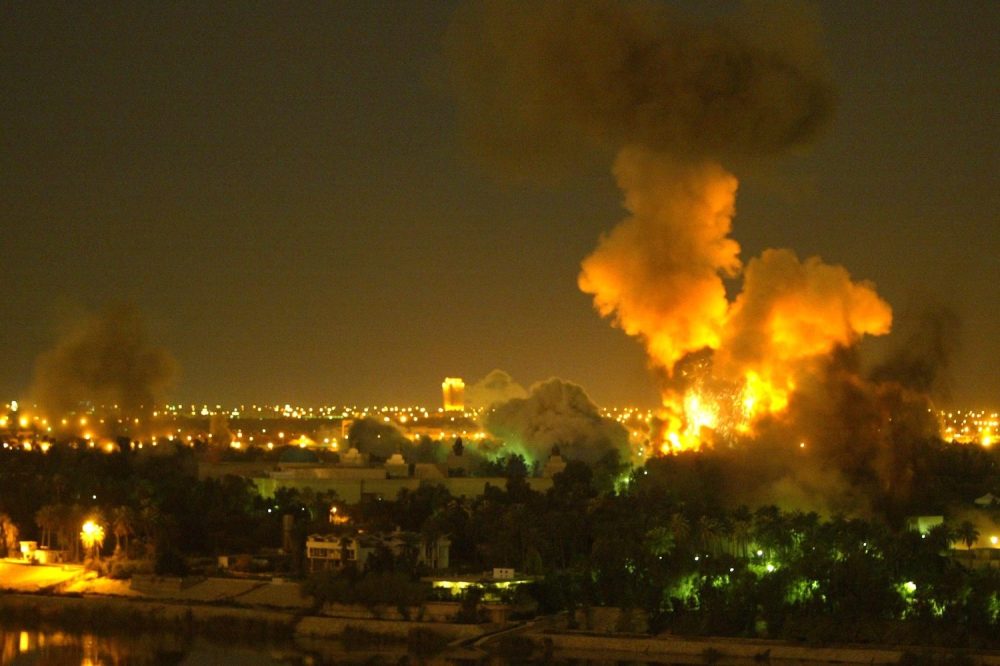
Let’s state the obvious. In the past two decades, Washington’s track record of building up successful opposition movements or stable governments in the Middle East after regime change has been lousy. I saw this firsthand in Iraq and Syria.
Years before U.S. President George W. Bush invaded Iraq in 2003, the U.S. government was trying to promote unity among disparate elements of the Iraqi opposition in exile. There was, of course, the pernicious influence of ill-chosen favorites such as Ahmed Chalabi. More problematic were the enduring differences between Iraqi political groups whose interests and political support bases were local, not national. Their visions for Iraq’s future focused on advantaging one element of Iraqi society or another, not its broader citizenry.
After Washington took out Saddam Hussein, American diplomats like me urged Iraqis to forget past wrongs and temper their actions for the sake of the nation of Iraq. To Iraqis, we sounded condescending or naive. Those differences between Iraqis undermined U.S. efforts to establish efficient national government after the U.S. invasion.
The U.S. government had not even finished with the Iraq fiasco before it joined its Middle Eastern and European colleagues in lavishing attention on another opposition in exile, this time Syrian. But the opposition could never reach a consensus around any national vision, whether secular or Islamist. At a 2012 conference, I had to break up a late-night fistfight between Arab and Kurdish opposition members. It was an early taste of the ethnic enmity that fostered dissension within Syrian opposition ranks—and provoked new fighting in northern and eastern Syria over the past two weeks.
Colleagues working in Libya and Afghanistan had similar problems with the political forces that the United States was backing. Ultimately, it is fighters, not political opposition figures, who shape politics after the fall of Middle Eastern regimes. When Libya’s Muammar al-Qaddafi was toppled in 2011, the new, Western-backed government could not assert control over the many militia groups that had brought the regime down. As a result, Libya’s political transition quickly collapsed into civil war along tribal and geographic lines. Libya is still divided today.
Likewise, three U.S. administrations never came close to securing a political deal to end the civil war in Syria. Instead, as the Assad government weakened, militias proliferated, and the externally based political opposition backed by the West became irrelevant. Ultimately, an armed Islamist militant group on the U.S. terrorism list seized the major cities and booted Bashar al-Assad out. Even now, Syria is divided along cultural and geographic lines into three parts.
Iraq, between 2005 and 2017, held together only because of enormous efforts by the U.S. military and billions of dollars in American material support to wobbly Iraqi security forces as the diplomats frantically tried to convince reluctant Iraqis to patch together weak coalition governments. Colin Powell was right when he said that if Washington broke Iraq, it would own it.
Of course, Iran has its own long and proud history, refined culture, languages, and demographic composition. It differs in big ways from its neighbors in the region. No American analyst has yet explained, however, why Iran’s particularities would enable it to escape the political and security dynamics that sank neighboring states suffering similar turmoil. It should be obvious to any serious policy analyst that Washington should have a considered assessment—not a hope—of who or what would succeed the Islamic Republic before it strives to undermine it as quickly as possible.
Perhaps Iran would follow another Pahlavi. But recall that political exiles returning to Iraq, Syria, Libya, and Afghanistan all boasted poor records of success.
Perhaps a new national opposition leader will emerge in the months ahead. That has not happened so far, and only Iranians—not Americans—can make it happen. Washington did not think much about the long-term harm to the image of the United States inside Iran when it backed an Iranian-led coup against a populist Iranian prime minister in 1953. Trump need not make that mistake again. Given the Iranian government’s repression, Iranians will need much time to develop a political opposition with a national vision, a national program, and a national organization.
It is important to note that already in Iran, there are reports of Kurdish armed groups clashing with government forces in northwestern Iran as well as Baloch fighters ambushing government forces in the east. In the face of growing armed opposition, weakened government security forces could lose control of some spaces in Iran, enabling armed opposition elements to proliferate; that is what happened in Libya, Syria, and Afghanistan.
No American analyst has explained how an Iran entangled in a low-grade or intense civil war would affect U.S. interests ranging from counterterrorism to energy to drug trafficking, refugee flows, and regional stability. None of the George W. Bush administration policymakers, including some sophisticated foreign-policy veterans, anticipated that the U.S. war that brought down Saddam would enable Iran, not the United States, to become the most influential voice in Baghdad. None of us working on Syria in 2011-2012 anticipated that the Syrian civil war would finally lead to the displacement of half the population and provoke refugee flows to Europe that helped alter domestic politics in key NATO allies.
Before Washington tries to quickly bring down the Islamic Republic, as detestable as it is, planners need to have considered answers about what a long civil war in Iran means for U.S. interests. Worries along these lines are leading states in the region to caution Washington now.
Against these multiple failures of U.S. policy, some optimistic commentators have cited Trump’s success in Venezuela as evidence of a new playbook. Now, they believe that the United States can employ a variety of military assets in tactical operations to disrupt the Iranian security services’ campaign of repression, such as airstrikes against Iranian security forces and cyberattacks on Iranian command and control operations.
Certainly, as we saw in the Venezuela operation, U.S. capabilities in this domain are remarkable. But this does not mean that things would be the same in Iran. Iranian commanders, some of whom have deep operational experience in urban combat in Iraq and Syria, might well devise workarounds to manage command and control adequately in major Iranian cities. And the full Iranian leadership, unlike that of Venezuela three weeks ago, rejects any regime change.
It is important to note that so far, the Iranian security forces remain cohesive. The United States may be underestimating how much the upper- and middle-level Iranian leadership sense that they are fighting for their lives and those of their families. As Robert McNamara warned after Vietnam, there are limits to what high-tech U.S. weaponry can do against low-tech but highly motivated adversaries.
Finally, it is crucial to note that Trump’s operation in Venezuela did not in fact bring down the Maduro regime; it simply brought his vice president to power. This is not what Iranians are risking their lives for. The U.S. president’s pledge that “HELP IS ON ITS WAY” might give hope to Iran’s protesters. But they should remember that this president scorns U.S. involvement in democracy promotion and has evinced little interest in Venezuelan democracy after the capture of Nicolás Maduro.
In reflecting on Washington’s failure in Vietnam, McNamara saw the problem as more than just military: “We did not recognize that neither our people nor our leaders are omniscient. … We failed to recognize that in international affairs … there may be problems for which there are no immediate solutions. … At times, we may have to live with an imperfect, untidy world.”
Iran is worse than imperfect and untidy. It is tragic. It would be still more tragic for hasty, emotional U.S. intervention to make things even worse.