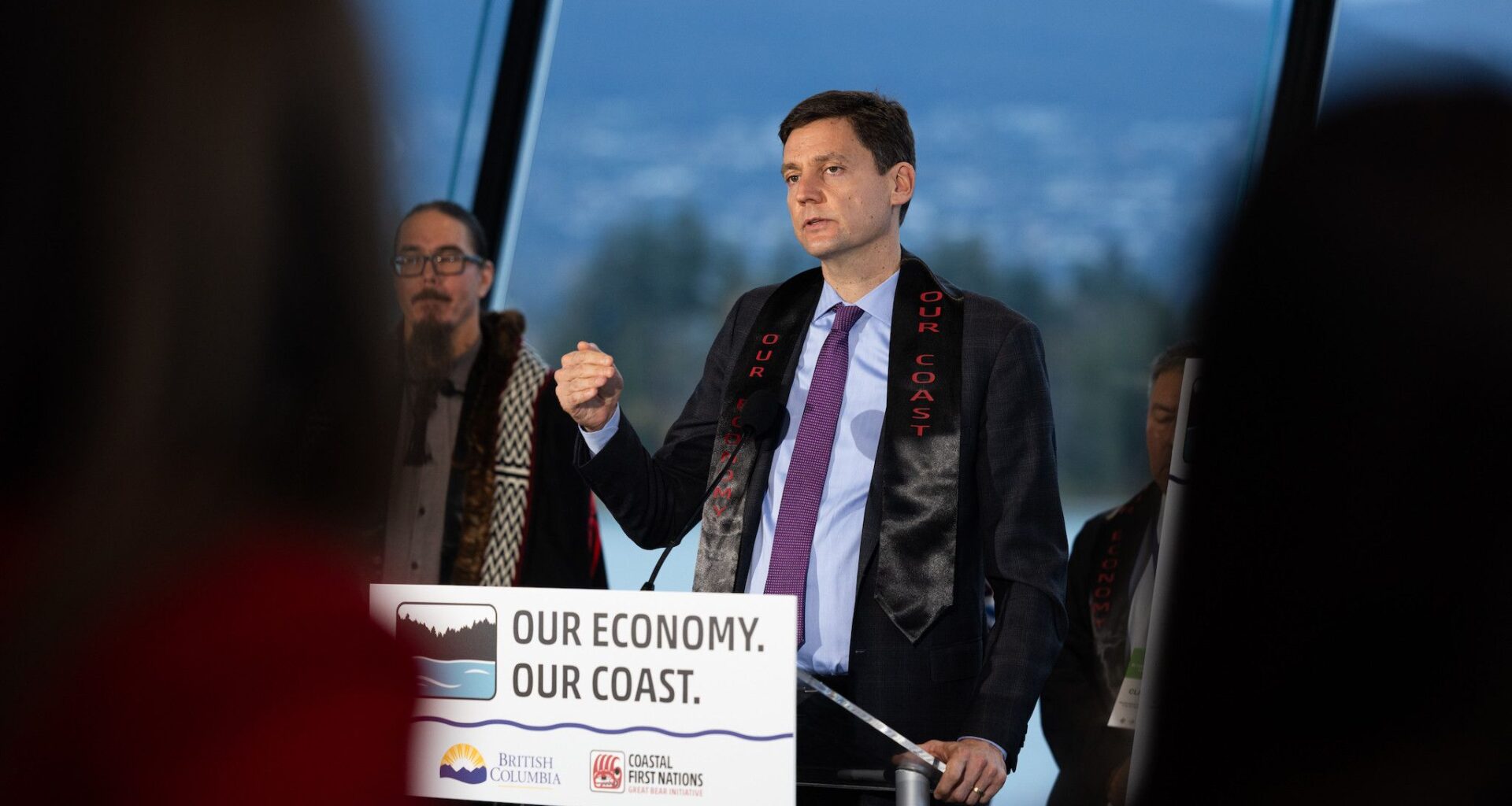
The provincial government led by the BC NDP has announced what it deems to be an important step toward protecting the environment, supporting Indigenous reconciliation, and providing stability for forestry jobs in northern Vancouver Island. But the Conservative Party of B.C. argues this same decision shows the BC NDP is quietly changing how public land is controlled, without enough public debate.
Last week, the provincial government signed four ministerial orders to move forward with the Gwa’ni Land Use Planning Project, a joint plan developed with the Namgis First Nation.
The plan affects more than 166,000 hectares (1,660 sq. km.) of Crown land in the Nimpkish Valley near Alert Bay and Port McNeill — a land area more than 11 times the size of the City of Vancouver or roughly five per cent of Vancouver Island.
The B.C. Conservatives have issued a sharp criticism, accusing the government of “land governance by stealth” at a time when Premier David Eby has already admitted problems with how Indigenous rights laws are being applied.
“For improved stewardship of resources in our territory”
According to the provincial government, the Gwa’ni project is about setting clear rules for how land, rivers, forests, and watersheds in the Nimpkish Valley can be used in the future.
The area includes old-growth forests, wildlife habitat, and all five species of Pacific wild salmon. The plan is meant to decide which areas should be protected, where forestry can happen, and how cultural, environmental, and economic values can be balanced.
The provincial government notes the project has been worked on since 2021, with input from First Nations, forestry companies, local governments, tourism operators, and the public.
“It’s important to have long-lasting, forward-looking plans to manage the environment and natural resources in a way that benefits everyone — and that’s exactly what we’re doing in the Nimpkish Valley,” said Randene Neill, B.C. Minister of Water, Land and Resource Stewardship, in a statement.
“This planning project is a wonderful example of how, when we all work together transparently and openly to determine our values for the future of our province, we create certainty and predictability for everyone who lives in this beautiful area.”
The Namgis First Nation asserts the plan is about protecting its territory while also allowing for a sustainable forest industry.
“The ‘Na̱mg̱is First Nation is pleased to see the first steps taken to implement the joint Gwa’ni Land Use Planning Project recommendations,” said elected chief Victor Isaac. “The changes to the Vancouver Island Land Use Plan are the foundation for improved stewardship of resources in our territory, respect for our forest and cultural values, and will contribute to the predictability needed for a sustainable forest sector on our region.”
The provincial government also notes the plan supports forestry operations under Tree Farm Licence 37, including a joint decision-making agreement signed in December 2025. That agreement allows the Province and the ’Na̱mg̱is First Nation to jointly approve forestry plans in parts of the territory.
Forestry company Western Forest Products welcomed the move.
“Advancing the Gwa’ni Land Use Planning Project sets a strong foundation for sustainable land use on the north Island,” said Steven Hofer, president and CEO of Vancouver-based Western Forest Products.
“Western’s work in the region is strengthened by our collaboration with ‘Na̱mg̱is First Nation and their forward-thinking approach demonstrated through this land-use planning process.”
Several mayors, regional officials, and tourism representatives also say the project will bring long-term stability to the north Island.
“Stop rewriting land governance by stealth”
But the B.C. Conservatives see the situation very differently. In its release today, the party said the provincial government is signing land-use agreements while admitting that the 2019-approved Declaration on the Rights of Indigenous Peoples Act (DRIPA) — based on the provincial government’s interpretation of the United Nations Declaration on the Rights of Indigenous Peoples (UNDRIP) — has caused concern across the province.
“While promising to fix DRIPA, the Eby government continues to quietly sign binding land-use agreements that fundamentally alter how Crown land is governed in British Columbia,” reads the release.
Conservative critic for Indigenous relations Scott McInnis said the public has already rejected similar changes.
“This is Land Act reform by stealth,” said McInnis, referring to the BC NDP-led provincial government’s cancelled proposed legislation to provide First Nations with far greater influence on how Crown lands are used, with some critics in 2024 calling it a veto power.
“British Columbians already rejected these changes once. In 2024, public backlash forced the NDP to pull its Land Act amendments,” continued McInnis.
He questioned why the provincial government is moving ahead now.
“The Premier admits DRIPA is creating concern throughout the province,” said McInnis. “So why is his government still locking in permanent DRIPA-motivated land-use decisions under that same broken framework?”
McInnis also accused the provincial government of avoiding scrutiny.
“These agreements are being pushed through quietly, announced late on weekends, and wrapped in carefully worded news releases that avoid telling people what is really happening,” he charged. “The NDP is deliberately avoiding public scrutiny.”
Another Conservative critic, Donegal Wilson, said the approach is hurting public trust.
“Public lands belong to all British Columbians,” said Wilson. “They should not be governed through a growing patchwork of individual agreements negotiated quietly and announced after the fact.”
Wilson warned that uncertainty discourages investment.
“That lack of certainty is exactly why people don’t want to invest, don’t want to expand, and don’t want to engage with a regulatory environment that feels unpredictable and politically driven,” continued Wilson.
The Conservatives are calling on the government to stop signing new land-use agreements until DRIPA issues are addressed.
“You cannot say one thing and do another,” McInnis said. “Fix DRIPA first. Bring these decisions into the open. And stop rewriting land governance by stealth. Public lands must stay public.”
All of this is unfolding against a wider backdrop of growing unease in B.C. over the potential property, economic, and investment impacts of other provincial reconciliation-focused policies and court rulings, including decisions on Aboriginal title land claims.
Those concerns intensified after a high-profile case involving mineral rights, which set precedent by asserting all provincial laws are to be interpreted through the lens of DRIPA — prompting Premier Eby to commit to amending DRIPA to ensure the provincial government, not the courts, retains authority over how reconciliation is implemented. The B.C. Conservatives have been calling for an urgent full repeal of DRIPA instead of amendments.
As well, yesterday, the provincial government announced DRIPA-layered amendments to the Heritage Conservative Act will be paused, following major backlash.
As the provincial government presses ahead with land-use agreements, environmental protections, and Indigenous partnerships, critics argue these moves are colliding with broader worries about legal certainty, private investment, and the long-term balance of power between the legislature, the courts, and negotiated agreements — adding another layer of controversy to an already polarized policy landscape.