
Over the past two days, the euro against the US dollar surged approximately 1.1%, briefly reaching a high of 1.1767. Although it subsequently retreated somewhat, overall, it remained firmly above 1.17. On Wednesday (January 21), the intraday low did not fall below the 1.17 mark, with quotes during European trading hours hovering around 1.1710, showing limited fluctuations as the market seemed to enter a ‘wait-and-see mode.’

The driving force behind this rally was not due to a sudden strengthening of the Eurozone economy but rather because the US dollar itself encountered issues. Recently, the US President’s tough rhetoric on tariffs and geopolitical matters has sparked international market concerns about escalating tensions between Europe and the United States. This sentiment directly impacted financial markets: traders began reducing their holdings in US dollar assets, particularly US Treasury bonds, which in turn depressed the exchange rate of the dollar. As the primary counter currency, the euro naturally received passive support.
More crucially, the market is no longer solely focused on interest rate differentials but increasingly on ‘risk appetite’ and ‘event-driven shocks.’ For instance, an important speech scheduled to take place later that day at Davos was seen as a key moment that might release signals aimed at easing tensions. However, news leaked suggesting someone intended to disclose ‘private communication content,’ leaving the market, which had hoped for de-escalation, even more doubtful. The result was that after an initial spike, exchange rates became volatile; buyers hesitated to chase higher prices, while sellers refrained from acting, plunging the entire market into a state of observation.
The European Central Bank’s ‘reassurance’ versus America’s ‘internal and external troubles’
 If the weakening of the US dollar presented an opportunity for the euro, what truly allowed it to gain a foothold was the stabilizing signal sent by the European Central Bank. The central bank governor publicly stated at Davos that despite the increasingly fragmented global trade environment, Europe’s competitiveness remains promising so long as non-tariff barriers are reduced. She also emphasized that inflation within the Eurozone is under control, monetary policy is in a ‘favorable position,’ and stability is likely to be maintained for some time. This indicates that the European Central Bank will not shift towards easing due to external pressures in the short term, nor will it ‘rush to cut interest rates’ to bail out the market.
This is good news for the euro. After all, in the foreign exchange market, those who don’t make erratic moves have more confidence. Currently, the Eurozone’s policy rate stands at 2.00%, right in the middle of the range analysts estimate as neutral (1.75%-2.25%), indicating that policy is neither too tight nor too loose. As such, the euro’s movement is less likely to be dragged down by its own central bank policies and instead places dominance in external variables—especially developments concerning the US dollar.
On the other hand, looking at the United States, problems are spreading from the economic level to the institutional level. On the same day, the US Supreme Court was set to hear arguments in a case involving the Federal Reserve, raising market fears that this could be the beginning of government attempts to interfere with the independence of monetary policy. Even if the final ruling does not affect the interest rate path, the controversy itself increases risk premiums—when people start doubting whether the Fed can still ‘call its own shots,’ the credibility halo of the US dollar as a global safe-haven currency diminishes.
Moreover, the latest ADP data revealed that in the four weeks leading up to December 27, the US added only 8,000 new jobs, far fewer than the previous period’s 11,250. While this is not official non-farm payroll data and cannot immediately alter interest rate expectations, at this sensitive juncture, it weakens the narrative logic of ‘American exceptionalism.’ Without robust data to back it up, the US dollar becomes more susceptible to being swayed by sentiment and headlines, amplifying volatility further.
Shadows of trade war re-emerge, capital flows reveal danger signals
Beyond risks related to policy and institutions, geopolitical tensions and trade frictions are quietly intensifying. According to reports, the European Parliament is discussing whether to suspend last July’s trade arrangements with the US in response to American threats. Although this proposal may not necessarily be implemented, the mere fact that it is ‘being discussed’ has already created ripples in the market.
Companies are beginning to reassess cross-border costs and supply chain stability, while traders have increased their pricing of risk premiums. In this environment, exchange rates are no longer determined solely by economic growth or interest rate differentials, but are instead driven more by sentiment and positioning. And the US dollar happens to be the asset most easily sold off amid such uncertainty.
More noteworthy are the details of capital flows. Reports indicate that a Danish pension fund sold approximately $100 million worth of US Treasuries, with its total assets amounting to about $25.7 billion. While the scale seems negligible in the global bond market, the sentiment it conveys cannot be ignored—institutional traders have begun adjusting their holdings of US Treasuries due to concerns over fiscal sustainability and policy uncertainty. If similar actions are emulated by more large funds, it may trigger a chain reaction, further undermining confidence in the US dollar and US Treasuries.
This also explains why, against the backdrop of overall US dollar weakness, there has been no significant profit-taking even as the euro rose above 1.17. In the comparison for “minimal relative loss,” the euro has become the “less bad” option. Capital prefers to stay on the sidelines rather than rush back into the embrace of the US dollar.
The technical picture enters a critical phase, with future movements depending on one ‘switch.’
From a technical chart perspective, after the EUR/USD pair surged to 1.1767, it pulled back and formed clear support near 1.1640, then rebounded to 1.1710, reclaiming the psychological level of 1.1700. This is a positive signal, indicating that short-term bulls have not yet lost control. Momentum indicators, after retreating, show signs of recovery, while oscillators have returned to neutral territory, suggesting the market is not in an extreme overbought or oversold condition but appears to be undergoing range reorganization driven by event factors.
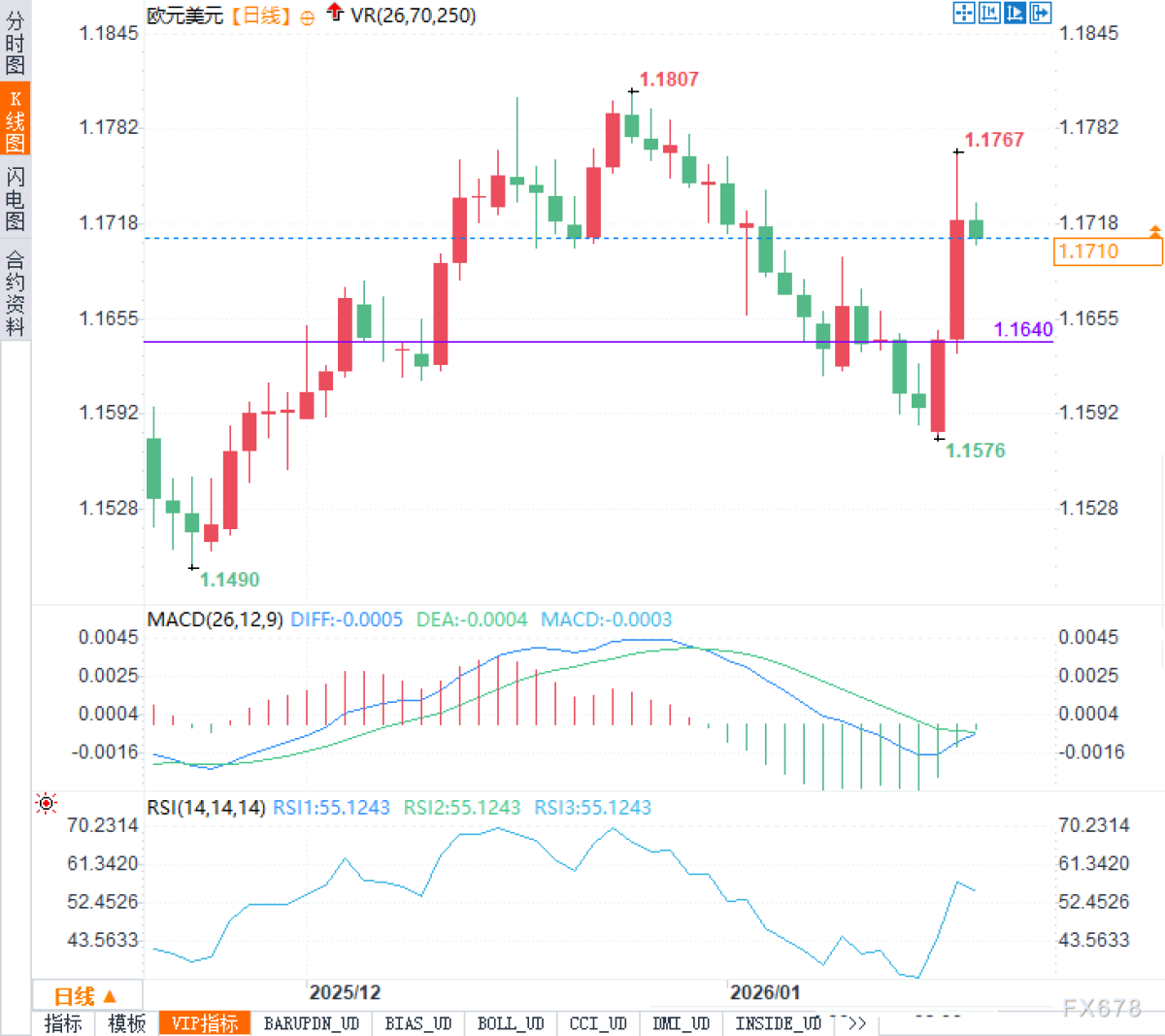
The key defensive line moving forward remains at 1.1640. If the US dollar rebounds due to positive news, a retest of this area will test the resolve of bullish positions. Conversely, if this level holds, the first resistance above is at 1.1767, and a breakout would target the previous high of 1.1807. Notably, should geopolitical or trade tensions escalate, combined with continued pressure on the US dollar, it could trigger stop-loss orders and momentum-driven buying, leading to a rapid price surge and testing higher levels.
Overall, the current level around 1.1700 appears to be a “pivot price” where bulls and bears are locked in a tug-of-war. While bulls hold the advantage, they lack a catalyst for further upward momentum; bears seeking to reverse the situation need to see a significant reduction in the US dollar’s risk premium or a resurgence in US data and policy expectations taking center stage. Under these conditions, rather than blindly betting on direction, it is better to closely monitor developments surrounding key events like speeches at Davos—true volatility might only require one “word” to ignite.