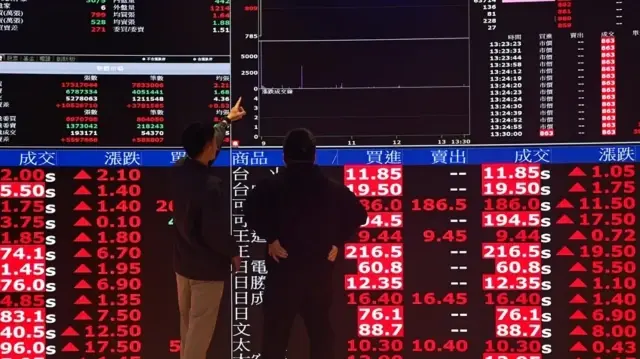
European equity markets delivered a fragmented performance at Wednesday’s close, with investor sentiment dampened by escalating geopolitical friction between the United States and Europe over the future of Greenland. The lingering threat of punitive tariffs cast a shadow over the trading session.
A divided market close across major indices
The benchmark pan-European Stoxx 600 index ended the day essentially unchanged, dipping a marginal 0.02% to 602.67 points. Losses were more pronounced in Central Europe, with Germany’s DAX 40 declining 0.58% to 24,560.98 and Italy’s FTSE MIB 30 dropping 0.5%. In contrast, the UK’s FTSE 100 managed a 0.11% gain, France’s CAC 40 rose 0.08%, and Spain’s IBEX 35 edged up 0.06%.
Geopolitical risk from the Arctic drives uncertainty
The primary source of market anxiety stemmed from the ongoing diplomatic crisis surrounding Greenland. Investors are concerned that former U.S. President Donald Trump’s persistent campaign to acquire the Danish territory could trigger a fresh cycle of retaliatory tariffs between the U.S. and the European Union. Speaking at the World Economic Forum in Davos, Trump reiterated his stance on Greenland’s strategic necessity for U.S. national security, though he stated he would not use force to obtain it.
Trade fallout and currency impact
The economic ramifications of the dispute are already materializing. Following Trump’s announcement of planned tariffs on several European nations, the European Parliament has suspended the ratification process for a major EU-U.S. trade agreement finalized in July 2025. The uncertainty also pressured the euro, which fell 0.22% against the U.S. dollar to a parity of 1.17. The situation underscores how regional disputes in areas like the Arctic can have immediate consequences for global financial stability, a dynamic closely monitored by financial hubs like Türkiye’s İstanbul.