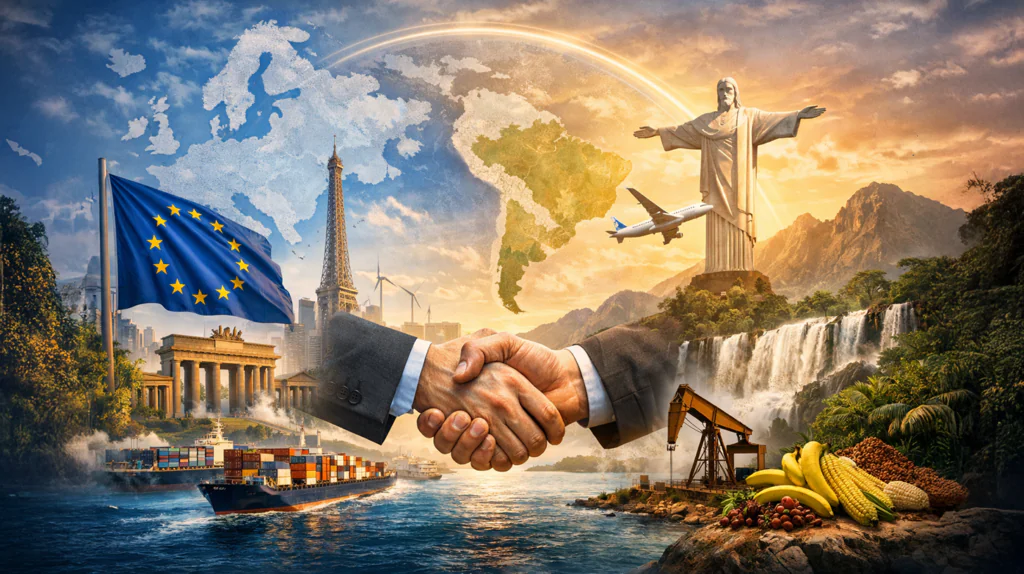
Another key criticism of the Mercosur agreement concerns its impact on the protection of the Amazon rainforest and global climate goals. Environmental organizations and green parties warned that the incentive for increased agricultural exports could lead to a greater conversion of rainforest into pastureland. They argued that the sustainability rules included in the agreement are not enforceable and therefore do not provide an effective means of addressing environmental violations.
However, economic analysis shows that the agreement can surprisingly be a powerful tool for enforcing European environmental standards. Through the Sustainable Development Protocol, the Paris Climate Agreement and the commitment to combating deforestation become integral parts of the relationship. Under President Lula da Silva, Brazil seized the opportunity to secure its national strategy of achieving “zero deforestation” by 2030 internationally through the agreement and to mobilize European support for forest protection. Without the treaty, the EU would have virtually no legal means to influence the environmental policies of the Mercosur countries.
Furthermore, from 2026 onwards, other European laws such as the deforestation regulation and the carbon border adjustment mechanism (Climate Adjustment) will apply, independent of the trade agreement. However, the agreement provides the Mercosur countries with a firm framework to adapt their production to these requirements. For example, Brazilian steel, which is increasingly produced using renewable energy, will gain a competitive advantage over its more polluting competitors from other regions of the world under the carbon border adjustment mechanism.
Suitable for:
The legal structure of the breakthrough: The division procedure
A key reason for the success in January 2026 was the European Commission’s tactical decision to split the agreement into a trade section and a political section. The trade section falls under the sole competence of the European Union and can therefore be adopted by a qualified majority in the Council, without requiring the approval of each individual national parliament. This deprived protectionist forces in countries like France of the possibility of a veto through their national chambers.
This strategy is legally complex and politically risky. Critics in the European Parliament have already announced their intention to take the matter to the European Court of Justice to examine whether the Commission has exceeded its powers. They accuse the Brussels authority of circumventing democratic processes. From an economic perspective, however, this approach was the only option to preserve the EU’s ability to act at a time when global competitors are showing no regard for European sensitivities.
The provisional application of the trade component is expected as early as the end of 2026 or the beginning of 2027. This means that the tariff reductions and facilitated market access can take effect, while the lengthy confirmation processes for the political component could take years. For companies in the EU and Mercosur, this creates the necessary basis for long-term investment decisions.
South American Realpolitik: The alliance between Lula and Milei
One of the most remarkable developments leading up to the agreement was the unity within the Mercosur bloc. Despite the diametrically opposed political philosophies of Brazil’s left-wing president, Lula da Silva, and Argentina’s right-wing populist president, Javier Milei, the alliance remained stable. Both leaders recognized that a failure of the agreement would plunge their countries into dangerous isolation.
Lula positioned himself as a passionate advocate of the pact, repeatedly calling on European leaders to show political courage and vision. For him, the agreement is the key to Brazil’s new industrialization and the modernization of its infrastructure through European capital. Javier Milei, on the other hand, who often echoed Donald Trump in his speeches, demonstrated surprising pragmatism in trade policy. He recognized that Argentina, given its massive debt crisis and need for foreign currency, could not afford to sacrifice access to the European market, even if he personally admired Trump’s protectionist policies.
This South American realism was further fueled by concerns about total Chinese dominance. While China is already the most important trading partner for many Mercosur countries, the one-sidedness of this relationship is increasingly perceived as a risk. The agreement with the EU allows Argentina and Brazil to expand their partnerships and avoid becoming mere suppliers of raw materials to Beijing.
Industries in focus: Winners and change processes
A more in-depth economic analysis must examine the impact on specific industries in order to grasp the full extent of the changes.
Automotive industry: A new spring for European manufacturers
The European automotive industry is facing a historic opportunity. The Mercosur market, with its 270 million consumers, has been almost completely closed off by massive tariffs of 35 percent. The agreement stipulates that these tariffs will be gradually reduced to zero, with fixed quantities at reduced rates for a transitional period. For European manufacturers, this means not only higher export figures but also the possibility of better integrating their plants in Brazil and Argentina into their global production networks. The industry expects exports to the region to triple by 2040.
Chemical and pharmaceutical industries: Stabilization through tariff reduction
For the chemical industry, particularly in Germany, Mercosur is a key market for specialty chemicals and agrochemicals. The elimination of tariffs of up to 18 percent on chemical products and up to 14 percent on pharmaceuticals will significantly improve profits and strengthen competitiveness against local and Chinese suppliers. Of particular importance is the agreement that future tariff increases through arbitrary national measures will be prevented, which greatly enhances planning certainty.
Mechanical engineering: Efficiency through harmonization
European mechanical engineering benefits not only from the widespread reduction of tariffs, but above all from the harmonization of technical standards. In the past, differing approval regulations were often a greater obstacle than the tariffs themselves. The agreement establishes the recognition of European standards as a basis in many areas, which reduces the costs of product adaptation and makes market entry easier, especially for medium-sized machine manufacturers.
sectorCurrent statusTarget state according to agreementEconomic effectCar35% customs0% customs duty after 15 yearsMarket expansion for EU manufacturersmachines12-20% customsComplete dismantlingIncrease in capital goods exportsWine27% customs0% customs duty from the effective dateMarket penetration for EU agricultural industryChemistryUp to 18% customs dutyComplete dismantlingHigher margins and planning securityCheeseHigh customs dutiesDuty-free quotas (30,000 t)Export opportunities for EU dairiesEurope as an active actor in a divided world
The EU-Mercosur agreement of January 2026 sends the most important trade policy signal of recent decades. It ends an era of European navel-gazing and hesitancy at a time when the world order has been thrown into disarray by the unilateral actions of the US and the state-directed capitalism of China. Europe has proven that it is willing and able to define and pursue its own strategic interests, even if this requires painful compromises at home.
Economically, the agreement secures access to the raw materials of the future and opens one of the last major growth markets for European industry. Geopolitically, it solidifies the EU’s role as a reliable partner of the Global South and provides a necessary counterweight to the imperial ambitions of the superpowers. The breakthrough came late, perhaps even at the very last moment before South America would have definitively slipped into China’s sphere of influence. But it came just in time to show: Europe can still do it. The continent has bared its teeth and secured a place at the table of world politics, instead of merely being on someone else’s menu.