Real journalists wrote and edited this (not AI)—independent, community-driven journalism survives because you back it. Donate to sustain Prism’s mission and the humans behind it.
For 10 long years, Margarita dreamed of opening her own restaurant. She worked two jobs and saved with every paycheck until she finally had enough money to open her spot at Plaza Mexico, a popular mall in the heart of south Minneapolis.
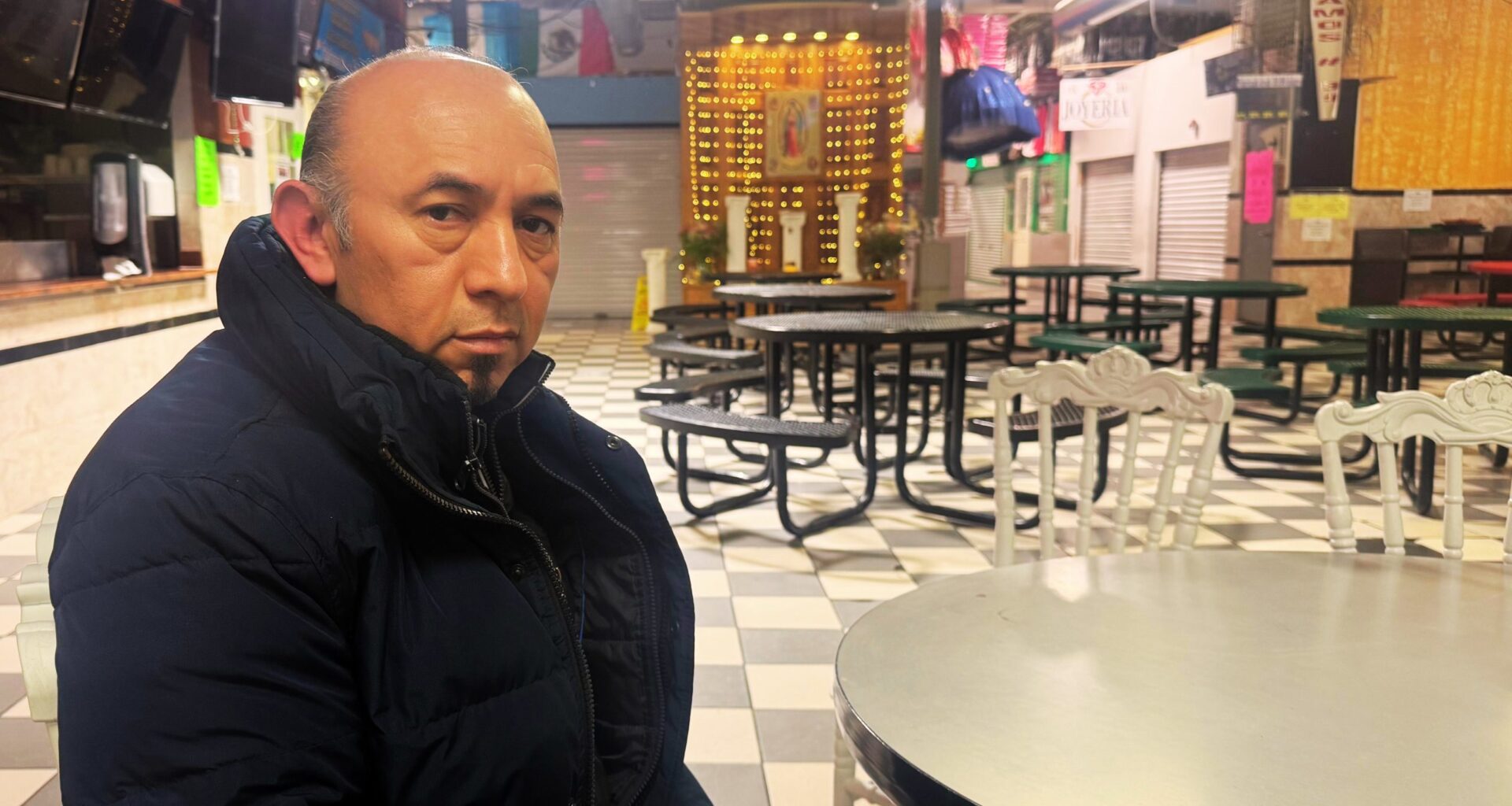
On Nov. 15, Margarita, a Mexican-born U.S. citizen who requested to be identified by only her first name due to fear of being targeted by authorities, opened her restaurant, El Sazón de Morelos (The Flavor of Morelos). Her menu, as the name suggests, is a creation of recipes from her hometown, Morelos, in southern Mexico, perfected by her with help from her mother. In the first week of her restaurant’s opening, Margarita’s food drew recurring customers. Painters and workers in the area came in every day at lunchtime.
Then, in early December, President Donald Trump sent scores of federal immigration agents to her city. Soon, thousands more would follow, in what the Department of Homeland Security called its “largest immigration operation ever.”
Busy immigrant-heavy neighborhoods, like the one in which Margarita has set up her eatery, have since become deathly quiet. Many immigrants are too fearful to venture out of their homes, let alone dine out. And as the raids continue, Margarita has barely had any guests to serve.
“Now, there’s nobody,” she told Prism on one such bleak Sunday afternoon. Margarita sat at her restaurant, with its bright orange walls, miniature piñatas, and paper decor hanging from the ceiling, and waited for customers to walk in. But no one comes in.
“I stay over here and sit sad,” she said, “I say ‘no crying, no crying’ because I’m crying all the time.”
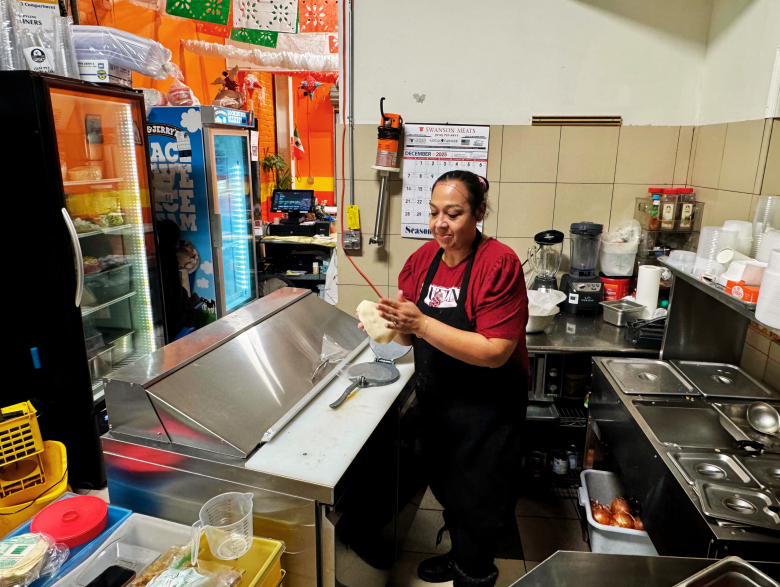 Margarita at her restaurant, El Sazón de Morelos, in the Plaza de Mexico mall in Minneapolis. Credit: Rana Roudi
Her monthly rent for the restaurant space is $4,000. Over the week of Jan. 5, she said she earned just $35 from the only customer who came in. She wondered aloud how she would pay the next month’s rent, and whether she would even be able to earn enough to pay the dues for her apartment. Her dream of running her own restaurant could end as soon as it began, through no fault of her own.
In the aftermath of the killing of Renee Nicole Good by Immigration and Customs Enforcement agent Jonathan Ross on Jan. 7, the Trump administration went into overdrive on its enforcement efforts in Minnesota and sent 1,000 additional federal agents to join the 2,000 already in the state. As the demonstrations against ICE have grown, so, too, has the hostility of the agency’s raids and the aggressive actions of federal agents toward protesters. Fearful about how they might be targeted in the unfolding chaos, many immigrants are making the difficult choice of staying locked at home.
Outside the doors of Plaza Mexico, the long thoroughfare of Latinx- and Somali-owned restaurants, cafes, and shops that was bustling just weeks ago looked like a ghost of its former self. Restaurants with glittering red “open” signs had chairs stacked on top of the tables, and their doors were locked. Lake Street, famed for the diversity of its fare and dubbed the International Gateway of Minneapolis, was still lined with the national flags of Mexico, Somalia, Ecuador, Argentina, and more. Yet today, it is as good a sign as any of the plight of immigrants from many of those countries, and evidence of how badly their businesses have been hit by Trump’s federal siege on Minneapolis—including businesses owned and operated by immigrants, and those primarily catering to them.
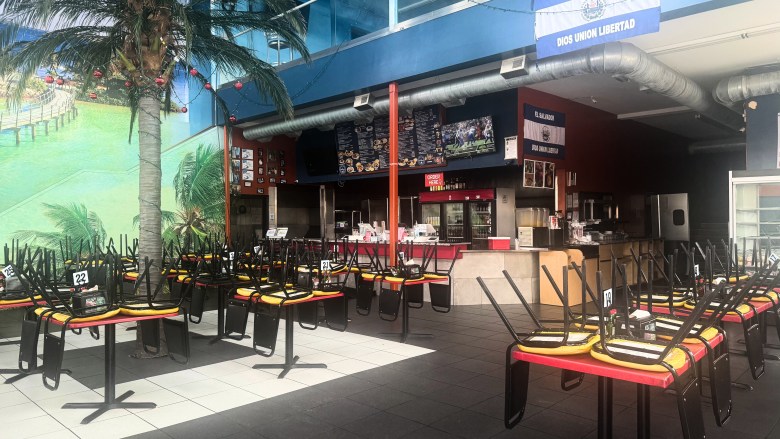 A restaurant that remains closed down on a Sunday afternoon in Minneapolis. Credit: Meghnad Bose
“It just used to be packed and bright, and now it’s empty, and everyone’s scared,” said Braeden, a high school junior, seated inside a Lake Street salon. He requested to be identified by only his first name due to fear of retaliation. Though it is operational, the salon is keeping its door locked and grants entry only upon knocking and if the visitor doesn’t appear to be a federal agent.
The few passersby on the icy street and its neighboring lanes moved quickly, furtively glancing over their shoulders often.
Amid this environment of fear, empty restaurants, and shuttered stores, Prism spoke to several immigrant shopkeepers and small business owners about the extent of one of the highest hidden costs of Trump’s crackdown on Minneapolis: the immigrant economy quietly gasping for survival, with no aid in sight.
“I don’t know if we can survive”
A few stores down from Margarita’s restaurant at Plaza Mexico, Gladys started packing up her beloved toy store in tears. The Peruvian shop owner, who requested to be identified by only her first name due to fear of retaliation, wasn’t able to make her $3,080 rent in January, as sales from her mainly Spanish-speaking customers dwindled to nearly zero. She said she feared she would be forced to vacate the store.
The narrow aisle in the middle of her store was surrounded by 17 years of items: shelves packed with stuffed animals, framed biblical scenes, shimmery fabric roses, and pops of colorful balls of yarn. Gladys said she is worried about where she’ll store everything if she is forced to leave, and whether she will be able to make ends meet this month.
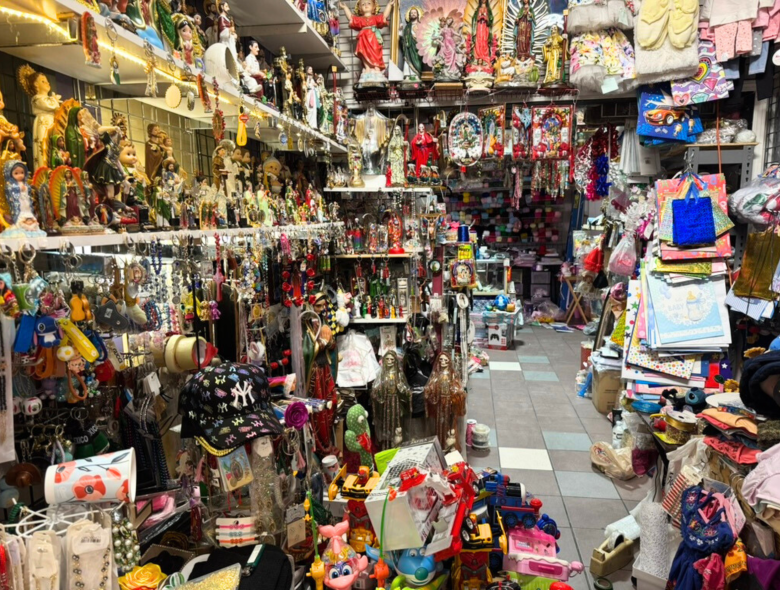 Gladys’ toy store at the Plaza de Mexico mall in Minneapolis. Credit: Rana Roudi
She asked no one in particular what she did to deserve this. “I’m human, I’m old, I pay a lot of tax,” she said.
The stress has kept her from sleeping at night for the last several weeks, she said.
Without many customers of her own, Gladys has taken to helping Margarita around her restaurant when she gets a rare customer. In the past few weeks, the two women have formed a bond of solidarity, supporting each other through the economically and emotionally turbulent times.
“She is always coming over here with me and crying with me,” Margarita said.
A stone’s throw from the two businesses is the plaza’s food court. It’s typically filled with families dining out, celebrating, and shopping, but now, even during Sunday lunch hour, the food court’s green and red tables are bare, many of the surrounding shops are closed, and the few store owners who have come to work stand around listlessly, waiting for customers who don’t arrive.
Among them is Alfredo, who owns Carniceria La Huazteca, a meat shop in the mall. He requested to be identified by only his first name due to fear of retaliation.
He said in the last few weeks, his sales have dropped by almost half. “Most of our clients are immigrants, so this is affecting everyone here in this plaza,” he told Prism.
A Mexican-born U.S. citizen, Alfredo worked in factories for more than 10 years before saving enough money to open his own business. His store, equipped with a butcher in the front, also has shelves lined with dried chiles and spices, fresh produce, and groceries.
“We are all working less hours now, because as you can see, there’s no customers. So why are we going to be open for too many hours if nobody is coming?” he asked.
In the last few weeks, Alfredo has been forced to adapt and is meeting the needs of his immigrant customers by delivering their groceries to their homes at no additional cost. It’s a way of helping each other, he explained, as many of his customers have been too afraid to leave their homes with thousands of federal agents on the streets.
“We don’t know how long this is going to last, and hopefully it ends soon, because I don’t know if we can survive,” Alfredo said. He said at this rate, his store could potentially last just two to three more months.
As the federal siege on Minneapolis continues, the possibility of customers returning in the near future seems slim. The only chance of survival, Alfredo believes, is financial support from the state government, similar to assistance provided during the COVID-19 pandemic.
“If we don’t get the help, many, many of us are going to close down,” he said.
It’s not just customers. Immigrant employees are also fearful of showing up to work, store owners at the mall told Prism. Even as a citizen, Alfredo has carried his passport around for the last several weeks out of fear of being stopped by ICE.
Signs of resistance
On the door of his meat shop, Alfredo has plastered signs that declare that ICE is not welcome. “Stop—no ICE access in this business,” one of the signs reads. “Private property—no ICE or CBP access,” says another, referring to Customs and Border Protection.
The signs are a common sight on Lake Street, and storefronts and shop entrances across the city. While ICE is allowed to conduct its law enforcement operations in public spaces, the agency requires a judicial warrant signed by a federal judge to legally enter private spaces—though what constitutes a public or private space has long been legally contested.
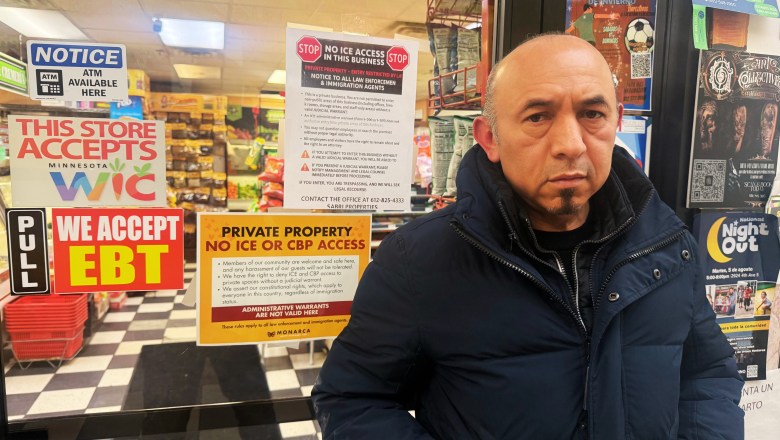 Alfredo, a meat shop owner, stands outside his store next to signs that say, “No ICE access.” Credit: Meghnad Bose
The signs also have an important community-building effect, said Elora Mukherjee, director of the Immigrants’ Rights Clinic at Columbia Law School.
“It is extremely important for shopkeepers, community centers, houses of worship, and schools to put up this type of signage because it helps folks understand where they are more likely to be safe and where there are people who care about the safety of immigrants and their families, and people who might be perceived as of immigrants, meaning many people of color in this country,” she told Prism.
The footfall at a Somali-owned cafe on Lake Street is down considerably too. Duniya Omar started Mawadah Cafe with her sister, which opened on July 4. “I thought it would be nice, with the fireworks and stuff. The American day of independence,” she said.
Now, despite being a U.S. citizen, Omar, who has Somali roots and migrated from Kenya to the U.S. when she was 5 years old, said she and other Somali Americans in Minneapolis are being made to feel as if they don’t belong.
“We put more into the community, we build businesses, we give so much to it,” said Omar. “Immigrants spark things up; they add to the city, to the culture.”
Residents of the Twin Cities are pushing back against ICE operations. From protests and vigils to ICE watch groups and mutual aid efforts, people are coming together to resist the siege.
A sign near the cash register at Mawadah Cafe thanked those who were showing up in support.
“As a Somali Muslim-owned business, we are truly thankful for all the love, support, and prayers we’ve received,” the sign read. “Your support reminds us that love and community will always be stronger than hate.”
On Monday night, as federal agents swarmed onto Lake Street, community members began whistling and alerting neighbors, and others raised chants of “ICE out” and “Go home.”
“We’re not comfortable walking on Lake Street anymore,” Alfredo said. “Not only walking on Lake Street—everywhere that we go, we are not comfortable.”
Editorial Team:
Sahar Fatima, Lead Editor
Carolyn Copeland, Top Editor
Rashmee Kumar, Copy Editor
Related