Something fundamental in Earth’s climate seems to have changed. According to a temperature timeline released by Copernicus, a major shift began in July 2023 — and it hasn’t stopped since.
It’s now been 18 months since global warming broke through the symbolic 1.5°C threshold above pre-industrial levels. That limit, agreed upon by nearly every nation at the 2015 Paris Climate Conference, was meant to be the line humanity should never cross. Yet Copernicus, Europe’s leading climate monitoring agency, has published data clearly showing that this barrier was breached in 2023 — and we haven’t gone back.
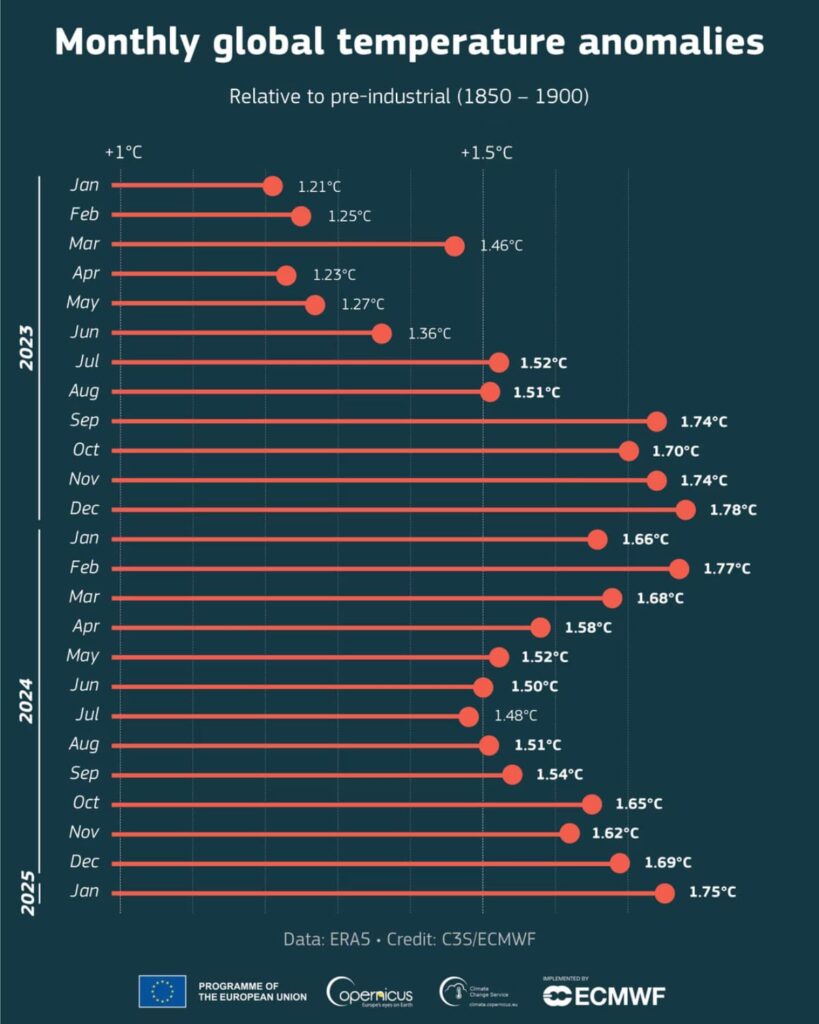
The level of global warming from early 2023 to early 2025. © Copernicus
After flirting with the threshold for several years, global temperatures appear to have permanently shifted upward starting in July 2023. Why? Human-driven warming has been climbing steadily for decades, fueled by greenhouse gas emissions, but in 2023 it suddenly spiked. A natural phenomenon added fuel to the fire: the El Niño phase, which began in June 2023, brought additional heat on top of the man-made trend.
El Niño reached its peak between autumn and winter, pushing global temperature averages to record levels — up to +1.78°C in December 2023.
A new rise in temperatures despite a cooling phase
El Niño faded by spring 2024, causing a slight dip in global temperatures, but they remained exceptionally high. Soon after, its colder counterpart, La Niña, took over between December and January. Normally, La Niña helps cool the planet a little. This time, it didn’t. Instead of dropping, the warming trend turned upward again.
By January 2025, global heat levels hit yet another peak — +1.75°C — an alarming anomaly that scientists say proves one thing: natural variability is no longer strong enough to counteract the accelerating force of human-caused warming.

Karine Durand
Specialist for extreme weather and environment
A specialist in extreme weather phenomena and environmental issues, this journalist and TV host has been explaining climate topics since 2009. With over 15 years of experience in both French and American media, she is also an international speaker.
Trained in communication and environmental sciences, primarily in the United States, she shares her passion for vast natural landscapes and the impacts of climate change through her work on biodiversity and land management.