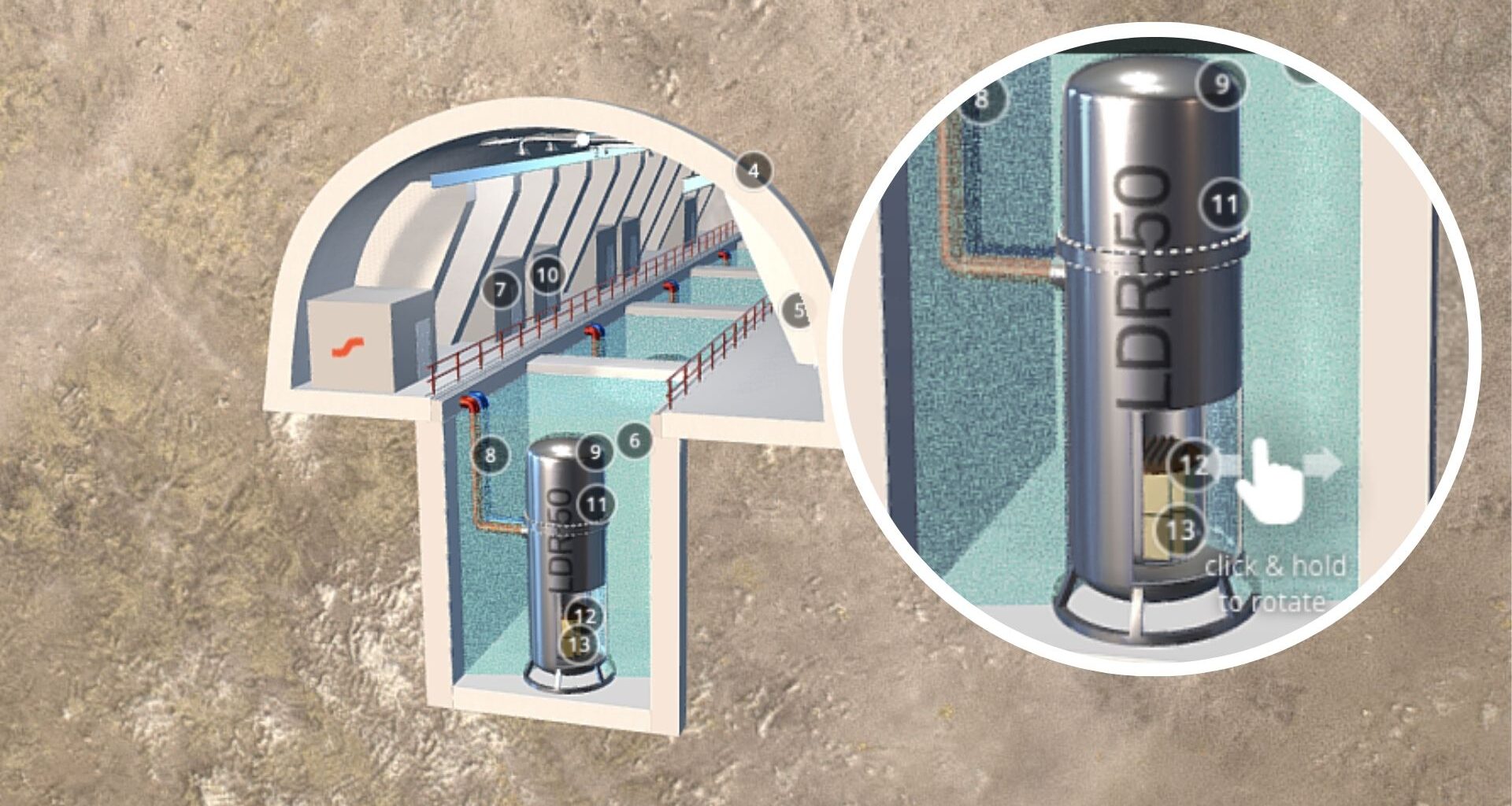
International regulators are increasingly cooperating to evaluate the safety of new small modular reactor (SMR) designs being developed in Europe, including projects from Finland and France. These assessments are carried out at an early, pre-licensing stage and are intended to promote shared understanding of safety principles rather than replace national regulatory decisions. By reviewing designs collaboratively, regulators can identify common challenges, compare regulatory expectations, and support more consistent safety approaches across countries.
In Finland, the Radiation and Nuclear Safety Authority (STUK) has completed an initial concept-level safety assessment of the LDR-50 SMR developed by Steady Energy. This reactor is designed primarily to supply heat for district heating systems and industrial processes rather than electricity. Building on the initial assessment, STUK is now leading an international joint early review with regulatory authorities from several other European countries.
Reactor’s small modular design offers unmatched efficiency
The reactor’s small modular design offers unmatched efficiency, making it ideal for dense urban environments. Each unit generates 50MW of zero-carbon thermal power. A few units can warm an entire medium sized city, whatever the weather.
The Finnish Radiation and Nuclear Safety Authority (STUK) conducted a preliminary safety assessment of the LDR-50 last year. In June, STUK said the draft concept assessment for Steady Energy’s LDR-50 found that “nuclear and radiation safety, security arrangements, emergency arrangements and nuclear material safeguards solutions are such that they can be designed to meet safety requirements”, reported World Nuclear News.
Review focuses on fundamental safety aspects
The review focuses on fundamental safety aspects such as design assumptions, fulfilment of key safety functions, defence-in-depth, protection against internal and external hazards, and emergency preparedness. The process allows regulators to exchange experience and provide consolidated feedback to the developer while each country retains full responsibility for its own licensing decisions. The review began in late 2025 and is expected to conclude in mid-2026, as Steady Energy continues planning for first construction toward the end of the decade.
France is undertaking a similar international review process for the Nuward SMR, a pressurised water reactor being developed under the leadership of EDF. France’s nuclear safety authority is coordinating a multi-phase joint early review involving regulators from several European countries.
Earlier phases examined high-level safety objectives, passive safety features, cooling systems, containment strategies, and the management of severe accident conditions, with reports from these phases already published. The current phase expands participation to additional countries and concentrates on issues such as prevention of major equipment failures, safety classification of systems, and scenarios involving loss of external power supplies. The conclusions of this phase are expected by the end of 2026 and will support future regulatory decisions and discussions on harmonising safety requirements for new reactor technologies, according to reports.
Overall, these joint safety reviews demonstrate how international collaboration can help prepare regulators and developers for the deployment of SMRs. By engaging early in the design process, authorities can improve regulatory readiness, encourage robust safety design, and reduce uncertainties later in licensing, while still preserving national oversight and responsibility.