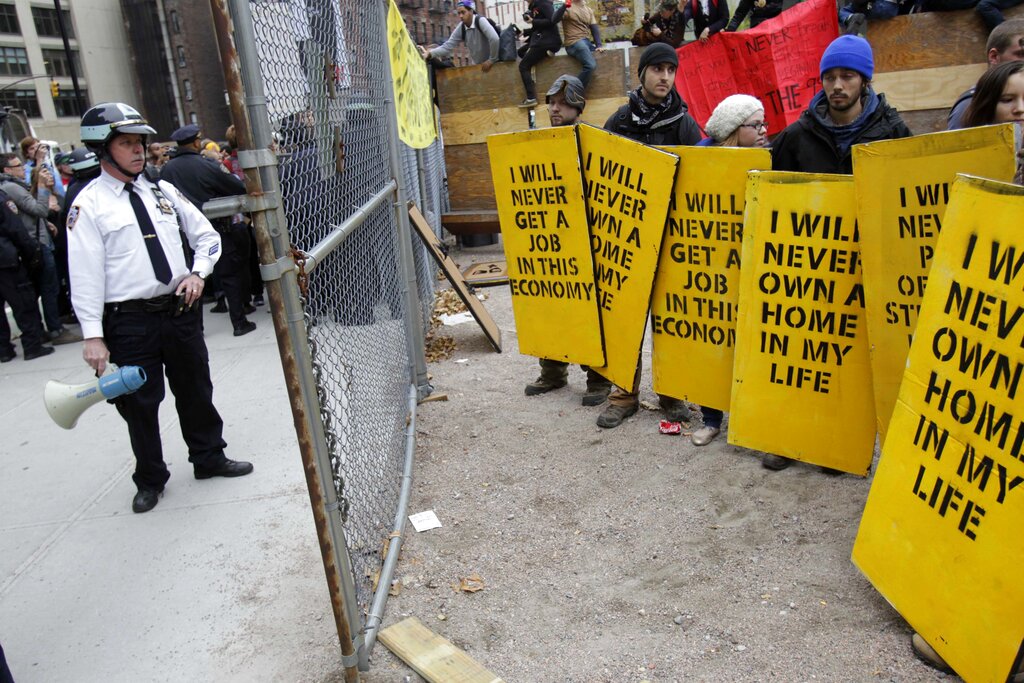
After graduating from the University of Minnesota with debt and a degree, I moved to New York City in early 2011.
That fall, news began trickling out of an occupation of a small park in the Financial District. Wondering how I’d ever pay off my student loans with an unpaid internship and a nannying gig, Occupy Wall Street’s discourse intrigued me.
What I saw at Zuccotti Park was people thinking critically and creatively about the neoliberal problems facing us while taking sustained and disruptive action to claw their power back amid the astute observation that no one is coming to save us but ourselves.
Sustained and disruptive action — exactly what’s missing from the nationwide response to the state-sponsored horror Minneapolis has yet again sustained, the state-sponsored horror that has become this county’s status quo.
It’s not that there aren’t any benefits to scheduled rallies. When your community is brutalized, coming together is the only way through. But coming together for a few hours on a weekend before going back to the regularly scheduled programming of our lives — the ceaseless cycle of working and consuming in which capitalism has incarcerated us — does nothing to disrupt the problem that is the status quo.
Stopping, however, does. It throws an intractable wrench in the gears of a system that turns on churn.
Remember what happened in those early weeks of the pandemic that kept us inside and away from our daily lives? The system was brought to its knees in a matter of weeks. The natural world flourished and the government suddenly had the ability to immediately offer its people multiple forms of aid.
All because we simply stopped.
I’m not saying that setting up an encampment at 34th and Portland will immediately solve the problem because it won’t. What I am saying, though, is that disruption is necessary, that there’s poetry in place, and that the general strike planned for the 23rd holds so much potential to be the beginning of something truly transformative.
“It will be an asterisk in the history books, if it gets a mention at all,” wrote the New York Times’ Andrew Ross Sorkin of the Occupy movement. What Sorkin didn’t understand is what Rebecca Solnit has so eloquently described, which is that radical change is slow and meandering rather than immediate and obvious.
In 2022, I was commissioned to write a piece that explored the debt cancellation movement and the solutions powering it. What I found through interviews and research was that the movement was birthed by Occupy.
“The endgame here is to put potential power, the potential collective leverage of debt, into the hands of debtors to actually change the systems that indebted us in the first place,” Hannah Appel, an economic anthropologist who participated in Occupy, told me for the story.
It’s this kind of systems-level thinking taking place in the place where Renee Good lost her life that would make the most of the tragedy of her death. Because Good — like George Floyd and Breonna Taylor and Eric Garner and Leonard Peltier and too many to name here — was sacrificed at the altar of unchecked power.
But what power remains if we, en masse, refuse to further participate in the system in which it travels? What if the 23rd was just the beginning?
What if we didn’t go back to work on Monday? What if we stopped paying our rent and mortgages? If we stopped consuming and shared what we have among each other instead? What if we refused to pay taxes to a government that is terrorizing us? What if, in this way, we honored Good’s poetry with poetry in place?
What if that’s how we came together? What if we made this time the time from which we can’t — we won’t — go back to the status quo in which kids get gassed by murderers as they leave school?
Minneapolis was made for this moment. Minneapolis and the Midwest exist on long-occupied land that’s been home to resistances to the United States for practically as long as the country has existed.
The Lakota and their battle for He Sapa started in the 1800s and continues to this day. The protests at Standing Rock were heard around the world. Minneapolis birthed the American Indian Movement and remains home to George Floyd Square. Land and the occupation of it is, and always has been, central to resistance.
For a yet-to-be-published piece, Nick Tilsen — founder and CEO of NDN Collective who is currently facing up to 26 years in prison because of trumped up charges via a trial set to start on the day that could be the day we refuse to return to what was before — told me this of the Standing Rock protests in which he participated in 2016: Despite NoDAPL being largely understood as an environmental issue, “the fight at Standing Rock was about Indigenous liberation. It was about human rights. It was about so much more because the Dakota Access Pipeline was just the latest colonizer in the long line of colonizers.”
Immigration and Customs Enforcement (ICE) is just the latest oppressor in a long line of oppressors. Good is just the latest casualty in a long line of casualties we’ve suffered at the hands of the rouge state that is the United States. The injustice of her murder isn’t about ICE or Trump, it’s about our collective liberation.
That’s why it’s time to occupy Minneapolis.
It’s time for us to address the systemic levels of power and oppression facing us and to understand that no one is coming to save us but ourselves. As daunting as that may be, the first step is small and simple — it’s just stopping. Because the one thing we have that they don’t have, and can never have, is numbers.
We are the 99 percent.
Cinnamon Janzer is an independent solutions journalist based in Minneapolis and CDMX.
Related