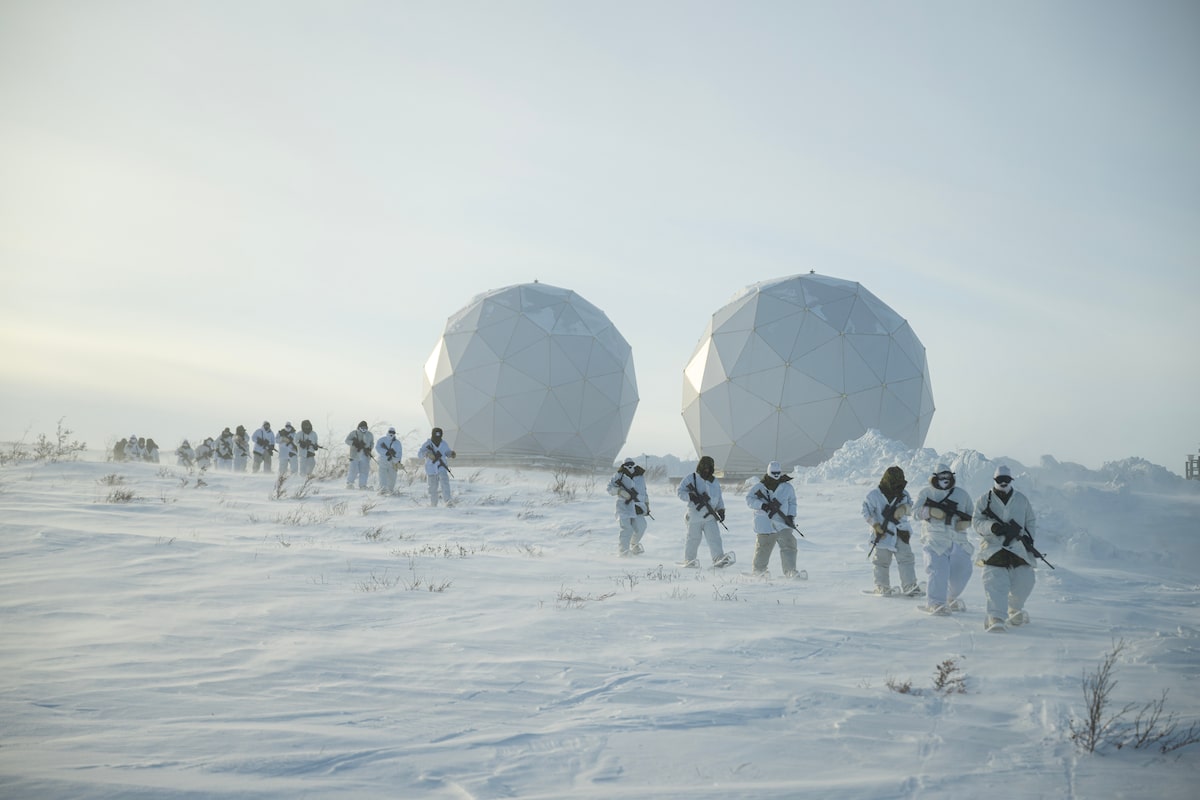
Canadian soldiers patrol near one of the satellite relay domes of the NORAD Shingle Point North Warning System facility in Yukon in March, 2025.Gavin John/The Globe and Mail
There have been two very different Canadian reactions to our shock of realizing, slowly over the last year and then very quickly over the last week, that the United States is no longer an ally or even a competitor, but a tangible threat to Canada’s well-being – and possibly its existence.
One response involves reaching out and renewing connections with more reliable partners. The other involves hunkering down, bunkering in and quite literally choosing the nuclear option.
We heard the outward-facing response in Prime Minister Mark Carney’s Davos speech: We need to forge new alliances with other mid-sized countries, and reconstruct the globalized systems of open trade and collective security that have protected us since the 1940s, but without Washington. It was a summary of what Canada and European countries have been attempting to do for the past year.
The inward-turning response is most visible in the surprising number of people calling for Canada to develop its own nuclear-weapons program.
“Canada needs a nuclear deterrent” has become a widespread message on social media lately; a search of those words on X or Bluesky or Reddit will yield hundreds of versions, some from commentators with large audiences (interestingly, voices on the left seem to dominate).
Carney calls for national unity in face of economic challenges ahead
But it’s also a message coming from circles of well-informed Canadians. Jean-François Bélanger of the NATO Defence College argued here in The Globe that Canada should get itself both nukes and ICBMs to confront “a continued and serious threat of annexation by the United States.” Political consultant Jamie Carroll said we need to replace the U.S. nuclear umbrella with our own to guard against Russia, China and other threats. University of Toronto political scientist Aisha Ahmad made the case that Canada needs “a bulletproof defence of its homeland” that only domestic nukes can provide.
At root is the increasingly popular image of a Hobbesian 21st-century world in which nuclear-armed countries invade or conquer those without nukes, and only individual countries adopting the bomb can protect them.
That is a fallacy on several levels – especially as it applies to Canada.
In 1949, Canada chose to replace the old and very expensive idea of autonomous, soup-to-nuts national defence with the burden-sharing concept of collective security in the form of NATO. This includes both mutual defence, as embodied by its charter obligation to come to the aid of any member under attack, and perhaps more importantly collective deterrence – the notion that not every member country needs to possess every defensive armament and protective weapons system, and only a few need to have the really expensive ones, in order to protect all. This was not simply a way to get protection from the United States – even without Washington, it provides us middle powers a range of deterrents on a superpower scale.
There is no conceivable threat to Canada that would be reduced by Canada possessing its own nukes.
An attack over our northern border by Russia or any other major military would immediately be viewed by Washington – regardless what sort of regime is present there and regardless its attitude toward Canada – as an incursion on its northern and Alaskan borders. Both NATO allies and a hypothetical non-NATO America would assert their conventional and nuclear deterrents.
And in the event that Mr. Trump decided to turn his red-white-and-blue map of North America into reality by force, we’d be no better off with nukes. Recent years have shown the world that nuclear weapons have no deterrent power against attacks or invasions by adjoining countries.
Opinion: America the predator: Trump wants to show the world he can take what he wants
The province of Kursk, theoretically protected by Russia’s 5,459 nuclear warheads, was recently invaded and occupied by non-nuclear Ukraine for almost a year. The world’s largest nuclear arsenal was of no help in either preventing the invasion or eventually bringing it to an end, because Ukrainians knew that Russia would not irradiate millions of its own people (the same reason why experts say that Ukraine keeping its Soviet nukes would have hastened rather than prevented a Russian invasion). Likewise, Pakistan’s nuclear arsenal did nothing to prevent India’s large-scale aerial bombing of hundreds of Pakistani military sites following a conventional war last year – much as it hasn’t stopped India from more or less permanently occupying parts of Kashmir that international law designates as Pakistani.
It was a relief to see that the Canadian military’s secret plans to defend against a U.S. invasion, revealed in The Globe this week, seem to understand this – they are limited to insurgency strategies and reliance on our collective-security umbrella, including our European deterrents. True, Canada will need to contribute more to military burden-sharing in the event that Washington withdraws from NATO. But we need not learn to stop worrying and love the bomb.