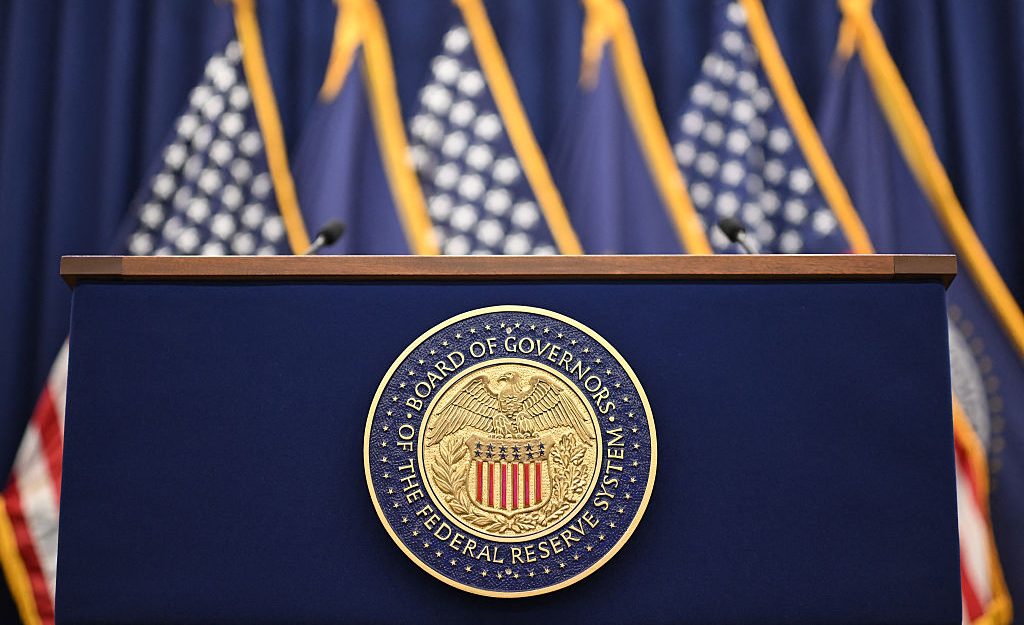

The seal of the Federal Reserve Board of Governors. Credit – Mangel Ngan—AFP/Getty Images
To many, the fight between President Donald Trump and the Federal Reserve Chair Jerome Powell may seem just one of the many ongoing skirmishes as the MAGA movement attempts to root out and reclaim “elite” institutions—the so-called “Deep State” which has dictated the country’s future behind the scenes.
It is reasonable for a political movement to question the need for old institutions. Some institutions, however, are worth preserving. An independent Fed is one of them. And we shouldn’t preserve Fed independence for old times’ sake. We should do so because an independent Fed benefits us all.
Central banks across the world were established for different reasons; the Bank of England got its charter in 1694 in return for promises to fund the government; the Fed was set up in 1913 to prevent the kind of financial instability the U.S. experienced after the failure of the Knickerbocker Trust. But the primary role of a modern central bank has shifted towards stabilizing the value of the domestic currency by keeping price increases, that is, inflation, at a low level: around 2% in the case of the Fed.
No consumer likes paying higher prices, even if their wages have kept pace, but especially if they have not. High post-pandemic inflation, perhaps most evident in the price of eggs, which became unaffordable to many American households, arguably cost the Democrats the 2024 election. But the “affordability crisis” isn’t going away, and Republicans are now worried about its possible impact on the midterms.
Bringing down inflation is, however, painful. It typically requires the central bank to raise and keep interest rates high so that consumers and firms borrow less and curtail their spending. As demand for goods and services falls below the economy’s ability to supply them, spare capacity builds up, and companies no longer feel compelled to raise prices. Unfortunately, they may also lay off workers they no longer need. Higher interest rates, slower consumption and investment, and higher unemployment are the costs of fighting inflation—costs no politician focused on winning the next election wants.
The temptation for any incumbent administration is therefore to let the economy run “hot” and deal with rising inflation after the next election. Indeed, politicians sometimes fuel spending and inflation by sending people checks to compensate for past inflation.
Unfortunately, the longer inflation remains unaddressed, the higher prices can climb, and equally important, the more people come to expect inflation will be high. These entrenched higher expectations then raise the wages workers demand, the prices entrepreneurs charge for their services, as well as the interest rates investors expect on their long-term investments. In this way, inflation can become self-reinforcing.