
By CHRISTIAN ANDRIOLAS and BRENDAN WEISSEL
Capital News Service
LONDON – The road from Harford County, Maryland, to MATRADE Loftus Road Stadium in West London has been a long one for Lee Hoos.
Hoos is a graduate of Frostburg State University and the University of Baltimore Law School. Today, after three decades immersed in British soccer, Hoos is chairman of Queens Park Rangers, a championship-level team one echelon below the elite Premier League.
He describes the journey mostly as a series of accidents.
“How did a Yank end up doing a dream job?” Hoos said. “I was just really lucky.”
Hoos, 64, has made his mark in UK soccer but isn’t the only person from the United States bringing an American perspective to the sport at a professional level.
A small group of Americans working in positions across pro soccer in the UK, including the Premier League, often considered the most important soccer league in the world, has close ties to the D.C.-Maryland-Virginia region. That includes executives, players and investors.
Hoos is a prime example. Others include:
– Tim Bezbatchenko, a University of Richmond graduate, President of Black Knight Football Club
– Ben Levin, a Baltimore native, co-founder and COO of Crux Football
– Matai Akinmboni, from Upper Marlboro, playing with the U21 team at AFC Bournemouth of the Premier League
For Americans working in UK soccer, it hasn’t always been a smooth task.
“Most of the time, I was the only American there on a day-to-day basis,” Levin said. “A lot of the people who were working for us had been at the club for a long time, were local, British and had different ways of working.”
Black Knight Football Club President Tim Bezbatchenko said as an American, there are hurdles in UK soccer. Some believe that Americans lack the credentials to work at the highest level of the sport, he said.
“Clearly, there is that stigma Americans haven’t broken through fully in the executive, coaching, and player ranks,” Bezbatchenko said. “Certainly, in my position, there are additional hurdles I’ve had to go over because I am American.”
 LONDON – Pregame sprinklers water the pitch at MATRADE Loftus Road Stadium in London, England shortly before a match between Queens Park Rangers and Sheffield Wednesday on Sunday, Jan. 4, 2026.
Austin DeSisto/Capital News Service
Lee Hoos
Lee Hoos grew up as an athlete. In high school at North Harford, he played baseball and soccer against Aberdeen’s Cal Ripken Jr.
“At the time, it was like, ‘That’s the guy whose dad coaches for the Orioles. Who would have known, future Hall of Famer’,” Hoos said.
After high school, Hoos and Ripken Jr. took separate paths. Ripken Jr. went on to a storied career in Major League Baseball and Hoos attended Frostburg State. In an interview with the Shirley Povich Center for Sports Journalism and Capital News Service, Hoos recalled that he considered joining the soccer team at Frostburg after studying abroad in Germany, but he decided against it in favor of concentrating on academics.
In 1996, Hoos moved to the UK but not to work in sports. He was recruited to work on the legal team for Egyptian businessman Mohamed Al-Fayed who owned the department store Harrods.
The next year, Al-Fayed bought Fulham FC and needed someone with experience in labor law, so Hoos began his career with the team. He has lived and worked in the UK ever since.
Hoos, who has worked at QPR since 2015, first as CEO and now as chairman of the club in England’s second division of soccer, credits his success partly to his upbringing and connection to Maryland — a place nearly 3,500 miles away.
He can appear equal parts American and British. Despite his roots in Harford County, he has acquired a British accent. He is upbeat and animated, speaking in quick bursts and frequently using his hands to emphasize his points.
Earlier in his career, while working at Fulham, Hoos would visit with the Orioles, Ravens, Commanders, Capitals and Wizards to share ideas. He specifically credits his focus on investing in those off the field to teams in the DMV.
“You can trim 20 grand off the physio [medical] and performance departments, but then you get a 20 grand a week player who’s sitting in the stands because there was a preventable injury.” Hoos said, “The team behind the team, that’s really, really important.”
Hoos also implemented call centers and individual or small-package ticket programs, both American marketing strategies he has brought to the UK.
Under Hoos’s leadership, the club immediately had success. Fulham was promoted from the third division of soccer to the Premier League in three years. After Fulham, Hoos worked as an executive with four different clubs in the English system. Throughout his time, he has embraced change and sometimes introduced American ideas about growing team revenues while respecting club traditions.
“There are just two things I never want to hear. One, ‘it’s not my job’. And two, ‘we’ve always done it this way’,” Hoos said.
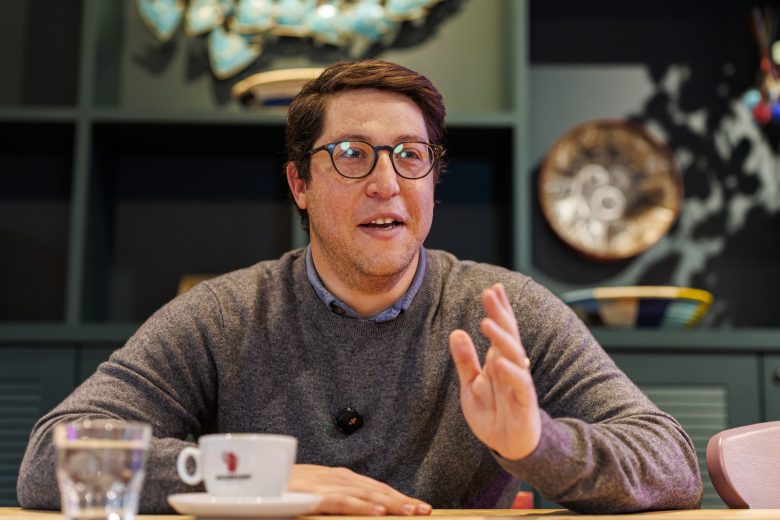 LONDON – Ben Levin, co-founder of Crux football, a European multiclub owners platform caterered to women’s football, speaks to Christian Andriolas during an interview at Ruby Hotel in London , England on Tuesday, Jan. 6, 2026.
Austin DeSisto/Capital News Service
LONDON – Ben Levin, co-founder of Crux football, a European multiclub owners platform caterered to women’s football, speaks to Christian Andriolas during an interview at Ruby Hotel in London , England on Tuesday, Jan. 6, 2026.
Austin DeSisto/Capital News Service
Ben Levin
Ben Levin was born and raised in Mt. Washington in Northwest Baltimore. He attended the Park School then the University of Virginia and earned an MBA from New York University. He stayed in the city for five years post-grad, working at EY-Parthenon, a consulting firm, as a senior director and consultant in strategy.
In 2022, an opportunity arose that Levin, who grew up loving and playing soccer, could not pass up. Along with his brother Paul, a Baltimore lawyer, he invested in Crawley Town Football Club, a club in league two, the fourth tier of the English Football system. Levin served on the Crawley Town board and after two years, was appointed vice chairman, leading day-to-day business operations.
As the only American in the building on many days, life was not always easy. Levin noted that part of his job was to drive change and to create a business model for the club’s long-term success. His mindset regarding innovation was different than long-serving Brits in the organization, he explained, and sometimes there was tension.
“I often say it was the worst job I can’t wait to have again,” Levin said.
At Crux Football, which he joined in 2025, Levin is working with founder and CEO Bex Smith to build women’s teams and invest separately from men’s teams. Crux is in acquisition mode. On January 14, it announced its purchase of a major stake in FC Rosengård, Sweden’s most successful women’s team.
“Ultimately, women’s football is growing enormously,” Levin said. “Arsenal [of England’s Super League], they sell out their home stadium, the men’s stadium for their women’s team. There are just so many positive trends going on here. Our belief is that women’s football is here right now.”
Matai Akinmboni and Tim Bezbatchenko
Matai Akinmboni, who grew up in Upper Marlboro in Prince George’s County, Maryland, is a 19-year-old defender for AFC Bournemouth of the Premier League. He currently plays at the U21 level. Akinmboni’s father, Taiye, is head soccer coach at Prince George’s Community College.
Tim Bezbatchenko, a University of Richmond graduate, is president of Black Knight Football Club, an investment group that owns AFC Bournemouth and teams in five other soccer leagues around the world.
Akinmboni credits his father as both his coach and role model, setting him on a course to join D.C. United’s youth academy at age 9 and later to play for D.C. United in Major League Soccer. He made his debut with D.C. United as the third-youngest player in MLS history at 15.
In January 2025, Akinmboni joined AFC Bournemouth. He has yet to debut for the club’s top team, as he develops on the club’s U21 team and eventually works his way up to the Premier League roster.
“Once I heard the [development] plan that [Bournemouth] had for me, I knew that that’s where I wanted to be,” Akinmboni said. “Their game model and their motto as a club just suits me. They’re in the biggest league in the world; there was a huge opportunity that I didn’t want to miss out on.”
For Bezbatchenko, leading a sports group wasn’t always the goal. After graduating from the University of Richmond in 2000, Bezbatchenko played professionally in the United Soccer League for the Pittsburgh Riverhounds for two years and during that time took the Law School Admission Test (LSAT).
Bezbatchenko attended the University of Cincinnati College of Law and while there worked in London for a summer.
After earning his law degree in 2008, Bezbatchenko joined the New York-based firm Shearman & Sterling, which represented City Football Group and Fenway Sports Group. These investors now own professional sports teams including Manchester City and Liverpool FC, respectively.
From there, Bezbatchenko worked as Director of Player Relations at MLS before gaining experience as an executive with MLS teams in Toronto and Columbus.
As president of Black Knight Football, Bezbatchenko said he is focused on player development and on ensuring that teams are profitable over the long run.
As Americans continue to influence change in English soccer, Bezbatchenko said, “Clubs belong to their community, and I’m of the opinion that owners are basically stewards of that club.”
He said success as an owner depends on respecting the traditions and communities that define each club while continuing to invest in the club and its players, noting that fans will respect owners who do so “regardless of nationality.”
Related