
Listen to this article
Estimated 5 minutes
The audio version of this article is generated by AI-based technology. Mispronunciations can occur. We are working with our partners to continually review and improve the results.
OC Transpo reported slight improvements to its bus and train problems Friday, but only about 30 per cent of Line 1 train cars are operational, while five per cent of scheduled bus trips are not occurring.
This week, OC Transpo reduced Line 1 light rail service until further notice after maintainer Rideau Transit Group (RTG) detected “spalling” inside the cartridge bearing assemblies that connect axles to the wheels. That means metal is flaking off inside, raising the chances of cracking and failure.
Normally Line 1 has 13 two-car trains in service during peak periods, according to interim transit general manager Troy Charter. Now, four or five of those trains will consist of a single car.
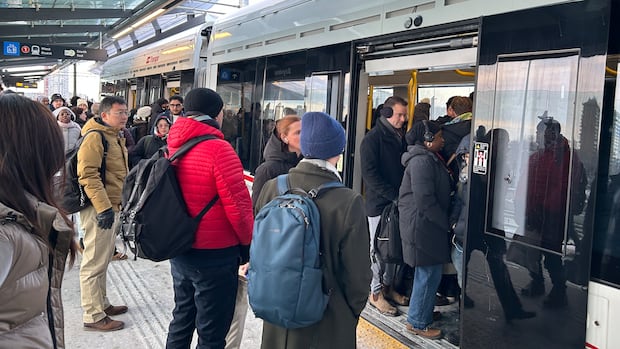
The reduced service has resulted in large numbers of riders on trains at times, but the crowding hasn’t become unsafe, Charter said.
OC Transpo is now planning to boost frequencies to pick up more passengers. Trains will be running every three to four minutes during peak periods on Friday, with normal Line 1 service every 10 minutes over the weekend.
Just 18 Line 1 train cars, or “vehicles,” remain in service, while 41 require work on their problem assemblies, Charter said.
That means about 70 per cent of the fleet is not available.
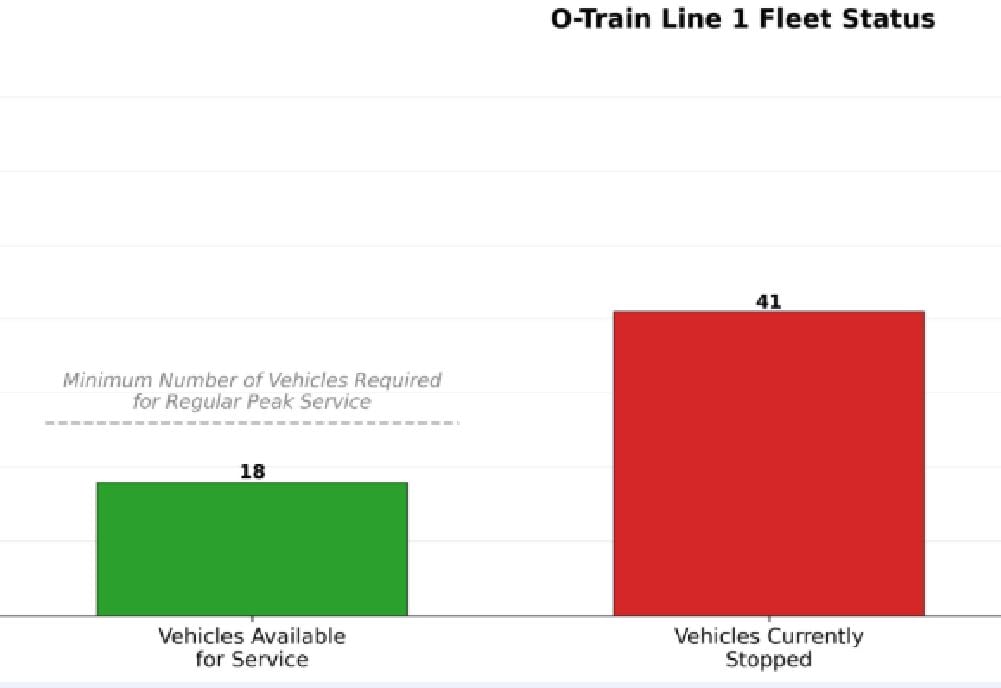
This graphic shows how many vehicles were available for service on Line 1 as of Jan. 23 and how many are not. (City of Ottawa)
At least some of those vehicles are needed to prepare for the extension of the LRT to the east and west, Charter said during a news conference on Friday. Last fall, OC Transpo said opening the link to Orléans was achievable by the end of this March.
It’s too early to tell whether the current issues with the cartridge bearing assemblies will affect that timeline, Charter said.
City to hold contractor accountable
Twenty trains should be in service by Monday, Charter said, without providing a timeline for a return to normal service, which requires 26 cars.
To deal with the spalling problem, OC Transpo is asking its maintainer RTG to replace any assemblies that have racked up more than 100,000 kilometres.
This proactive decision is to ensure there’s no safety risk, Charter said, even though the CEO of trainmaker Alstom Americas recently told Radio-Canada that the problem is not critical.
“Given that we’ve had the derailments… we’re doing our due diligence, we’re speaking with experts, ” Charter said.
It takes about a day to replace two axles, Charter said. Each train has 10 axles, though they can vary in terms of mileage.
“We’re asking them, obviously, to prioritize the ones that require only one axle replacement,” he said.
Asked whether the city will be liable for costs, Charter said OC Transpo has a performance-based contract with RTG, which must ensure the trains are up to standard.
“We’re holding them to account to rectify the issue at their cost and not the city’s,” he said.
Alstom is working on a complete redesign of the bearing assembly, according to Chater, who said an update on its progress is coming.
January’s bus problems
OC Transpo has also scaled back bus service because of a bus shortage this month. Some routes were cancelled days in advance while others were cancelled as people waited in the cold.
The service has blamed its aging bus fleet as more complex repairs keep buses off the road for longer. It’s also blamed a shortage of mechanics.
For the week of Jan. 11, the service delivered 95.1 per cent of scheduled bus trips, Charter said Friday.
OC Transpo’s target is 99.5 per cent. It usually runs around 97.5 per cent. At some points this month, that number has been around 90 per cent.
The previous week’s average was 94.1 per cent.
Searching for used buses to fill gap
OC Transpo is doing “anything and everything” to get fleet levels back to where they need to be to provide scheduled service, Charter said. That includes sending buses outside Ottawa for repairs.
“We’ve only sent one bus so far,” he said. “We want to see what their performance is and, should they produce good results, we’d be looking at sending more buses on a regular basis to them.”
OC Transpo has been waiting for years to get deliveries of new electric buses to renew its fleet. It has already bought 11 used diesel buses to fill the gap, and Charter said his team is now looking for more.
“We’ve cast the net far and wide to speak to as many properties as possible,” he said. “We’re across North America at this point.”
But OC Transpo needs to do its due diligence to ensure the used buses are reliable, he said.
“The last thing we want to do is procure a bus that’s 15, 16, 17 years old and puts us in the same state that we are right now,” Charter said.