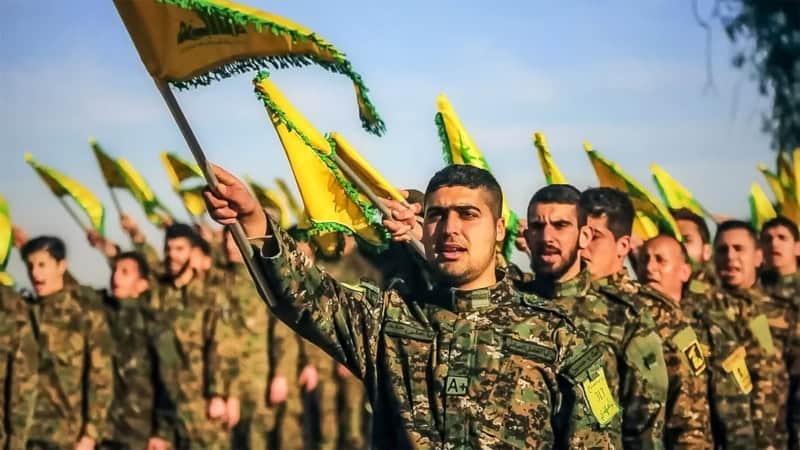
 Hezbollah members attend a funeral for a member of the group in south Lebanon in February 2025. (Shutterstock)
On January 21, at 10:47 am, an Israeli drone targeted a vehicle on the Bazouriyeh-Burj Shemali Road, east of the city of Tyre, in the South Lebanon Governorate’s Tyre District. The location of the strike was approximately 7.25 kilometers south of the Litani River, and therefore in the South Litani Area. The Lebanese Armed Forces (LAF) claimed to have established “operational control” over this area on January 8, 2026, a term understood to mean it had cleared it of Hezbollah’s arms and restrained the group’s activities. However, the Israel Defense Forces (IDF) claimed that the strike’s one fatality was a Hezbollah operative named Abu Ali Salami.
Hezbollah-affiliated social media accounts later confirmed Salami’s death, giving his full name as Hajj Ahmad Hussain Salami. Salami, whose nom de guerre was Abu Ali, was from the village of Yanouh. The IDF later clarified that he was Hezbollah’s “liaison officer” in the village of Yanouh in south Lebanon, overseeing the organization’s local activities “with the purpose of facilitating Hezbollah’s activities within the civilian sector and private property in the village, and to entrench terror infrastructure amidst the civilian population.”
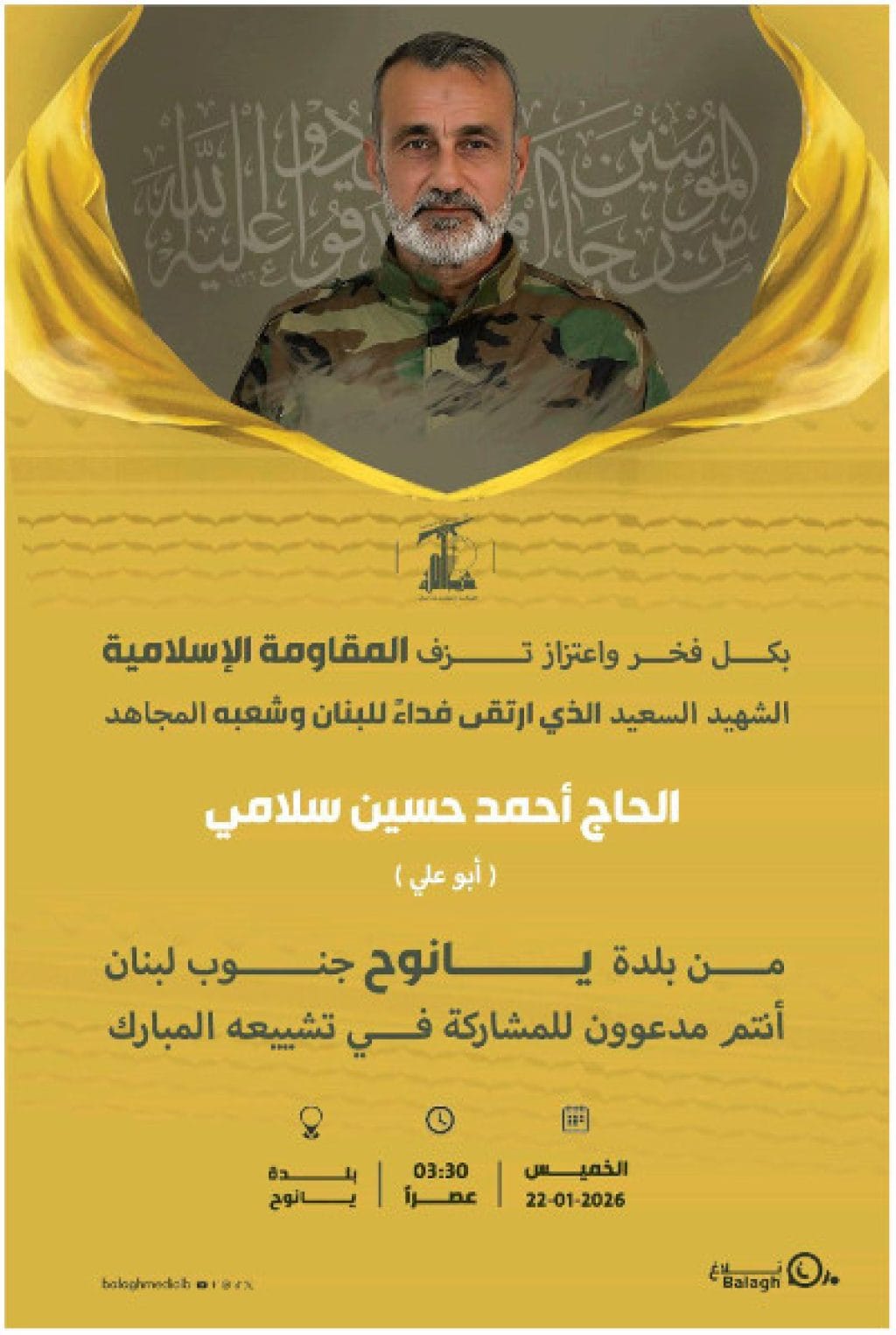 Death announcement for Ahmad Hussain Salami. (Balagh Media Telegram)
Detailing the alleged role of Hezbollah operatives who act as village liaisons, the IDF claimed that Salami and similarly-positioned operatives traded assistance from the group—including aiding locals with charitable and other donations, compensation for damaged property, and medical assistance—for favors from the locals, creating a dependence upon Hezbollah and an obligation to recompense its aid.
“Whomever receives aid knows the day will come that they will have to return the favor—sometimes just a ‘small’ request: to store boxes, provide information on what is happening in the village, or to allow [Hezbollah] to temporarily use a piece of property—effectively making the civilian a part of the terror network, and occasionally the one paying the price once their home becomes a designated target,” the IDF said.
Salami, the IDF claimed, had recently leveraged his role in such a manner in Yanouh. On December 13, 2025, the IDF said it forwarded a request to the committee overseeing the implementation of the November 27, 2024, Israel-Lebanon ceasefire to inspect a suspected Hezbollah weapons storage facility in Yanouh. Acting in accordance with its function, the committee forwarded the IDF’s complaint to the LAF. However, the LAF notified Salami in his role as the village’s Hezbollah liaison officer. He then passed this notice on to additional Hezbollah operatives under his command.
Rather than setting the stage for compliance regarding a suspected Hezbollah weapons storage facility, as the ceasefire agreement requires, Salami and his fellow Hezbollah operatives instead prevented LAF personnel, upon their arrival in Yanouh, from entering and dismantling the structure. They organized a demonstration of the village’s women outside the suspected Hezbollah installation, deterring LAF soldiers from entering it.
The IDF claimed that Salami then convinced LAF personnel to leave the installation, after which he and his subordinates removed several “suspicious crates” from the structure. “At the end of the incident, the terrorist [Salami] agreed with the Lebanese Army to document the structure as empty of weapons and thus to claim that the structure was empty,” the IDF stated, noting, “The actions of the terrorist Abu Ali Salami constitute a violation of the understandings between Israel and Lebanon.”
Hezbollah’s liaison officers
The IDF’s report claimed that with the onset of its Operation Northern Arrows in October 2024, many local Hezbollah liaison officers abandoned the villages to which they had been assigned, seeking safety by fleeing northward. However, after the November 27 ceasefire went into effect, they returned to their villages “to aid Hezbollah’s regeneration and restore its terror infrastructure amidst the civilian population, while also seeking to rehabilitate the organization’s image as a legitimate actor.” Now, the IDF claimed, these officers are playing a central role in Hezbollah’s efforts to rebuild itself in south Lebanon, particularly in the South Litani Area.
The Israeli military said that after grasping the link between these liaison officers and the villages, the IDF’s 91st “Galilee” Division has been working with Military Intelligence and the Israeli Air Force “to disrupt their activities in south Lebanon.” As a result, the IDF claims to have “killed ten of them” in recent months. However, a video accompanying the IDF’s post only listed seven deceased liaison officers beyond Salami. A separate review of IDF statements on recent targeted killings by FDD’s Long War Journal puts the total number of Hezbollah operatives put the number of Hezbollah liaison officers killed at nine.
These eliminations have included:
September 3, 2025: Israel assassinated Hezbollah operative Abdelmenem Mousa Sweidan, who acted as the group’s liaison officer in Yater in the Nabatieh Governorate’s Bint Jbeil District.
October 1, 2025: Israel assassinated Hezbollah operative Ali Mohammad Qaraawni, who acted as the group’s liaison officer in Kafra in the Nabatieh Governorate’s Bint Jbeil District.
October 7, 2025: Israel assassinated Hezbollah operative Mahmoud Ali Issa, who acted as the group’s liaison officer in Kafra in the Nabatieh Governorate’s Bint Jbeil District.
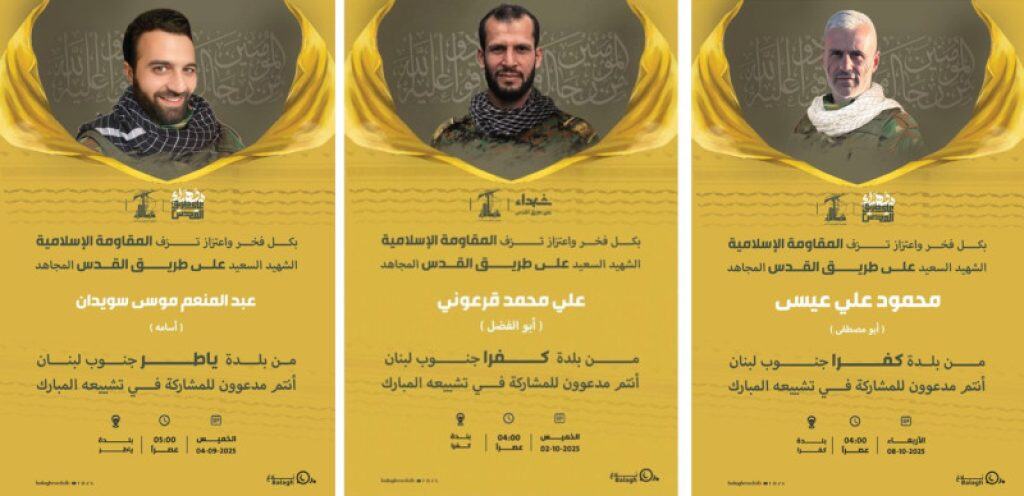 Left to right: Death announcements for Abdelmenem Mousa Sweidan, Ali Mohammad Qaraawni, and Mahmoud Ali Issa. (Balagh Media on Telegram)
October 26, 2025: Israel assassinated Hezbollah operative Abed Mahmoud al Sayyed, who acted as the group’s liaison officer in Bayyada in the South Lebanon Governorate’s Tyre District.
November 4, 2025: Israel assassinated Hezbollah operative Hassan Mahmoud Sayyed, who acted as the group’s liaison officer in Adaisseh in the Nabatieh Governorate’s Marjayoun District.
November 16, 2025: Israel assassinated Hezbollah operative Mohammad Ali Shweikh, who acted as the group’s liaison officer in Mansouri in the South Lebanon Governorate’s Tyre District.
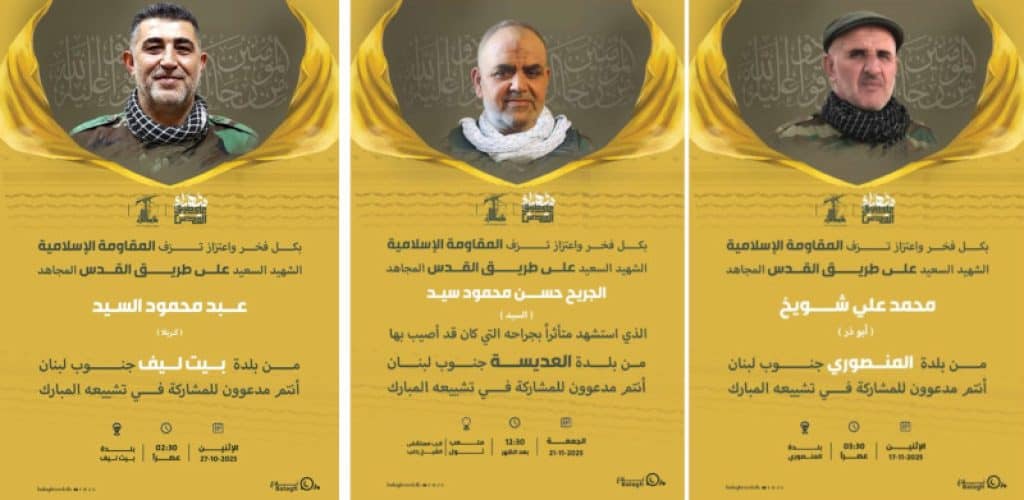 Left to right: Death announcements for Abed Mahmoud al Sayyed, Hassan Mahmoud Sayyed, and Mohammad Ali Shweikh. (Balagh Media on Telegram)
November 22, 2024: Israel assassinated Hezbollah operative Hussain Yassin Hussain, who acted as the group’s liaison officer in Houla in the Nabatieh Governorate’s Bint Jbeil District. Hussain was also a municipal worker in Houla.
December 14, 2025: Israel assassinated Hezbollah operative Ihsan Fares Zeineddine, who acted as the group’s liaison officer in and around Bint Jbeil in the Nabatieh Governorate’s Bint Jbeil District.
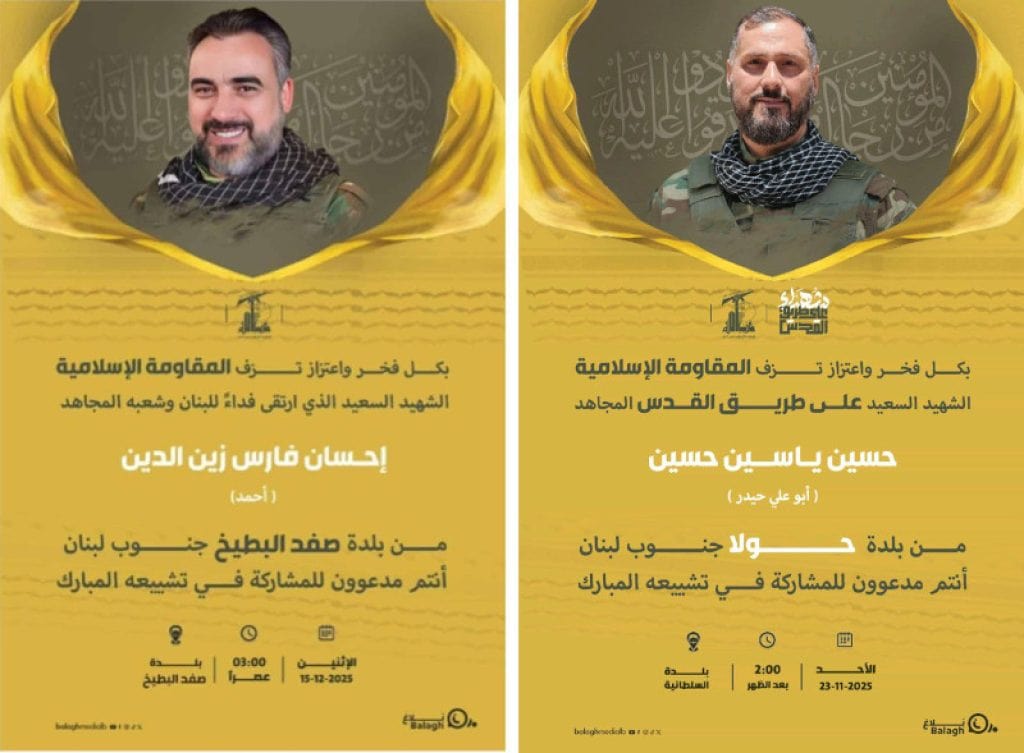 Left to right: Death announcements for Hussain Yassin Hussain and Ihsan Fares Zeineddine. (Balagh Media on Telegram)
The IDF said that in villages where these liaison officers operate, “the line blurs” between civilian and Hezbollah domains. These liaison officers, the Israeli military claimed, operate as part of a larger Hezbollah mechanism “designed to quietly control” Lebanese locales and “assimilate into the civilian environment/routine.”
The IDF’s statement noted that this effort functions “through renting houses, converting properties [for military use] and collecting intelligence—adding up to create a singular picture in which Hezbollah is seeking to reestablish itself not only through the efforts of its operatives—but with the help of anyone enabling its activities on the ground.”