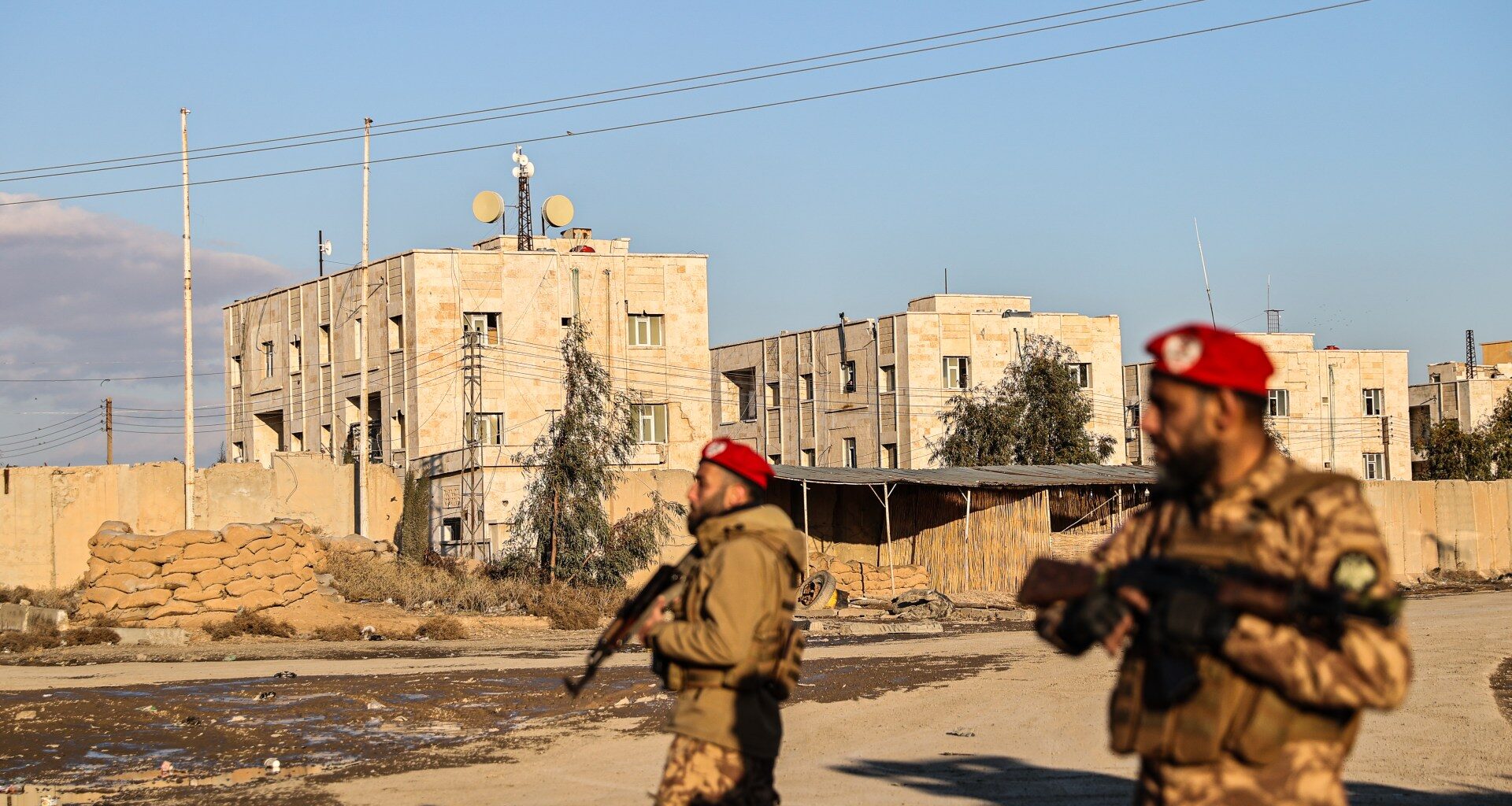
The Syrian government says it has taken over control of al-Aqtan prison, a facility in the northeastern city of Raqqa housing a number of ISIL (ISIS) detainees, following the withdrawal of Kurdish-led SDF fighters under a ceasefire agreement.
The Ministry of Interior said in a statement on Telegram on Friday that officials from the Prisons and Correctional Facilities Administration had assumed control of the prison in the former SDF stronghold of Raqqa, and had begun an examination of prisoners’ conditions and their records, the state-run SANA news agency reported.
Recommended Stories list of 4 itemsend of list
The takeover of the prison and cessation of hostilities in Raqqa occurred in line with a four-day ceasefire agreement between the Syrian government and the SDF, which came into effect on Tuesday night. The ceasefire followed last week’s lightning advance by Syrian forces in which they retook large swaths of territory long held by the SDF.
Convoys of buses and cars carrying more than 1,000 SDF personnel were seen moving out of Raqqa, as Syrian forces granted them safe passage to travel westwards to Kobane, a Kurdish-majority city on the border with Turkiye.
The Syrian army’s operations authority said units had also begun transferring SDF elements from the al-Aqtan prison and its surroundings in Raqqa governorate to the city of Ain al-Arab, east of Aleppo, in line with the ceasefire agreement, SANA reported.
Security vacuum filled
Reporting from Raqqa, Al Jazeera’s Zein Basravi said Syrian forces had filled the power vacuum left by the retreating SDF forces “very quickly”, and teams had begun demining and dismantling munitions left inside the prison, removing SDF weaponry on large trucks.
“The Syrian army is now squarely in control of the prison,” he said, describing the “relative smoothness” of the handover as a “positive development”.
He described the developments in Raqqa as a “rare occasion where the SDF and the Syrian military … have acknowledged that they have cooperated and they have done so successfully”.
“It’s the first time that I can remember covering this story for the last couple of weeks that they’ve both acknowledged that they’ve worked together to secure safe passage for SDF fighters,” he said.
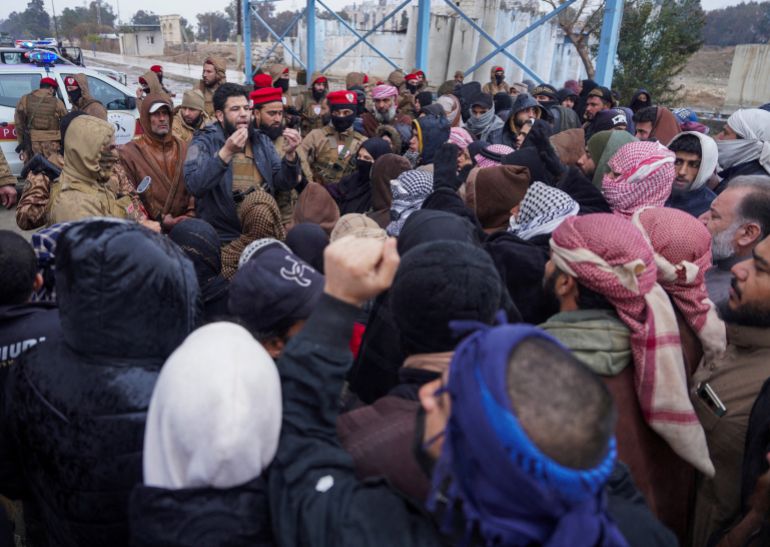 A member of the Syrian military police speaks to relatives of detainees gathered near al-Aqtan prison, where a number of ISIL (ISIS) detainees are held, in Raqqa, Syria, January 22, 2026 [Karam al-Masri/Reuters]Calm restored following chaotic standoff
The situation at the prison, which has been the site of clashes in recent days, was now “calm”, Basravi said, noting “it wasn’t like this here 24 hours ago”.
An Al Jazeera team reporting from outside the prison on Thursday witnessed chaotic scenes as large crowds of civilians pushed against the barricades controlled by Syrian soldiers, with SDF fighters remaining inside.
One soldier told Al Jazeera the Syrian government forces were waiting to see if they would need to retake the prison by force.
Basravi said the civilians were trying to get through the barricades into the prison to find out the condition of their relatives who were detained inside, some of whom they had not heard from in days amid the instability.
Some claimed their relatives had been detained unjustly by the SDF.
“My son was going to visit his relatives in Hasakah,” said one man, Mohammad Ali. “The SDF detained him at a checkpoint just because he had a photo of Syrian President Ahmed al-Sharaa.”
Amid the chaotic scenes outside the prison on Wednesday, gunfire was heard in the distance, Al Jazeera teams on the ground reported.
Meanwhile, US planes dispatched by CENTCOM were heard overhead as they began flying ISIL detainees out of northeast Syria to Iraq, as part of a push to secure thousands of suspected fighters amid concerns over instability in Kurdish-run prisons.
Securely behind bars
Basravi said that with its takeover of the prison, the Syrian government now found itself answerable to two groups with demands over the detainees, requiring it to strike a delicate balance.
It had obligations to the international community – specifically the anti-ISIL coalition, which it joined in November last year – to ensure that ISIL detainees remained securely behind bars.
But it also faced pleas from locals who claimed their loved ones had been unjustly detained by SDF forces who previously controlled the prison.
He said a visit by senior officials to the prison on Friday, and the Interior Ministry’s statement that it was examining the files held on those inside, was a “positive development” in assuaging the concerns of the latter group.
But while families remained in the dark over the condition of their detained relatives, a repeat of Thursday’s scenes was possible.
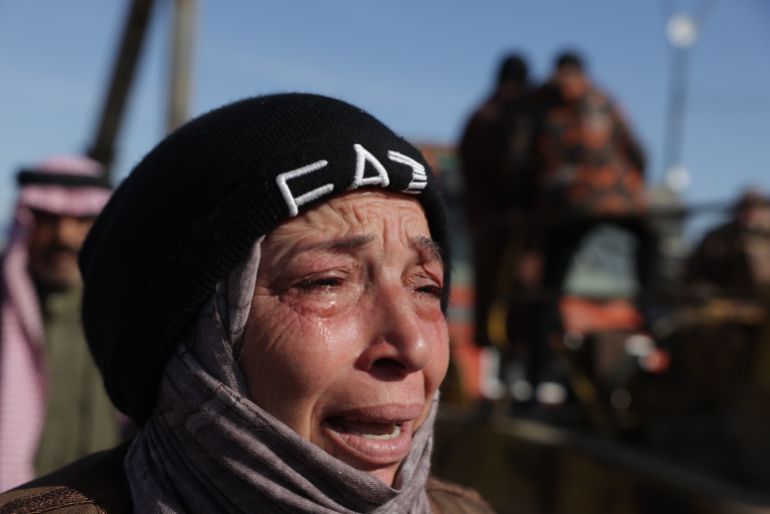 A woman cries as Syrian families wait for their loved ones around al-Aqtan prison, near Raqqa, Syria, on January 21, 2026 [Bakr Al Kasem/Anadolu]Wider implications
The handover comes as the SDF faces a Saturday night deadline to come up with a plan to integrate with Syria’s army.
The deadline is aimed at pushing through a sweeping deal agreed on January 18 that would see the semi-autonomous institutions run by Kurdish forces in the northeast over the last decade join the central state, something the SDF had resisted over the last year.
Turkiye’s Foreign Minister Hakan Fidan said in a televised interview that the truce should be extended while prisoners are transferred to Iraq, saying this would limit security risks and avoid the prospect of further destabilisation in northern and eastern Syria.
Speaking to Al Jazeera from Beirut, analyst Armenak Tokmajyan said he believed the SDF was being genuine in its negotiations with the Syrian government, as they were now “cornered in a few pockets in northeast Syria”.
“However, there is still a risk of the ceasefire collapsing and going back to fighting, said Tokmajyan, a nonresident scholar at the Malcolm H Kerr Carnegie Middle East Center. “There are a lot of details that need to be ironed out, specifically relating to Kurdish-majority areas – whether [around] governance, weapons, integration of Kurdish fighters.”
He said developments in the northeast were being closely watched, particularly by the Druze in the south and Syria’s other minorities, as they held broad implications for whether Syria would be a unified, centralised state or one granting autonomy to minority groups.
The Syrian army’s rapid advance in the northeast had been “a major step forward for President al-Sharaa and those international backers who want a centralised and a unified Syria”, he said, adding that the battle was “not really over”.
“It will depend on how the integration of the Kurdish minority in Syria will look like,” he said. “Everyone is watching if Ahmed al-Sharaa will successfully and peacefully be able to offer a model for reintegrating the SDF into Syria.”
Syria now controls two prisons and one camp.
Al-Aqtan is the second prison to come under government control after being abandoned by the SDF.
On Monday, Syrian troops entered Shaddadi prison in Hasakah province. Some 120 ISIL detainees managed to flee amid the chaos, most of whom have been recaptured, according to state media.
On Wednesday, Syrian troops entered al-Hol camp, which is also located in Hasakah province, home to some 24,000 people, mostly women and children linked to ISIL.
The United Nations refugee agency said Friday that it had managed to enter al-Hol, adding that “the delivery of essential supplies has resumed, including trucks carrying bread”.
This week, the US military transferred 150 senior ISIL detainees from Kurdish custody in Syria to neighbouring Iraq.
They were among an estimated 7,000 members of the group due to be moved over the eastern border.
An Iraqi security official told news agency AFP that the 150 detainees were “all leaders of the Islamic State group, and some of the most notorious criminals”, and included “Europeans, Asians, Arabs and Iraqis”.
Iraqi Prime Minister Mohammed Shia al-Sudani told French President Emmanuel Macron on Friday that European countries should repatriate ISIL detainees, “assuming their responsibilities by receiving those individuals who hold their nationalities”.