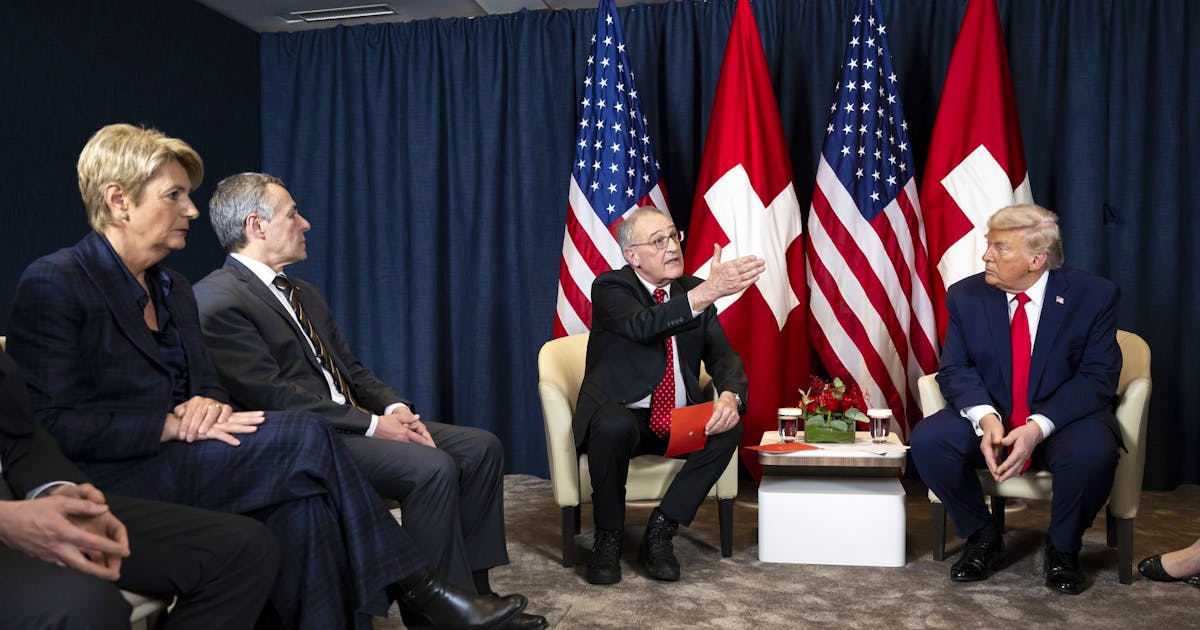
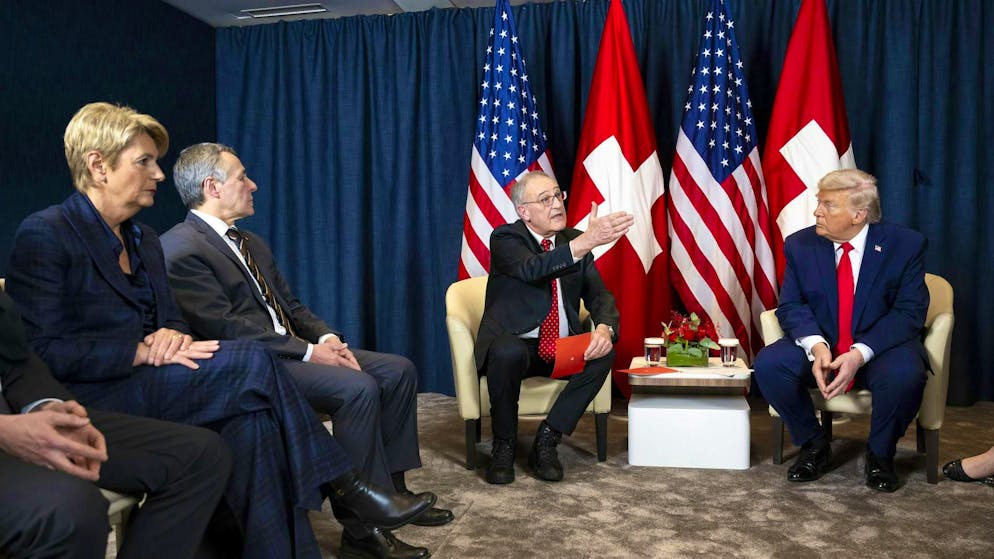
President Guy Parmelin speaks with US President Donald Trump.
Keystone/Laurent Gillieron
There was so much to talk about – and of course the World Economic Forum in Davos was also about artificial intelligence and climate change. But between Greenland, Gaza and the US President’s speech, economic issues were almost relegated to the sidelines.
No time? blue News summarizes for you
The economy usually takes center stage at the WEF.At this year’s meeting, however, US President Donald Trump brought geopolitics to the fore.The appearance of the Canadian Prime Minister, who gave a remarkable speech about breaking the Western alliance, also caused a stir.Artificial intelligence and climate change played at most a marginal role in Davos.
The World Economic Forum in Davos is traditionally a place of exchange between elites. Heads of state and government, corporate leaders and other influential personalities meet in Davos to discuss markets and power, risks and opportunities.
This year, too, there would have been many topics that are likely to have a significant impact on the global economy in the coming years. But in the end, one thing in particular will be remembered: US President Donald Trump’s overarching appearance.
Of course, it was also about artificial intelligence. In presentations and discussion panels, experts from all over the world underlined their ambitions to use the potential of the technology to increase productivity and efficiency and make companies more profitable. China’s massive investments in renewable energy were also discussed.
Trump steals the show on AI and climate change
However, topics such as climate change and the upheavals caused by AI did not receive the same media attention as in previous years – because one man left his mark on the summit, which ended on Friday: when it came to politics, Trump stole the show.
Jane Harman, a former US Democratic congresswoman, had the impression at the end that she had actually attended two conferences. “One was for very senior industry leaders. (…) The second was about foreign policy, or geopolitics, and that was dominated by one person.”
During the US President’s third visit to Davos, around 24 hours passed between Trump’s arrival and departure. In a rambling speech characterized by the usual exaggerations, he underlined the global role of the USA.
Criticism instead of adulation
In contrast to his previous visits to Davos, where he was adulated by company bosses, Trump was met with some merciless criticism this time – not least from the governor of the US state of California, Gavin Newsom. The Democrat is being touted as a possible challenger to Trump in the 2028 presidential election.
He was unable to muster any sympathy for what he sees as the Europeans’ submissive attitude towards Trump. It was “pathetic”, said Newsom and regretted not having packed knee pads for the heads of state who gathered in Davos.
Others, on the other hand, gave the Republican the praise he so appreciates and which he himself often freely expresses on his own behalf.
NATO Secretary General Mark Rutte and Ukrainian President Volodymyr Selensky praised his efforts to end the Russian war of aggression against Ukraine, to strengthen the West’s defense and to provide Kiev with security guarantees in the event of a peace agreement.
A breach that can never be repaired
However, statements such as these could not prevent one interpretation from prevailing in Davos as to how the current situation in the world should be assessed: the USA under Trump has distanced itself far from its Western allies. Canadian Prime Minister Mark Carney spoke of a rupture that could never be repaired.
In the run-up to his visit to Switzerland, Trump had already sown fresh discord with tariff threats against eight European countries that opposed his goal of a US takeover of Greenland, a semi-autonomous territory of NATO partner Denmark.
In a dramatic U-turn, Trump then rowed back from the plan on Wednesday, which caused uproar at home and abroad and sent the stock markets into turmoil. Shortly beforehand, he had emphasized that nothing less than a takeover of the Arctic island was under consideration, “including rights, title and ownership”.
In a post on his Platform X, the Republican wrote that he had agreed with Rutte on a framework for a future agreement on security in the Arctic. He ruled out taking Greenland by force.
Europeans view Trump’s peace council with skepticism
The 79-year-old made another exclamation mark with the founding act of his so-called Peace Council. The international body is tasked with ensuring that the ceasefire between Israel and the militant Islamist Hamas in the Gaza Strip, which came into force in October, lasts and is gradually transformed into a post-war order.
States as diverse as Belarus, Kosovo, Indonesia and Argentina accepted her invitation to participate. However, the project did not spark enthusiasm among the USA’s long-standing allies in Europe, but rather considerable skepticism that the body could one day replace the United Nations in its role as a mediator in international conflicts, as Trump has suggested.
Critics also criticized the lack of clarity about exactly how the committee, which Trump himself is to chair, will work. Or that the US President emphasized his statement that he wanted everyone who had power to attend by inviting authoritarian rulers such as Kremlin boss Vladimir Putin.
Elon Musk attends “boring” summit
In addition to the overarching geopolitics, artificial intelligence was a hot topic – albeit less in focus than would have been expected in other circumstances.
For the first time, tech billionaire Elon Musk and Nvidia CEO Jensen Huang paid their respects in Davos. Musk had described the World Economic Forum as “boring” in the past. He arrived at short notice to talk about robotics and the energy requirements of AI data centers as well as to get rid of moderate criticism of US tariffs on Chinese solar modules.
Huang rejected fears that the AI boom could destroy jobs. Rather, he said, building the necessary infrastructure would create jobs for “plumbers, electricians, construction workers, steel workers and network technicians”.
Nvidia chips for China like nuclear weapons for North Korea?
The rivalry between China and the USA in the AI sector was brought up by Anthropic CEO Dario Amodei. He compared the sale of advanced Nvidia chips to the People’s Republic with the sale of nuclear weapons to North Korea.
Where it was about economics and not geopolitics, however, optimism seemed to be the prevailing mood among tech bosses, AI pioneers and corporate leaders.
“I want to end this forum with the quote from Elon Musk that he said yesterday at the end of the session – that it’s better to be an optimist and be wrong than to be a pessimist who is right,” said Larry Fink, co-chair of the World Economic Forum and head of US financial giant Blackrock.
With material from the AP news agency.