Greenland and Denmark have formed a united front, setting aside their ‘dark chapter’ to respond to US President Donald Trump and his repeated threats to acquire the mineral-rich Danish territory. The Arctic island, a Danish colony for three centuries, still has a complex relationship with Denmark.
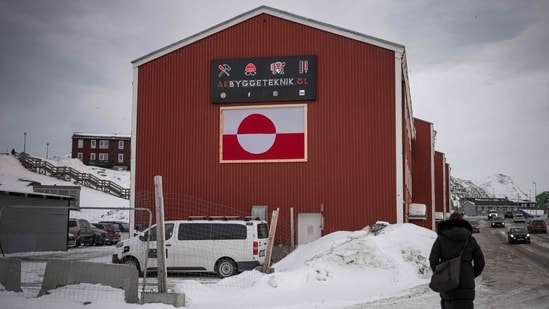
A woman walks in front of a building displaying the Greenlandic flag in Nuuk, Greenland. (AFP)
The island’s main political parties all support independence, but they disagree on how to achieve it. Trump’s interest in the region led them to form a coalition government in March last year.
Greenland’s leaders also said last week they were not interested in Trump’s attempt to take control of the vast island, an idea he strongly pushed before stepping back on Wednesday after reaching what he called a “framework” deal on Arctic security with NATO’s secretary-general.
At the peak of the crisis, Greenland’s Prime Minister Jens-Frederik Nielsen said that if the government had to choose between the United States and Denmark, it would choose Denmark.
So, what’s the “troubled history” between Denmark and Greenland?
On January 14, Greenland’s foreign minister, Vivian Motzfeldt, was in Washington alongside her Danish counterpart, Lars Lokke Rasmussen, for meetings with US vice president JD Vance and secretary of state Marco Rubio.
By Monday, she had travelled to Brussels for talks with Rutte, this time joined by Denmark’s defence minister, Troels Lund Poulsen.
However, this show of unity hides the lasting marks of their shared colonial history.
Greenland was under Danish colonial rule from the early 18th century. In 1953, it became a Danish territory and a full part of Denmark, before gaining self-rule in 1979. This autonomy was expanded further in 2009.
Astrid Andersen, an expert on Danish-Greenlandic relations at the Danish Institute for International Studies, told news agency AFP, “It’s a long history. It has gone through different stages.”
“Any colonial relation is a question of domination, and there have been some injustices committed.”
These “injustices” include a 1951 social project in which 22 Inuit children were taken away from their families and prevented from using the Greenlandic language, as part of an attempt to build a Danish-speaking group of future leaders.
In 2021, the six who were still alive each received compensation of 250,000 crowns (33,500 euros).
Another troubling period began in the 1960s and lasted about three decades, during which Denmark worked to lower birth rates in Greenland. Thousands of women and teenage girls, at least 4,000, were given IUDs without their approval to prevent them from becoming pregnant.
Prime Minister Mette Frederiksen has issued apologies to the affected women, nearly half of whom could not go on to have children, and a process for compensation is now in place.
Denmark’s social services also relied on controversial psychological tests to, in their view, decide whether Greenlandic mothers were suitable to raise their children.
A 2022 study found that in mainland Denmark, children born to Greenlandic families were five to seven times more likely to be placed in children’s homes than those born to Danish families.
The use of these tests was stopped only last year.
With inputs from AFP