Source: Barron’s Chinese
Author: Adam Tooze
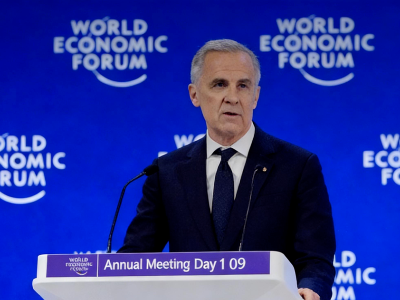
Canadian Prime Minister Mark Carney’s speech in Davos has been hailed by many observers as one of the most significant political speeches on international relations in decades. In this article, Tooze juxtaposes Carney’s latest remarks with his pivotal 2019 speech as Governor of the Bank of England, outlining a clear trajectory of intellectual evolution.
Let me be blunt. We are in the midst of a rupture, not a transition.
 Although the statement is highly conceptual and deliberately avoids mentioning Trump, Mark Carney’s speech in Davos on Tuesday represents the weightiest response from a head of government to date regarding the impact of President Trump’s actions on Western international relations during his presidency.
This stood in stark contrast to previous speakers.
Larry Fink and others among the leadership of the World Economic Forum deliberately avoided addressing the most divisive issues in transatlantic relations.
European Commission President Ursula von der Leyen presented a clear yet moderate European stance, merely stating that Trump’s threat to impose tariffs over Greenland was a “mistake.”
Macron, at the very least, appeared more casual. He mentioned the absurdity of being forced to threaten the United States with counter-coercion and described the current situation as “madness.” At one point, some of us seemed to hear the president mutter whether this crisis might be related to the size of someone’s “manhood.” If it weren’t for my neighbor turning to me in surprise, I would have doubted my memory. Admittedly, it could also have been an illusion caused by the reflection on his aviator sunglasses.
Carney’s speech was entirely different. He demonstrated both seriousness and a high degree of moral stature.
“We are reminded almost daily that we are living in an era of great power competition, where the rules-based international order is receding, the strong do as they will, and the weak suffer what they must. This dictum from Thucydides is seen as inevitable, and the natural logic of international relations is returning. Faced with such logic, nations tend to drift along, compromise, avoid conflict, and hope to secure safety through submission. But that cannot be.”
In a highly dramatic passage, he cited Czech dissident Václav Havel’s 1978 essay ‘The Power of the Powerless,’ emphasizing the necessity of rejecting the path of least resistance, even if it means repeating lies. Subsequently, Carney described the uncomfortable state of ‘expedient coexistence’ witnessed in recent years.
For decades, countries like Canada have prospered under the so-called ‘rules-based international order.’ We joined the institutions it created, praised its principles, and benefited from its predictability. Thus, we were able to pursue value-driven foreign policies under its protection. We understood that parts of this narrative were false: the strongest could exempt themselves when needed, trade rule enforcement was asymmetrical, and the application of international law varied depending on who was the defendant or victim. Nevertheless, this fiction was useful, especially when American hegemony provided public goods, open sea lanes, a stable financial system, collective security, and support for conflict resolution frameworks. So, we hung signs in our shop windows, participated in rituals, and largely avoided pointing out the gap between rhetoric and reality. But this bargain no longer works.
Over the past two decades, a series of crises in finance, public health, energy, and geopolitics have exposed the risks of extreme global integration. More recently, major powers have begun weaponizing economic integration, leveraging tariffs, using financial infrastructure to exert pressure, and exploiting supply chains as vulnerabilities. When integration becomes the source of your subjugation, you can no longer live within the lie of ‘mutual benefit.’ The multilateral institutions relied upon by middle powers—such as the WTO, the UN, and climate summits (COP)—and the overall architecture for collective problem-solving are under threat. As a result, many countries have reached the same conclusion: strategic autonomy must be enhanced in areas such as energy, food, critical minerals, finance, and supply chains.
Hegemonic states cannot sustain monetizing relationships indefinitely.
Allies will hedge against uncertainty through diversification strategies.
They will purchase ‘insurance’ and increase options to rebuild sovereignty—a sovereignty once rooted in rules but increasingly anchored in the capacity to withstand pressure.
Carney went on to advocate for ‘collective resilience investments,’ arguing that they are ‘cheaper than building fortresses individually. Common standards can reduce fragmentation, and complementarity yields positive-sum outcomes. For middle powers like Canada, the question is not whether to adapt to the new reality—we must adapt. The question is whether to merely build higher walls or take more ambitious actions.’
What Carney advocates resonates with what Finnish President Alexander Stubb refers to as ‘value-oriented realism.’
This value-oriented realism includes the following key points excerpted from his speech:
Principled yet pragmatic: adhering to principles regarding fundamental values, sovereignty, territorial integrity, prohibition of the use of force except as permitted under the UN Charter, and respect for human rights; while pragmatically recognizing that progress is often incremental, interests may diverge, and not all partners share all of our values.
Engage with the world broadly and strategically, with openness and clarity: proactively confront the real world rather than waiting for an idealized version of it to arrive.
Calibrate the depth of relationships to reflect our values, and prioritize broad engagement to maximize influence amidst today’s fluid environment, heightened risks, and pivotal shifts for the future.
No longer rely solely on the power of values but also emphasize the value of strength.
Build strength domestically.
Diversify rapidly on the international stage. We have established a comprehensive strategic partnership with the EU and joined its defense procurement mechanism (SAFE); signed 12 trade and security agreements across four continents within six months; recently forged new strategic partnerships with China and Qatar; and are negotiating free trade agreements with India, ASEAN, Thailand, the Philippines, and Mercosur.
To address global issues, adopt a ‘variable geometry’ strategy, forming different coalitions around various topics based on shared values and interests.
This is neither naive multilateralism nor reliance on outdated institutions, but rather building operational coalitions tailored to specific issues, working alongside partners with sufficient common ground.
If we engage only in bilateral negotiations with hegemonic powers, we will be in a weak position, forced to accept the terms dictated by those powers while competing with one another to appear the most compliant. This is not true sovereignty but a performance of sovereignty while accepting subordination. In a world of great power competition, countries caught in the middle can choose to vie for favor or unite to forge a third path of significant influence.
Do not let the rise of hard power blind us: the power of legitimacy, integrity, and rules will remain potent as long as we choose to wield them collectively.
Face reality: stop invoking the ‘rules-based international order’ as if it still functions as claimed. Call it what it is—a system of intensified great power competition where the strongest pursue their interests using economic integration as a coercive tool.
Act consistently, applying the same standards to allies and adversaries alike. When middle powers condemn economic coercion from one direction but remain silent about it from another, we leave that sign hanging in the shop window.
To build the order we proclaim to believe in, rather than waiting for the old order to revive; to create institutions and protocols that truly function as described.
International diversification is not only economic prudence but also the material foundation of a substantive foreign policy, as countries can only earn the right to uphold principled positions by reducing their vulnerability to retaliation.
After reading through this list, I found myself largely in agreement. The term I ultimately adopted in my book, *The Deluge: The Great War, America and the Remaking of the Global Order, 1916–1931*, is ‘progressive realism.’
What interests me more, however, is that we have already heard many elements of his vision from Carney himself on multiple occasions. It particularly reminds me of his final speech as Governor of the Bank of England, delivered in August 2019 at Jackson Hole, titled *The Growing Challenges for Monetary Policy in the Current International Monetary and Financial System*.
As in 2016, August 2019 remained overshadowed by the long shadow of the ‘Trump 1.0’ era. However, speaking at Jackson Hole in his capacity as Governor of the Bank of England, Carney had greater latitude to systematically elaborate on the structural tensions that were evidently accumulating within the international order.
Interestingly, in 2019, Carney similarly proposed a set of priorities and timelines for action.
“In the short term, central banks must do the best they can with the tools they already have.”
“This means making full use of the flexibility afforded by flexible inflation-targeting regimes. To maintain the critical credibility of the policy framework, transparency is key, with central banks explaining their rationale for choosing specific trade-offs between price stability and output volatility.”
“More broadly, central banks around the world need to develop a better shared understanding of the scale of global risks and their implications for monetary policy. We cannot all rely on exports to overcome these challenges. In a global liquidity trap, coordinated actions can yield benefits, and other policies—especially fiscal policy—play a clear role. Acting earlier and more decisively will enhance policy effectiveness.”
These points can be seen as concrete examples of what Carney referred to in his 2026 Davos speech as ‘going it alone may be feasible, but it comes at a high cost.’ The cost is high because it overlooks spillover effects.
“In the medium term, policymakers need to reshuffle. In other words, we need to improve the structure of the current International Monetary and Financial System (IMFS). This requires ensuring that the core institutions of market-based financial systems, particularly open-end funds, are resilient throughout the global financial cycle. It also calls for strengthening the monitoring of cross-border spillover effects to guide macro-prudential policies, including capital flow management measures when necessary. This also highlights the importance of rebuilding an appropriate global financial safety net.”
He then proposed a more fundamental structural analysis:
“Risks are accumulating, and they are structural.”
According to Carney’s assessment in 2019, these risks stem from a fundamental asymmetry in the global economy. Earlier that year, he illustrated this with the following slide during a speech:
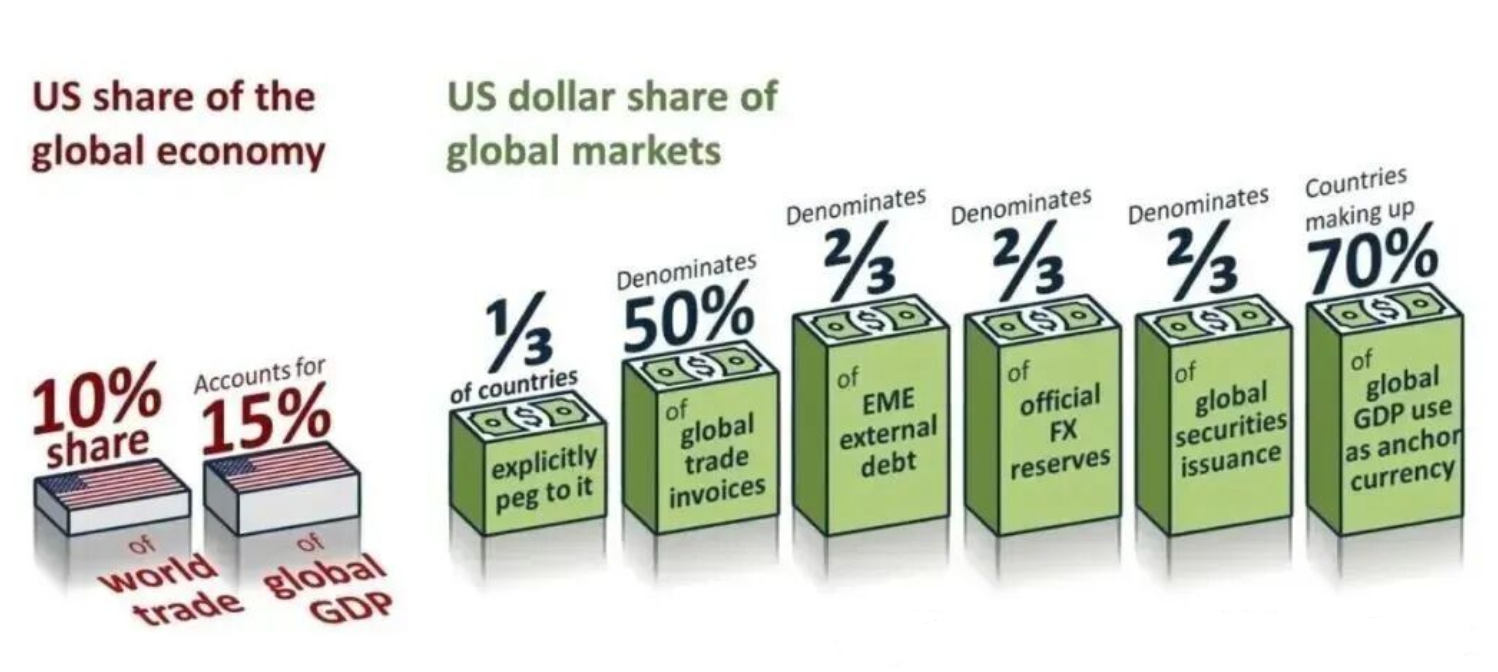
As the global economy becomes increasingly multipolar, the global financial system remains stubbornly centered around the US dollar.
“In the longer term, we need to change the rules of the game. We cannot entertain the illusion that the International Monetary and Financial System (IMFS) can be reformed overnight, nor can we expect market forces to quickly facilitate the transition of reserve assets. But equally, complacent acceptance of the status quo is misleading.”
Thus, as early as 2019, under the shadow of ‘Trump 1.0’ but more importantly driven by structural changes in the global economy, Carney had already concluded that winds of change were blowing, and it was time to prepare for a world no longer dominated by American hegemony. The wise policy approach lies in anticipating this rupture and shaping a new order. The new model he envisioned in 2019 foreshadowed the ‘variable geometry’ multilateral cooperation model he advocated yesterday at Davos. In 2019, he said:
“When change comes, it should not merely replace one monetary hegemony with another. Any unipolar system is unsuitable for a multipolar world. We must seriously consider all possibilities, including opportunities presented by new technologies, to build a more balanced and effective system.”
As Carney pointed out, there has only been one global monetary regime shift in modern economic history: the interwar period, which ended in disaster. During the 1920s, the gold exchange standard anchored primarily by the US dollar and the British pound proved catastrophic. From this, Carney concluded:
“In terms of the supply of reserve currencies, coordination challenges are more likely to arise when there are fewer issuers than in monopolistic or multi-issuer scenarios. While the rise of the renminbi may provide a second-best solution to the current issues of the International Monetary and Financial System (IMFS) in the long run, the optimal solution remains the establishment of a multipolar system.”
The primary advantage of a multipolar International Monetary and Financial System (IMFS) lies in diversification. Multiple reserve currencies would increase the supply of safe assets, alleviating the downward pressure on global equilibrium interest rates caused by an asymmetric system. As multiple countries compete to issue global safe assets, the safety premium obtained should decrease.
A more diversified International Monetary and Financial System (IMFS) would also reduce spillover effects from core countries, thereby lowering the synchronization of trade and financial cycles. This would reduce systemic vulnerabilities, enhance the sustainability of capital flows, and push up equilibrium interest rates. Although a multipolar IMFS currently seems distant, technological advancements provide the possibility for such a world to emerge. This platform will be based on virtual rather than physical forms.
The continuity between the model constructed by Carney in 2019 and his statements this week in Davos is evident.
However, reflecting on his more measured thoughts in 2019 further highlights the power embedded in his resounding statement on Tuesday:
“We are in the midst of a rupture, not a transition.”
Editor/Jayden